01
qingjian-team/qingjian
+79% /wk +814 ★/day↗accelerating
A Rust-based Chinese IME that treats your daily typing as a language lesson, because opening a study app is a chore.
A Rust-based Chinese IME that treats your daily typing as a language lesson, because opening a study app is a chore.
Project Maya runs GLM-5.3-Flash privately on one to sixteen GPUs by keeping hot experts in VRAM, warm ones in RAM, and the rest on NVMe.
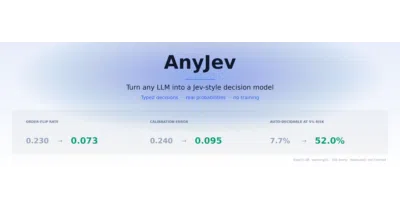
AnyJev turns any open LLM into a calibrated decision engine—typed choices with probabilities you can threshold—without touching a single model weight.
It turns 150+ scattered LLM guides into a single engineering curriculum—from API basics to production Agents and ByteDance interviews—because hoarding bookmarks is not a learning strategy.
It replaces autoregressive LLM classification with a single parallel forward pass, cutting latency from seconds to sub-20 ms while staying local.
ISC-Bench demonstrates that LLM agents produce harmful content not because of jailbroken prompts, but because completing the task requires it.
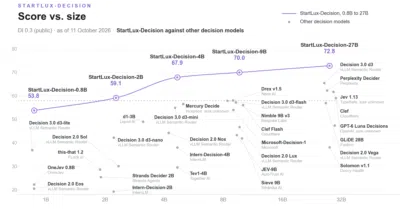
StartLux-Decision treats decisions as classification, not chat: one forward pass, a calibrated probability per option, and reasoning only when confidence dips below a gate.
TensorFold serves a short list of open model families on Apple Silicon and NVIDIA GPUs behind an OpenAI-compatible API, and accepts a drafted token only when it equals what the same engine would emit serially.
A Chinese-language LLM curriculum that rebuilds Stanford CS336 into six hands-on assignments, from writing a tokenizer to distributed training and GRPO.
It rewrites every kernel for AMD Strix Halo and a single 179B-parameter MoE family to beat general-purpose engines without spending fewer bits.
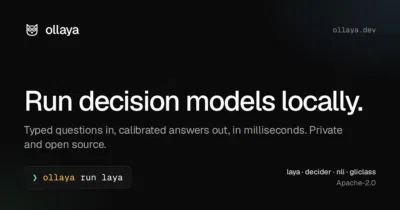
Laya runs in Node.js via ONNX Runtime, turning tickets and emails into calibrated choices, rubric scores, and P(true) values in a single forward pass.
A curated, source-backed catalog of 155 projects built on Jev, a model that answers typed questions with probabilities instead of generating text.
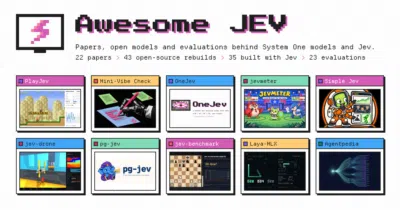
A curated awesome-list tracking 167 papers, models, benchmarks, and independent evaluations around TypeSafe's System One decision models.
TypeLLM forces existing autoregressive LLMs to emit JSON Schema-valid outputs—enums, booleans, bounded numbers, and strings—without retraining or architectural changes.
A community-maintained awesome list mapping the young 'decision model' ecosystem — models that return a probability for each answer you declare up front instead of generating text.
A from-scratch reimplementation of GPT-2 through Llama 4 and DeepSeek v3, built to teach you what the architecture papers actually mean.
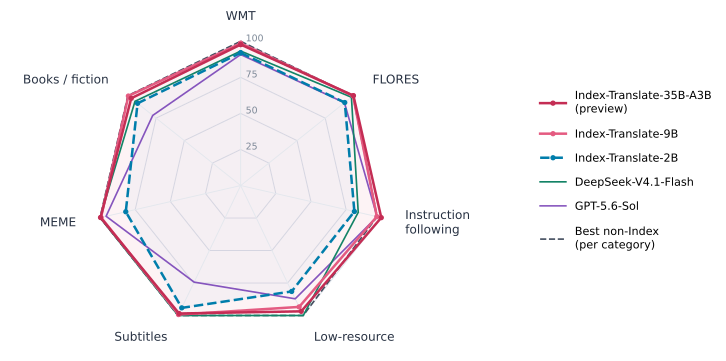
Index-Translate covers 150 languages, plus speech, dubbing, and whole-document translation — with a model that hits a target syllable count.
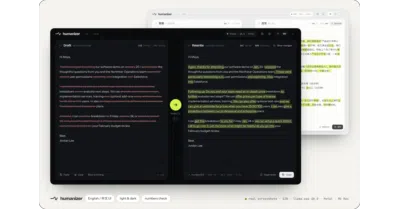
humanizer rewrites AI-written text so it reads human — while keeping every number, date and name intact, and never sending a byte to the cloud.
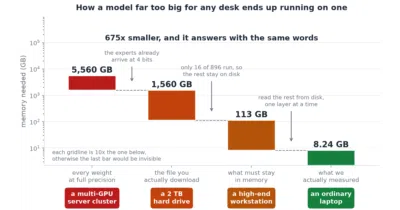
To prove that a 2.78-trillion-parameter model can run on a single CPU with 8 GB of RAM and no GPU.
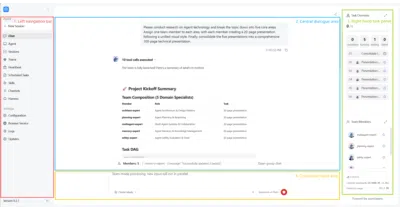
It breaks complex tasks across a team of specialized LLM agents that refine their own skills as they work.
heatdrop uses Google Analytics to see which pages get read — nothing else. Your call. How we handle data.