NVIDIA-NeMo/Automodel
Day-zero HuggingFace support for PyTorch distributed LLM training
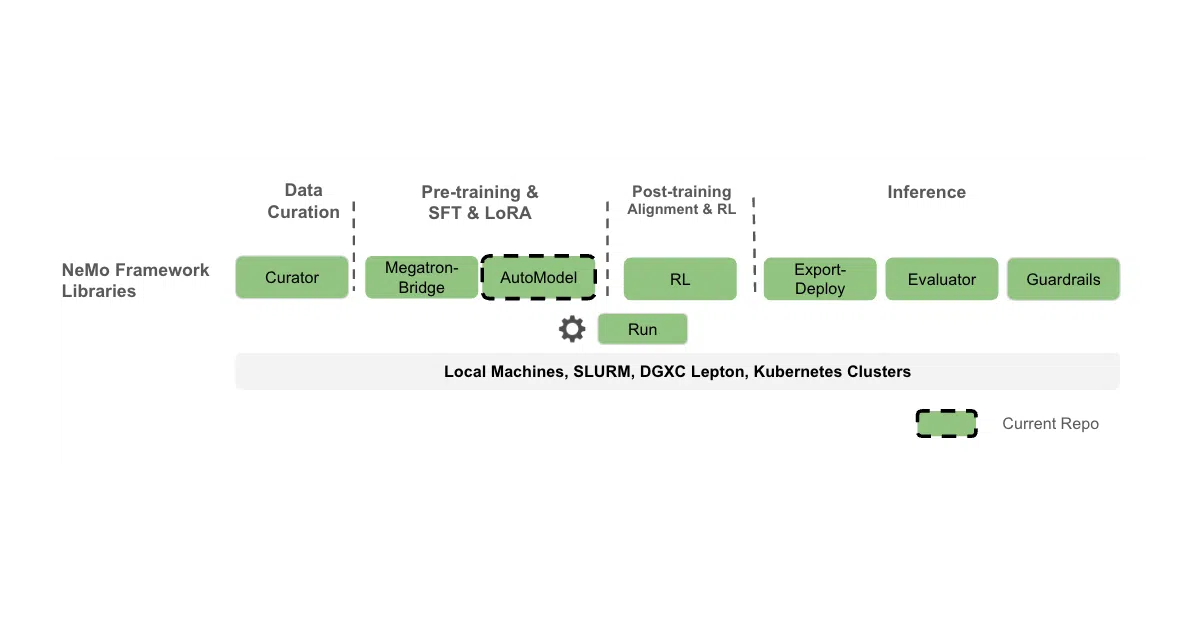
NeMo AutoModel automates the busywork of wiring HuggingFace LLMs and VLMs into PyTorch-native distributed training so you can fine-tune or pretrain without hand-rolling parallelism code.
Not currently ranked — collecting fresh signals.
star history
What it does
AutoModel is a PyTorch DTensor-native SPMD library that wraps HuggingFace transformers for large-scale training. It provides out-of-the-box recipes for fine-tuning and pretraining a long and growing list of recent LLMs and VLMs—including DeepSeek V4, Qwen3.6, Gemma 4, and Mistral Medium 3.5—using PyTorch-native parallelism and custom kernels. The project also ships with agent-friendly skills in skills/ to help automate common development tasks across the repository.
The interesting bit Instead of forcing you to rewrite model code for distributed strategies, the library promises Day-0 HuggingFace integration: you point it at a model ID and it handles the distributed training plumbing. That makes it less a monolithic framework and more a compatibility layer between the HuggingFace ecosystem and PyTorch’s distributed primitives.
Key highlights
- Supports a broad, frequently updated catalog of models (DeepSeek V4 Flash, Qwen3.6 MoE, GLM-5.1, Nemotron-3-Nano-Omni, MiniMax-M2.7, and many others).
- Built on PyTorch DTensor and SPMD execution rather than a custom runtime.
- Provides ready-to-use YAML recipes for LLM and VLM fine-tuning tasks.
- Includes agent-oriented skills in
skills/for automating recipe runs and model onboarding. - Targets both dense and MoE architectures, including vision-language and omnimodal variants.
Caveats
- The README is heavy on news and model announcements but light on architectural specifics; it is unclear exactly which parallelism strategies are automatically applied or how custom kernels are injected.
- Performance and scaling numbers are referenced in external documentation rather than shown directly in the README.
Verdict Worth a look if you are already in the PyTorch and HuggingFace ecosystems and need to scale fine-tuning across many nodes without maintaining your own distributed wrappers. Probably overkill if you are training a single small model on one GPU or already committed to a different distributed framework like FSDP or DeepSpeed.
Frequently asked
- What is NVIDIA-NeMo/Automodel?
- NeMo AutoModel automates the busywork of wiring HuggingFace LLMs and VLMs into PyTorch-native distributed training so you can fine-tune or pretrain without hand-rolling parallelism code.
- Is Automodel open source?
- Yes — NVIDIA-NeMo/Automodel is open source, released under the Apache-2.0 license.
- What language is Automodel written in?
- NVIDIA-NeMo/Automodel is primarily written in Python.
- How popular is Automodel?
- NVIDIA-NeMo/Automodel has 1.1k stars on GitHub.
- Where can I find Automodel?
- NVIDIA-NeMo/Automodel is on GitHub at https://github.com/NVIDIA-NeMo/Automodel.