01
qingjian-team/qingjian
+79% /wk +814 ★/day↗accelerating
A Rust-based Chinese IME that treats your daily typing as a language lesson, because opening a study app is a chore.
A Rust-based Chinese IME that treats your daily typing as a language lesson, because opening a study app is a chore.
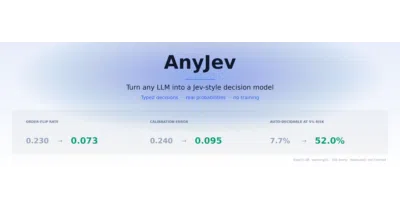
AnyJev turns any open LLM into a calibrated decision engine—typed choices with probabilities you can threshold—without touching a single model weight.
It turns 150+ scattered LLM guides into a single engineering curriculum—from API basics to production Agents and ByteDance interviews—because hoarding bookmarks is not a learning strategy.
It replaces autoregressive LLM classification with a single parallel forward pass, cutting latency from seconds to sub-20 ms while staying local.
Project Maya runs GLM-5.3-Flash privately on one to sixteen GPUs by keeping hot experts in VRAM, warm ones in RAM, and the rest on NVMe.
TensorFold serves a short list of open model families on Apple Silicon and NVIDIA GPUs behind an OpenAI-compatible API, and accepts a drafted token only when it equals what the same engine would emit serially.
A Chinese-language LLM curriculum that rebuilds Stanford CS336 into six hands-on assignments, from writing a tokenizer to distributed training and GRPO.
It rewrites every kernel for AMD Strix Halo and a single 179B-parameter MoE family to beat general-purpose engines without spending fewer bits.
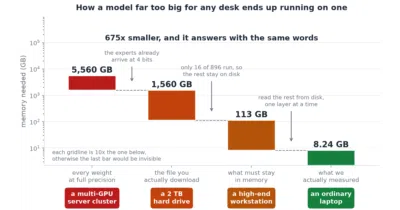
To prove that a 2.78-trillion-parameter model can run on a single CPU with 8 GB of RAM and no GPU.
A fully offline AI agent that reads your health data, manages contacts, and argues with your schedule — without sending anything to the cloud.
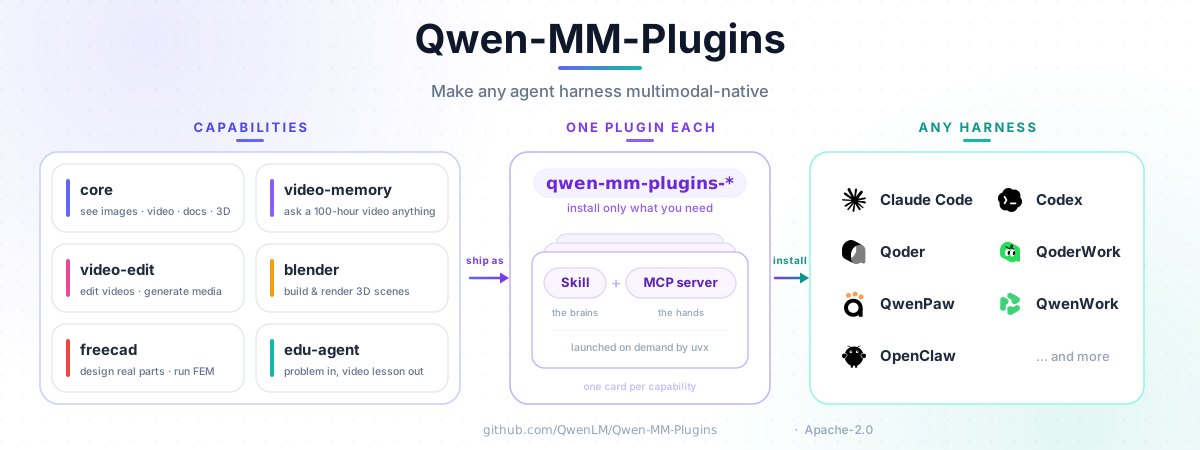
A modular plugin suite that gives existing agent harnesses native vision, video memory, audio understanding, and even CAD and 3D modeling capabilities.
Tianji is a Chinese open-source project teaching LLMs the delicate art of social etiquette — toasts, gifts, blessings, and awkward silences — while doubling as a full-stack LLM tutorial.
Most "personal" AI still phones home to cloud APIs; OpenJarvis is built to run locally by default, pulling in the cloud only when the task actually requires it.
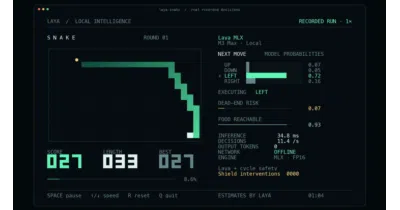
It brings Laya's typed-decision models to MLX so Apple Silicon can score, classify, and route structured inputs locally without generating text.
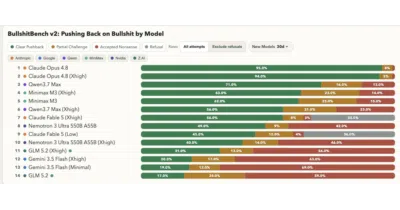
It exists because current benchmarks reward correct answers, not the wisdom to recognize when a prompt is fundamentally broken.
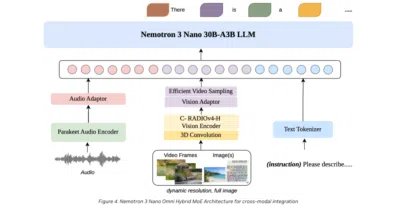
Complete, reproducible pipelines from raw data to deployment-ready Nemotron models, with a modular CLI that lets you remix stages like LEGO bricks.
ISC-Bench demonstrates that LLM agents produce harmful content not because of jailbroken prompts, but because completing the task requires it.
A grab-bag of Maven example modules showing Java developers how to wire chat, RAG, tool calling, and MCP into Spring apps.
Squeezes datacenter-scale MoE inference onto consumer GPUs by treating your desktop’s heterogeneous resources as a unified, elastic runtime.
AiNiee wraps LLM calls in a drag-and-drop interface for translating games, novels, subtitles, and documents without writing prompts.
heatdrop uses Google Analytics to see which pages get read — nothing else. Your call. How we handle data.