youssofal/MTPLX
Apple Silicon LLM Inference That Uses the Model’s Own Drafting Heads
MTPLX squeezes extra tokens per second out of Apple Silicon by using the multi-token prediction heads that ship with modern models like Qwen 3.6, instead of leaving them idle like most runtimes.
Velocity · 7d
+8.1
★ / day
Trend
→steady
star history
What it does
MTPLX is a native macOS app and CLI that runs local LLMs on Apple Silicon through MLX. It finally puts the multi-token prediction heads in recent models—Qwen 3.5/3.6, Gemma 4—to work: the model drafts several tokens ahead, verifies them in one batched forward pass, and keeps only what survives exact rejection sampling. The project cites a 1.6× speedup on a 16 GB M4 Mac mini and up to 2.24× on an M5 Max running Qwen 3.6 27B at temperature 0.6, with the same output distribution as standard decoding.
The interesting bit
Most speculative-decoding schemes either burn RAM on a separate draft model or cheat with greedy argmax that silently warps sampling. MTPLX does neither. It uses the target model’s own spare heads, then applies the Leviathan and Chen rejection-sampling theorem with residual correction so temperature=0.6 and top_p=0.95 behave exactly as they would normally. It also auto-tunes draft depth per machine—accounting for chip, memory bandwidth, and thermals—rather than pretending one size fits all.
Key highlights
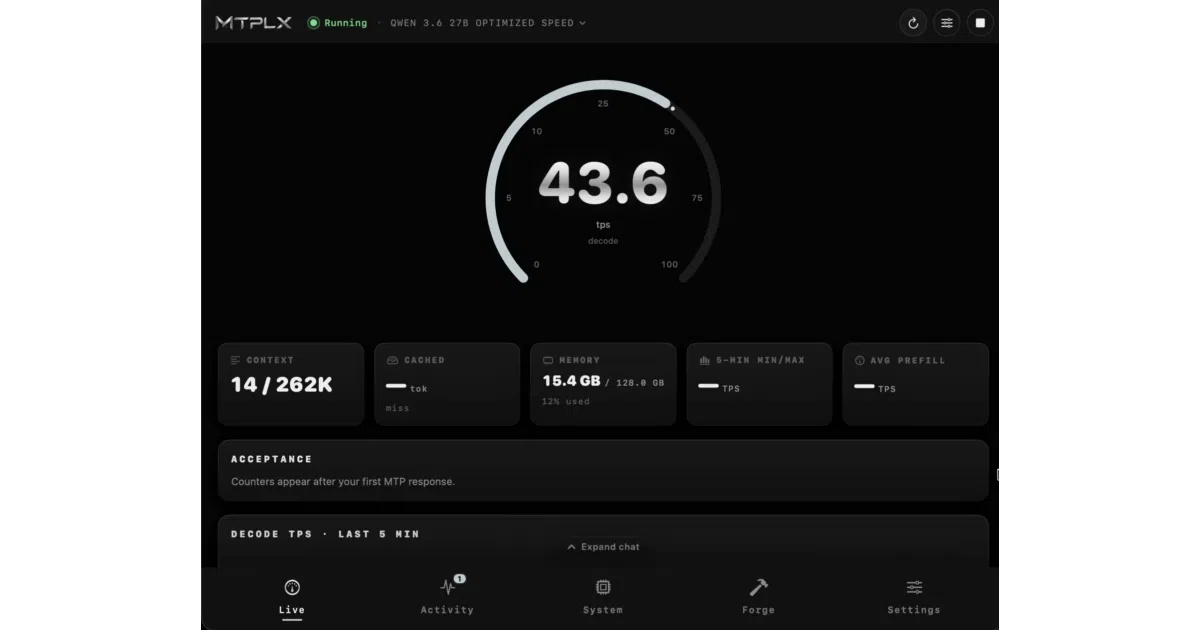
- Live dashboard tracking tokens per second, per-depth acceptance rates, cache state, and system pressure while the model runs.
- OpenAI- and Anthropic-compatible local API with streaming, tool calls, and an optional SSD cache that restores sessions across restarts.
Forgeconverts Hugging Face repos into MTPLX-ready MTP models, trains the adapter, and verifies the speedup on your hardware before you publish.- Explicit compatibility tiers:
mtplx inspectlabels models verified, unverified, incompatible, or missing MTP heads, and refuses to run unverified ones unless forced. - Thermal modes with a crash-safe watchdog that restores automatic fan control even after a
kill -9.
Caveats
- Apple Silicon only; the README bluntly tells Linux users to use vLLM instead.
- Requires macOS 14+ and an M1 or newer; the 27B model wants 32 GB of RAM or more.
- Tightly bound to the MLX ecosystem and to model families that actually ship MTP heads.
Verdict
Grab it if you run local LLMs on a modern Mac and want exact sampling without a second model eating your RAM. If you are on CUDA or non-Apple silicon, there is nothing to see here.
Frequently asked
- What is youssofal/MTPLX?
- MTPLX squeezes extra tokens per second out of Apple Silicon by using the multi-token prediction heads that ship with modern models like Qwen 3.6, instead of leaving them idle like most runtimes.
- Is MTPLX open source?
- Yes — youssofal/MTPLX is open source, released under the Apache-2.0 license.
- What language is MTPLX written in?
- youssofal/MTPLX is primarily written in Python.
- How popular is MTPLX?
- youssofal/MTPLX has 2.5k stars on GitHub and is currently holding steady.
- Where can I find MTPLX?
- youssofal/MTPLX is on GitHub at https://github.com/youssofal/MTPLX.