OpenDCAI/DataFlex
Dynamic data triage for LLaMA-Factory training loops
DataFlex stops LLM training loops from wasting compute on static data mixes by dynamically selecting, mixing, and reweighting samples inside LLaMA-Factory.
Velocity · 7d
+25
★ / day
Trend
↗accelerating
star history
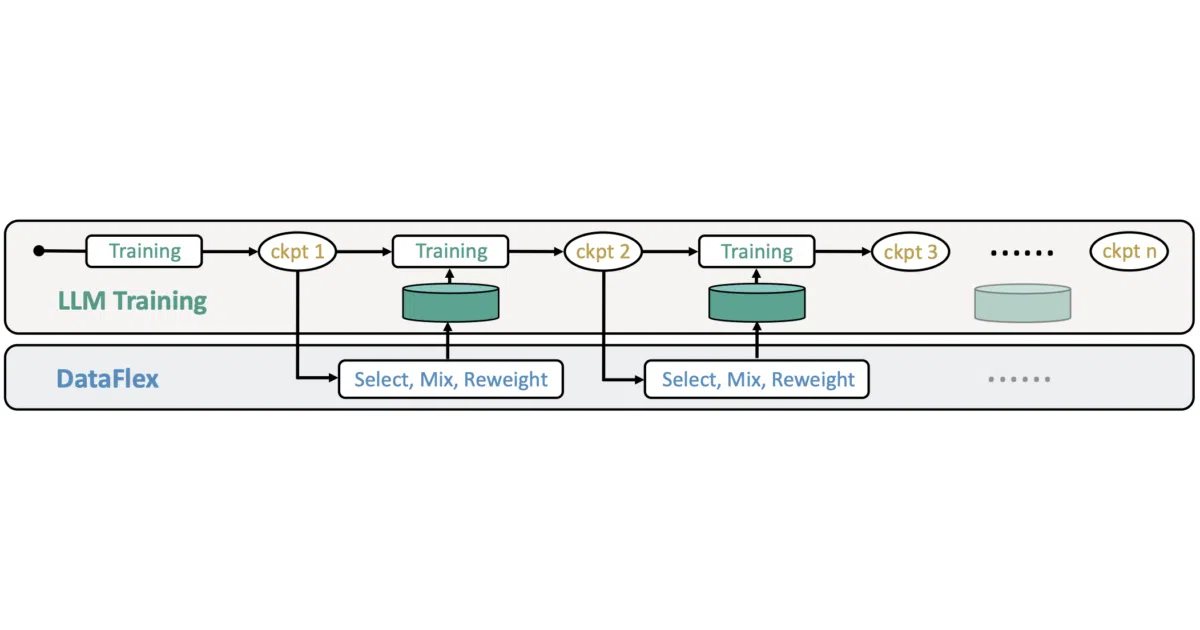
What it does DataFlex is a plug-in layer for LLaMA-Factory that turns static training data into a moving target. It implements a catalog of data-centric algorithms—sample selectors like LESS and NICE, mixture optimizers like DoReMi and ODM, and loss-based reweighting—and runs them inside the existing training loop so the model sees different data proportions or sample weights as training progresses. The project also acts as a reproducibility rescue mission for several research papers whose official code is missing or buggy.
The interesting bit Rather than treating data curation as a preprocessing step, DataFlex treats it as an optimization variable that shifts during the training loop. It is essentially high-quality glue code: it wraps fragmented academic implementations into a single registry-based system with unified YAML configuration, so you can swap selectors, mixers, and weighters without rewriting trainers.
Key highlights
- Implements hard-to-reproduce selectors (LESS, NICE, NEAR, TSDS) and mixture methods (DoReMi, ODM) under one roof.
- Drop-in compatibility with LLaMA-Factory: add DataFlex-specific YAML keys to existing configs.
- Experimental results show MMLU accuracy and perplexity improvements over static baselines on SlimPajama and Open-Hermes subsets.
- Supports DeepSpeed ZeRO-3 for gradient computation on larger models.
- Pairs with the separate DataFlow project for raw-data preprocessing, but accepts any standard JSON training format.
Caveats
- Several algorithms listed (Loss, Delta Loss, NEAR, Loss Reweighting) have no official repository, so DataFlex’s implementations are the de facto reference and should be scrutinized accordingly.
- The README flags some reproduced official repositories as problematic (⚠️), suggesting the field is still cleaning up its code.
- Python 3.11+ is recommended; Python 3.10 users need to resolve
llamafactorycompatibility manually.
Verdict Researchers who want to experiment with data-centric training without maintaining a patchwork of academic codebases should look here; if you are already happy with static data mixing and do not use LLaMA-Factory, this adds little value.
Frequently asked
- What is OpenDCAI/DataFlex?
- DataFlex stops LLM training loops from wasting compute on static data mixes by dynamically selecting, mixing, and reweighting samples inside LLaMA-Factory.
- Is DataFlex open source?
- Yes — OpenDCAI/DataFlex is open source, released under the Apache-2.0 license.
- What language is DataFlex written in?
- OpenDCAI/DataFlex is primarily written in Python.
- How popular is DataFlex?
- OpenDCAI/DataFlex has 2.7k stars on GitHub and is currently accelerating.
- Where can I find DataFlex?
- OpenDCAI/DataFlex is on GitHub at https://github.com/OpenDCAI/DataFlex.