01
firecrawl/firecrawl
+365 ★/day↗accelerating
Firecrawl turns search, scraping, and browser interaction into a single API so your agents can read the web without wrestling with proxies, rate limits, or JavaScript rendering.
Firecrawl turns search, scraping, and browser interaction into a single API so your agents can read the web without wrestling with proxies, rate limits, or JavaScript rendering.
Built to stop pipelines from sending text-based PDFs through expensive OCR services.
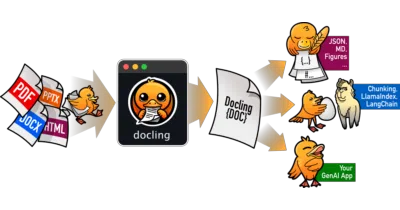
Docling turns PDFs, Office files, images, and even audio into structured AI-ready formats, entirely on your own hardware.
OpenDataLoader PDF exists to extract structured data from PDFs for AI pipelines while auto-tagging untagged documents for screen readers, all without proprietary dependencies.
It turns technical PDFs and EPUBs into on-demand Claude Code skills, so you can query a book's actual frameworks instead of hoping the model remembers them.
It translates scientific papers into bilingual PDFs while keeping formulas, charts, and annotations exactly where they belong.
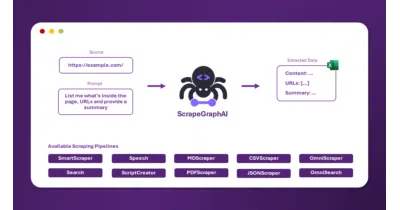
ScrapeGraphAI lets you extract structured data from websites and documents by describing what you want in plain English, leaving the LLM to wrestle with the markup.
It exists to handle the tedious wiring—annotations, dataset formats, tracking—that sits between a trained model and a useful application.
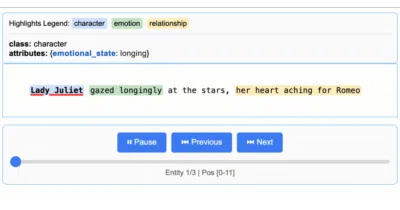
LangExtract exists because asking an LLM to pull names and dates out of a report is easy; proving exactly which sentence each came from is the hard part.
Repomix exists because copy-pasting twenty files into a chat window is a terrible way to ask an LLM for help.
Maxun is an open-source platform for developers who would rather record a browsing session than write another brittle web scraper.
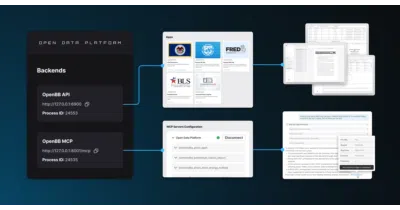
OpenBB normalizes proprietary and public financial data so engineers can feed the same sources to Python scripts, REST APIs, Excel, and AI agents without rebuilding integrations.
Because someone has to label the training data, and it might as well not be in a spreadsheet.
Chroma is an open-source search backend that handles the messy embedding pipeline so AI applications can store and retrieve documents with a minimal API.
A maintainer cataloged every Chinese NLP repo they touched into a single, obsessively categorized list so others wouldn’t have to hunt.
MinerU turns PDFs, Office files, and images into structured Markdown and JSON so LLM agents don’t drown in layout noise.
Built in a fit of rage after a $16 “open source” web-to-Markdown tool gated features behind API tokens.
A curated awesome-list that tries to answer "What is Data Science, and what should I study?" by cataloging courses, tools, libraries, and communities in a single sprawling index.
It turns images and PDFs into structured JSON and Markdown so your RAG pipeline doesn't have to squint.
A Python utility that converts office documents and media into structured Markdown built for LLM pipelines, not human eyeballs.
heatdrop uses Google Analytics to see which pages get read — nothing else. Your call. How we handle data.