01
pallavi-shekhar/ai-engineering-interview-questions-company-wise
+65% /wk +174 ★/day↗accelerating
A curated map of real AI engineering interview questions from 35 companies, tagged by topic and employer so candidates study what actually matters.
A curated map of real AI engineering interview questions from 35 companies, tagged by topic and employer so candidates study what actually matters.
Those viral Claude Opus 5.5 animations are just code the model wrote — this list collects them with the prompts that produced them, so you can copy the technique instead of guessing.
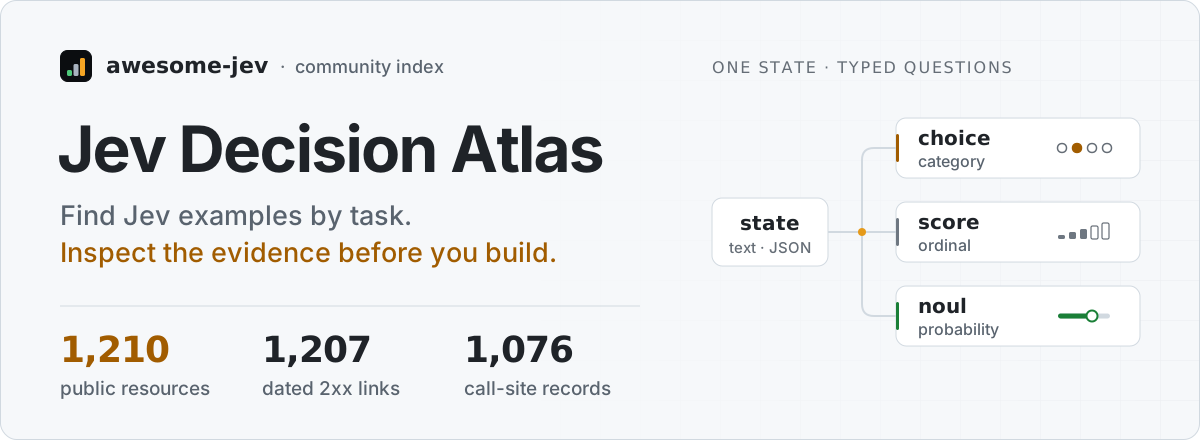
A high-signal field guide that maps where Jev makes real typed decisions in production, with a strict warning that inclusion is not endorsement.
It turns 150+ scattered LLM guides into a single engineering curriculum—from API basics to production Agents and ByteDance interviews—because hoarding bookmarks is not a learning strategy.
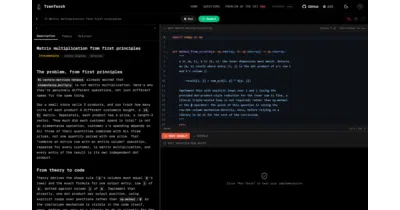
TrenTorch teaches machine learning by having you build a PyTorch-shaped framework from scratch, plus 350+ browser-graded coding questions.
A curated, commit-pinned directory of open-source projects that implement fast, typed discrete decisions for autonomous agents.
A Chinese-language LLM curriculum that rebuilds Stanford CS336 into six hands-on assignments, from writing a tokenizer to distributed training and GRPO.
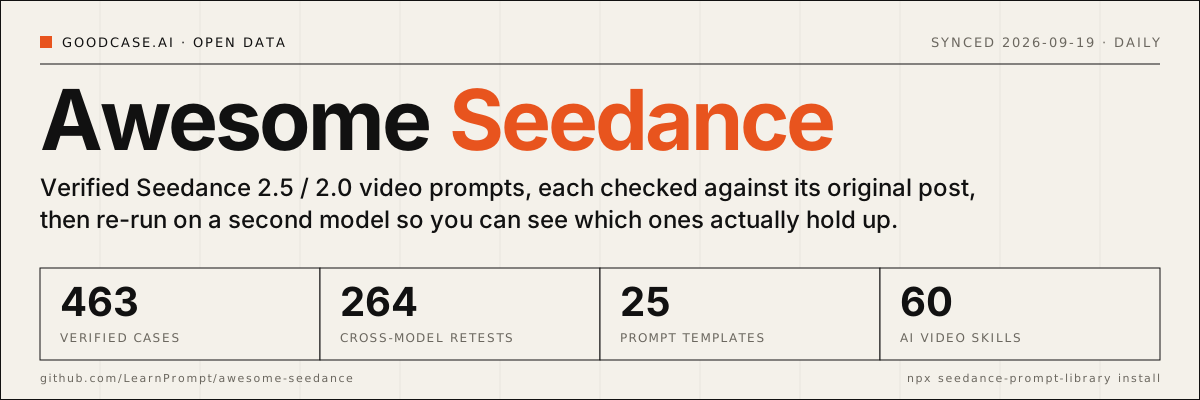
A verified prompt library for ByteDance's Seedance video generator, cross-checked against original posts and retested across models.
Because launch posts describe the vendor’s architecture, not your machine’s permission prompts and credit-card charges.
A Markdown-only syllabus for the discipline that appeared overnight: wiring GPUs, caches, RAG, and agents into one system that is fast, cheap, reliable, and safe.
One developer's curated set of guided prompts walks you from PRD to test plan, one structured conversation at a time.
A third-party index of 1,207 public resources for Jev, TypeSafe AI's typed decision model — organized by the decision each one makes, with dated link checks, call-site citations, and negative results filed next to the wins.
A tutorial that bridges the gap between inference theory and production code by making you build a working mini-sglang first.
A structured notebook stack that teaches AI from first principles—math, PyTorch, and neural nets—up to modern transformers, RAG, and OCR.
Tianji is a Chinese open-source project teaching LLMs the delicate art of social etiquette — toasts, gifts, blessings, and awkward silences — while doubling as a full-stack LLM tutorial.
Over 3,600 community-curated prompts for ByteDance's Seedance 2.0, treating AI video generation less like prompting and more like micro-screenwriting.
A curated directory of over 200 agentic AI projects arguing that workflow beats raw model size.
A Chinese-language prompt library that treats thesis dread as a workflow optimization problem.
Latent Box curates AI/creativity/art resources with a stated goal: if they list a thousand sites, a hundred should actually be worth remembering.
A curated collection that treats Seedance 2.0 more like a film crew than a chatbot.
heatdrop uses Google Analytics to see which pages get read — nothing else. Your call. How we handle data.