nokia-applied-research/AnyJev
Your LLM's hidden layers are better bookies than its tokenizer
AnyJev turns any open LLM into a calibrated decision engine—typed choices with probabilities you can threshold—without touching a single model weight.
Collecting fresh signals — velocity needs a few days of history.
collecting data…
star history
What it does
AnyJev wraps open LLMs so they answer structured questions—multiple choice, yes/no, scored ratings—with a probability distribution you can trust. It strips away position bias by averaging over cyclic option shifts at zero labels, then optionally fits a closed-form linear head on an intermediate hidden state using a few hundred examples. The result is a decision endpoint that costs less than one plain forward pass and emits odds instead of tokens.
The interesting bit
The project treats the LLM as a feature extractor, not a text generator: it often truncates the model to a middle block, finds that the remaining layers are just busy turning answers into tokens, and reads decisions from a pooling server serving those truncated hidden states. A fitted head is a few kilobytes, self-tunes on unlabelled traffic, and ships for specific model families—currently five Qwen3 variants.
Key highlights
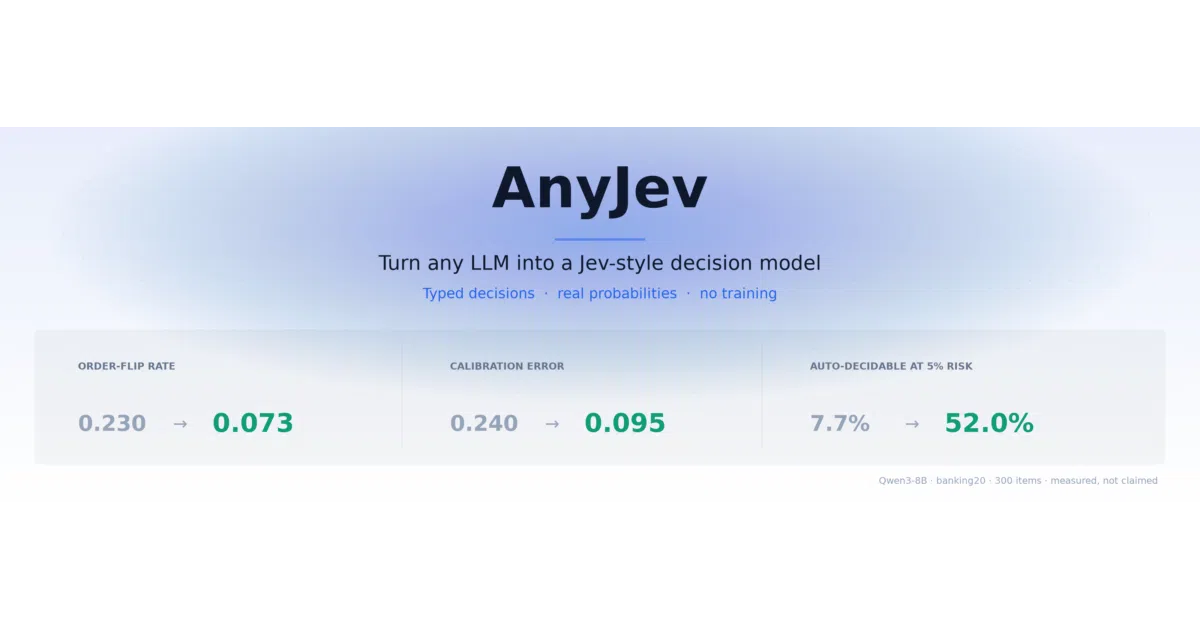
L0needs no labels and cuts the rate of flipped answers when options are reversed from 0.230 to 0.073, while raising the share safely automatable at ≤5% error from 7.7% to 46.3%.L2heads fit in seconds with 100–300 labels via closed-form solve; no backpropagation touches the base model.- Deployed through vLLM as an embed server plus a ~100 KB head, with truncated checkpoints often running faster and slightly more accurately than full depth.
- Heads auto-adapt to reworded questions and shuffled options by re-estimating mean and scale from unlabelled traffic.
- Shipped heads cover five Qwen3 models; other architectures (Llama, Gemma, Mistral, DeepSeek) are on the roadmap.
Caveats
- Accuracy benchmarks on the included
typed-decisionstask measure agreement with a teacher LLM, not human ground truth. L2heads are per-question and per-model: a head fit for one task won’t transfer to another, and only Qwen3 heads ship today.- The letter-token readout caps choices at 26 options, and the project has not yet been evaluated inside live agent loops.
Verdict
Worth a look if you run LLM-based routing, scoring, or classification and need probabilities you can threshold for automation. Skip it if you need cross-task generalization or work outside the Qwen3 family and don’t want to generate your own labels.
Frequently asked
- What is nokia-applied-research/AnyJev?
- AnyJev turns any open LLM into a calibrated decision engine—typed choices with probabilities you can threshold—without touching a single model weight.
- Is AnyJev open source?
- Yes — nokia-applied-research/AnyJev is open source, released under the Apache-2.0 license.
- What language is AnyJev written in?
- nokia-applied-research/AnyJev is primarily written in Python.
- How popular is AnyJev?
- nokia-applied-research/AnyJev has 508 stars on GitHub.
- Where can I find AnyJev?
- nokia-applied-research/AnyJev is on GitHub at https://github.com/nokia-applied-research/AnyJev.