mizorewww/laya-mlx
Sub-15 ms structured decisions without generating a single token
It brings Laya's typed-decision models to MLX so Apple Silicon can score, classify, and route structured inputs locally without generating text.
Collecting fresh signals — velocity needs a few days of history.
collecting data…
star history
What it does
laya-mlx is a native MLX runtime for Laya typed-decision models on Apple Silicon. You give it a state and structured questions—multiple choice, rubric scores, or true/false propositions—and it returns probabilities from a single bidirectional forward pass. After the initial weight download, everything runs offline with no PyTorch, Transformers, or cloud API.
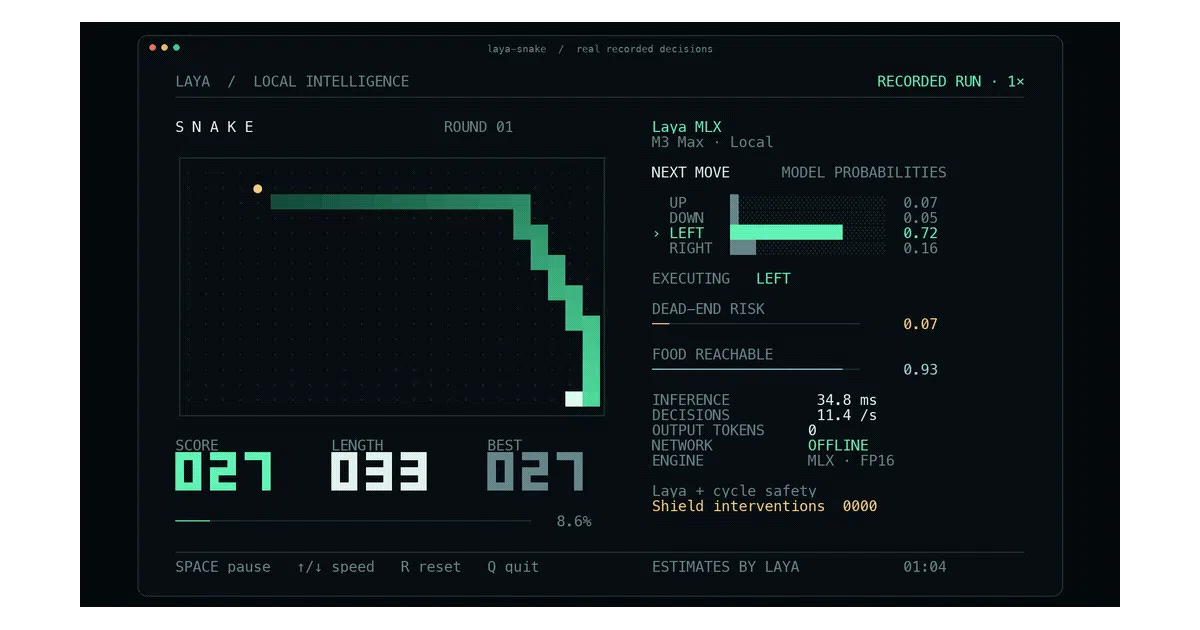
The interesting bit Instead of treating an LLM as a text generator and parsing its output, the project uses a bidirectional encoder—ModernBERT-large or mmBERT-base—with task-specific decision heads to emit structured answers directly. The result is median end-to-end latency of 7.4 ms for short multilingual questions and 13.4 ms for English, demonstrated by a real-time Snake terminal game that runs at 75 moves per second with a visible safety-correction layer.
Key highlights
- Zero output tokens: decisions come from encoder hidden states, not autoregressive decoding.
- Validated parity: all 63 validation fixtures matched upstream across both FP32 and FP16, totaling 378/378 passing comparisons.
- Speed: 7.39 ms median (multilingual) and 13.42 ms median (English) on M3 Max; batched throughput reaches 395 questions per second.
- Fully local: pure MLX inference with pre-converted Hugging Face checkpoints; no generative runtime required.
- Router included: built-in language routing and checkpoint selection, with optional resident-model preloading for mixed workloads.
Caveats
- Apple Silicon and macOS only; requires macOS 14+ and Python 3.11+.
- Inference and conversion only—training and fine-tuning remain in the upstream project.
- BF16 is available but sits outside the published validation matrix, and probabilities can drift slightly across precisions even when the selected label agrees.
Verdict Reach for this if you need low-latency, structured-decision scoring on a Mac and would rather have a fast encoder than a chatty LLM. Look elsewhere if you need generative text, cross-platform deployment, or model training.
Frequently asked
- What is mizorewww/laya-mlx?
- It brings Laya's typed-decision models to MLX so Apple Silicon can score, classify, and route structured inputs locally without generating text.
- Is laya-mlx open source?
- Yes — mizorewww/laya-mlx is open source, released under the Apache-2.0 license.
- What language is laya-mlx written in?
- mizorewww/laya-mlx is primarily written in Python.
- How popular is laya-mlx?
- mizorewww/laya-mlx has 1.8k stars on GitHub.
- Where can I find laya-mlx?
- mizorewww/laya-mlx is on GitHub at https://github.com/mizorewww/laya-mlx.