01
latent-spaces/brag
+570 ★/day↗accelerating
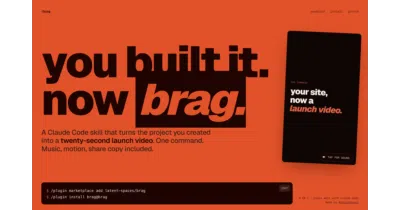
The gap between 'it works' and 'anyone knows it works' is usually a launch video nobody wants to make — so this agent skill makes it for you.
The gap between 'it works' and 'anyone knows it works' is usually a launch video nobody wants to make — so this agent skill makes it for you.
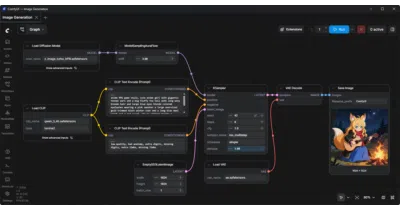
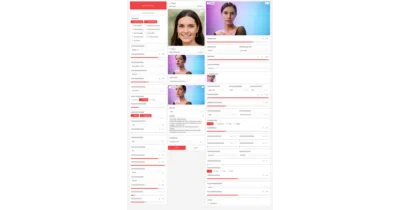
It exists because clicking 'generate' isn't enough when you need to control every model, parameter, and preprocessing step.
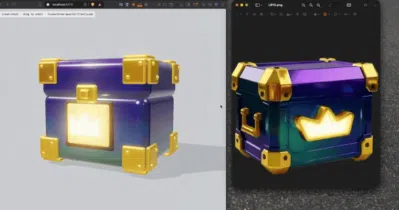
It exists to rebuild objects from reference photos as token-efficient, animation-ready Three.js code, using agent vision to gate quality before every sculpting pass.
SGLang exists to push low-latency, high-throughput inference for LLMs and multimodal models from a single GPU up to massive clusters.
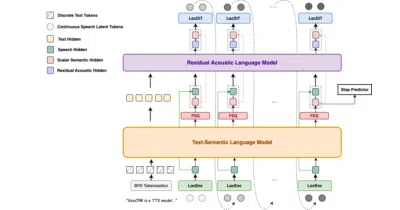
VoxCPM2 proves TTS doesn't need discrete tokens: a 2B-parameter diffusion model generates continuous 48kHz speech for 30 languages and text-prompted voice cloning.
Toonflow exists to turn a manuscript into an animated short drama without juggling five different browser tabs.
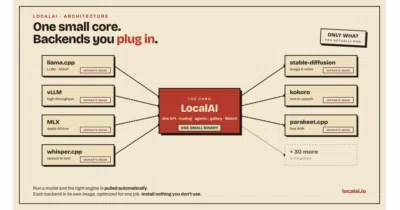
LocalAI wraps 36+ inference engines behind one OpenAI-compatible API and pulls them on demand, so you can run LLMs, vision, voice, and video on anything from a CPU to a Jetson.
ChatTTS is a generative speech model built for dialogue, letting LLM assistants laugh, pause, and speak in multiple voices.
A NeurIPS 2022 face restoration model that treats facial features as entries in a discrete codebook, making it harder to hallucinate implausible noses.
A TTS project built to clone realistic voices from just one minute of training audio.
An Electron app that wraps 200+ generative models behind a single UI, with an unusual pitch: no guardrails, no cloud lock-in, and a split personality between local and remote inference.
A reimplementation of OpenAI's Whisper that trades the original inference engine for CTranslate2 and gains up to 4× speed without sacrificing accuracy.
A minimal C/C++ port of OpenAI’s Whisper built to transcribe speech locally on phones, browsers, and underclocked POWER9 boxes.
It renders high-quality novel views of real-world scenes at 30 fps by replacing costly neural radiance fields with optimized 3D Gaussians.
It automates video transcription, translation, and dubbing while stubbornly insisting on single-line, human-readable subtitles.
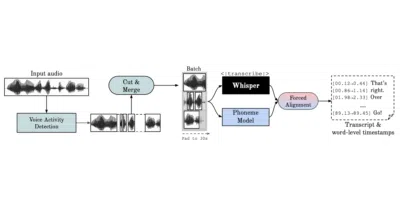
OpenAI's Whisper is accurate but slow and timestamp-imprecise; WhisperX bolts on batching, forced phoneme alignment, and speaker diarization to fix that.
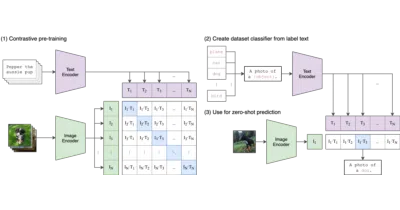
CLIP learns shared image-text representations so you can label photos with natural language instead of curated datasets.
It turns face swaps and lip-syncs into queued, retryable batch jobs instead of one-off scripts.
Because you shouldn't need to reverse-engineer a black box just to swap a noise scheduler or fine-tune a diffusion model.
Hypit gives AI agents a markup language and compiler to turn reference clips—or text prompts—into templated, batch-rendered video variants.
heatdrop uses Google Analytics to see which pages get read — nothing else. Your call. How we handle data.