MemTensor/MemT-1.0
A model that remembers without rereading the transcript
MemT-1.0 bakes persistent memory into the model itself, so history lives in a fixed-size latent state instead of a growing KV cache.
Collecting fresh signals — velocity needs a few days of history.
collecting data…
star history
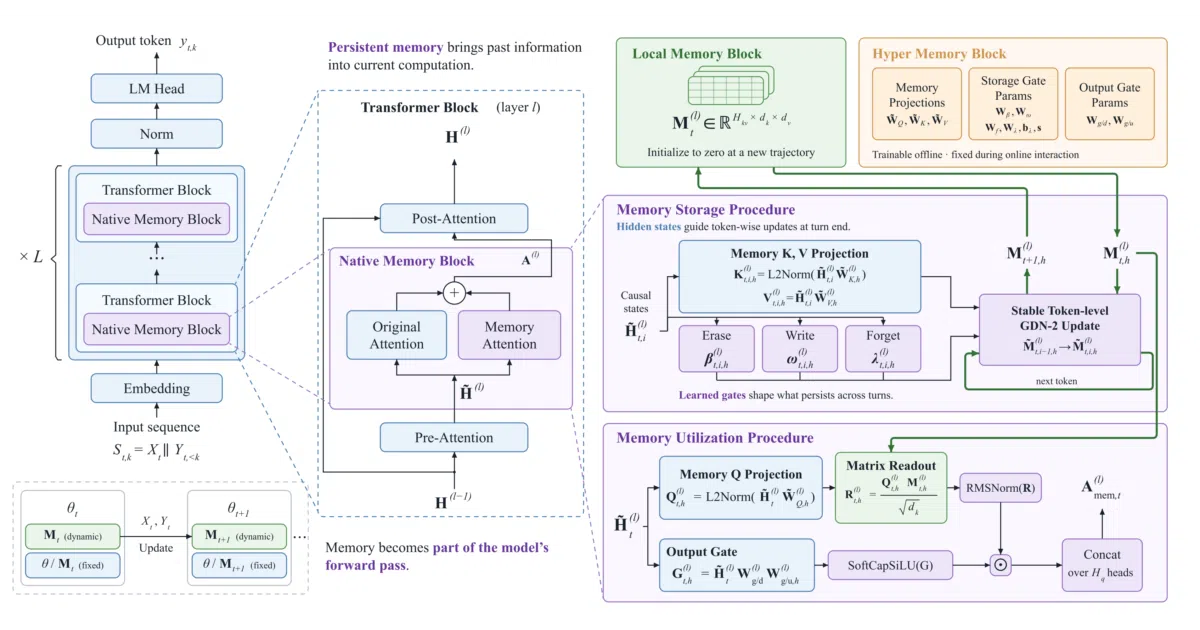
What it does MemT-1.0 is a family of memory foundation models built on Qwen3.6 and DeepSeek backbones. A Native Memory Block runs alongside standard attention: a dynamic local memory matrix plus a trainable hyper memory block with write, erase, forget, and output gates. Conversations get committed to this latent memory and the plaintext context is cleared — the model answers follow-up questions from memory state alone, with zero turns of transcript left.
The interesting bit The memory state stays constant in size regardless of history length — the README claims roughly 66× storage reduction versus a full-context KV cache at 128K history. Snapshots save to a single file and restore with an empty message list, which is a genuinely different mental model from context-window stuffing.
Key highlights
- Two sizes: Nano (36B total, 3B activated, 451M trainable memory params) and Flash (288B total, 17B activated)
- Mixture-of-Storage (MoS) architecture for scalable memory capacity
- Two-stage training pipeline on 34B tokens; ranked first and second among evaluated parametric-memory methods across 11 memory benchmarks
- Experience-guided agentic coding: retrieved procedural experience is stored in native memory and read via memory attention, without polluting the task context
- Served via SGLang with a Python client; memory snapshots persist across sessions
Caveats
- Textual-memory systems still beat it overall, especially on long histories needing detailed evidence retrieval — the authors say so themselves.
- Noncommercial licensing on both the paper (CC BY-NC-SA) and the repository software (PolyForm Noncommercial), so commercial use requires contacting the authors.
- The 66× figure and benchmark rankings come from the project’s own tech report, not independent evaluation.
Verdict Worth a look if you’re researching long-term memory architectures or building agents that shouldn’t drag an ever-growing transcript around. Skip it if you need a commercially usable model or state-of-the-art long-context retrieval today.
Frequently asked
- What is MemTensor/MemT-1.0?
- MemT-1.0 bakes persistent memory into the model itself, so history lives in a fixed-size latent state instead of a growing KV cache.
- Is MemT-1.0 open source?
- Yes — MemTensor/MemT-1.0 is an open-source project tracked on heatdrop.
- What language is MemT-1.0 written in?
- MemTensor/MemT-1.0 is primarily written in Python.
- How popular is MemT-1.0?
- MemTensor/MemT-1.0 has 505 stars on GitHub.
- Where can I find MemT-1.0?
- MemTensor/MemT-1.0 is on GitHub at https://github.com/MemTensor/MemT-1.0.