01
Leonxlnx/unlazy
+88% /wk +519 ★/day↗accelerating
unlazy forces AI agents to prove their work through runnable acceptance gates instead of trusting their own exit reports.
unlazy forces AI agents to prove their work through runnable acceptance gates instead of trusting their own exit reports.
Most browser agents chat at you; this one returns editable spreadsheets, slides, and sites you can actually use.
LearnHarness uses agents to map what you actually understand, then builds lessons one reasoning step at a time.
A tiny Rust daemon that turns every coding agent on the team into a reachable peer — no server in the middle.
Co-op Anything is an MCP server and playbook that turns coding agents into co-op mod engineers — reviving abandoned mods or building netplay from scratch.
ThinkRail is a mobile-first IDE whose entire engine is the pi coding agent, run in-process and scoped to git worktrees.
It stops long-running agents from drifting by forcing them to verify progress through independent roles before every new round.
A Claude Code skill that ships 39 film styles as prompts — and proves each one with a demo film its agent rendered, scored, and narrated entirely in code.
A read-only MCP bridge that turns your paid ChatGPT web session into the planning and review brain for Codex, while execution stays locked to the agent.
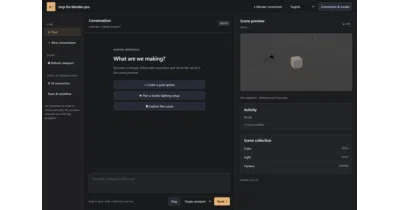
A Blender addon that pairs a visual chat workspace with a built-in MCP server, so AI assistants can inspect, build and edit 3D scenes rather than guessing at them.
B is a floating, emotionally expressive AI companion that reads your active windows, listens, and speaks up only when it has something worth saying.
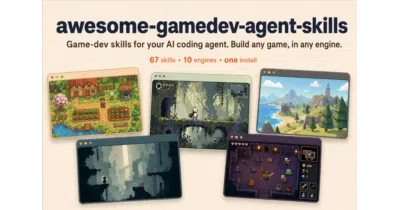
67 game-dev skills and a router that auto-loads the right context so your AI agent stops guessing your engine.
Agent-side workflows that turn novels into production-ready short-drama bibles—characters, outlines, and art guides—without leaving Claude Code or Codex.
22 tested Blender workflow skills that stop coding agents from hallucinating their way through the 3D pipeline.
Because LLMs confidently invent struct offsets and behavior from binaries, this toolkit makes them prove every claim against the actual bytes.
This toolkit turns a veteran cross-border ecommerce operator's SOP into seven reusable AI agent workflows — prompts, templates, and worked examples included.
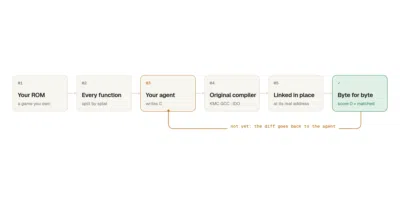
decomp.wtf pointed AI agents at your own game cartridges and demanded C that compiles to the exact original bytes; the decompilation community pushed back, so the author stopped.
imozuru borrows decades of library-science research on information seeking to make Claude Code chase citations, authors, and links until it lands on original texts — then refuses to summarize them.
qq-bridge plugs DeepSeek Harness agents into QQ group chats, where they read along, pick their moments to speak, and route their tool-approval prompts back to your phone.
Switch exists to stop you from copy-pasting agent outputs into Slack by turning any AI agent into a first-class citizen inside your existing chat channels.
heatdrop uses Google Analytics to see which pages get read — nothing else. Your call. How we handle data.