alchaincyf/deepseek-harness-orange-book
DeepSeek Harness, Dissected by a Non-Coder in 24 Hours
Because launch posts describe the vendor’s architecture, not your machine’s permission prompts and credit-card charges.
Not currently ranked — collecting fresh signals.
star history
What it does
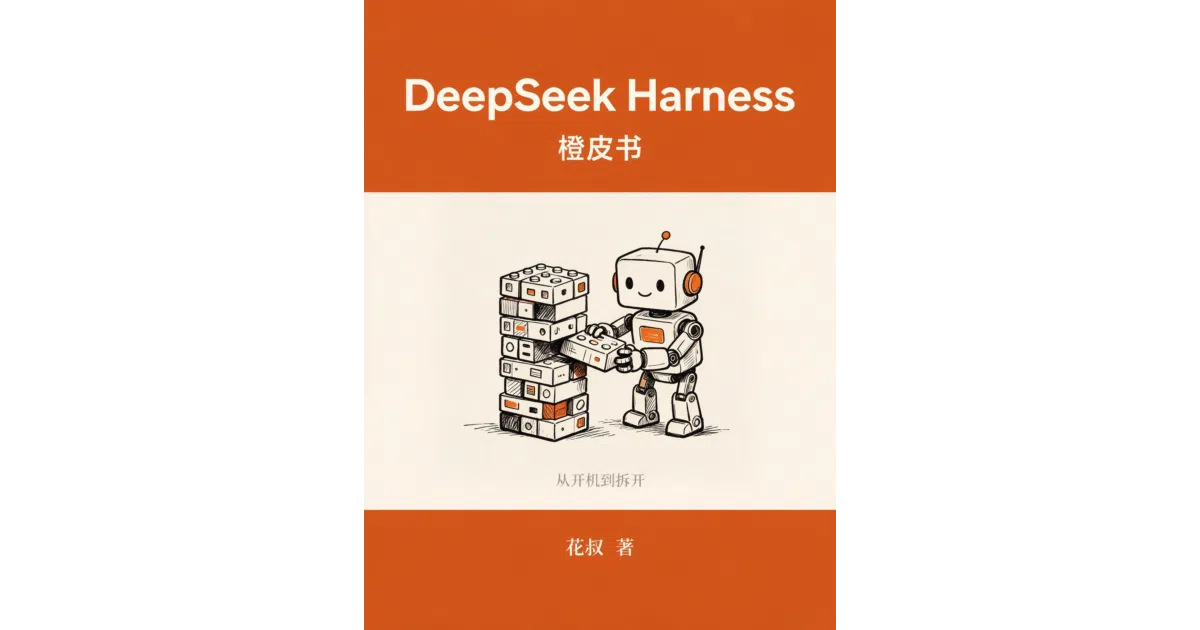
This repo hosts the DeepSeek Harness Orange Book, a Chinese field guide written within a day of DeepSeek open-sourcing its agent framework. The author, who says he has never hand-written a line of code, installed the MIT-licensed harness on his own hardware and documented what the official announcement omitted. The output is a book in PDF, EPUB, and HTML, backed by raw artifacts: complete system prompts, three unedited session logs, and a 129-line default boot manifest dumped straight from the tool.
The interesting bit
Instead of paraphrasing the launch post, the book treats the framework like a consumer appliance—tracking permission boundaries, migration friction from Claude Code, and the counter-intuitive 9% fixed-cost bump when enabling PTC mode. It also includes a 19-step log of the AI writing its own tool (count_chinese), growing the tool list from 32 to 33 lines while the author watched.
Key highlights
- Primary-source transparency: full system prompts, three raw session logs (standard, PTC, creative mode), and the exact 129-line startup checklist.
- A live cost audit, including the PTC fixed-overhead surprise and a bill for 5 model utterances that orchestrated 15 operations.
- A 20-page magazine-style slide deck if you need the TL;DR for a lunch break.
- Codebase archaeology: 12,293 commits across roughly 64 days, 683 agent notes, and four incident postmortems, including one where 100% test coverage still crashed the moment an editor connected.
- A recurring sidebar, “They wanted to do this, then didn’t,” surfacing rejected design decisions from the repository history.
Caveats
- The book is Chinese-only; the English summary is a single paragraph.
- Web-sourced numbers (stars, package counts) are snapshotted at press time and will age.
- System prompts and boot manifests are version-locked artifacts that may drift as Harness evolves.
Verdict
Read it if you are choosing between Harness, Claude Code, or Codex and need ground-truth data on permissions, costs, and migration gaps. Ignore it if you want the framework source code—this is the autopsy report, not the body.
Frequently asked
- What is alchaincyf/deepseek-harness-orange-book?
- Because launch posts describe the vendor’s architecture, not your machine’s permission prompts and credit-card charges.
- Is deepseek-harness-orange-book open source?
- Yes — alchaincyf/deepseek-harness-orange-book is an open-source project tracked on heatdrop.
- What language is deepseek-harness-orange-book written in?
- alchaincyf/deepseek-harness-orange-book is primarily written in HTML.
- How popular is deepseek-harness-orange-book?
- alchaincyf/deepseek-harness-orange-book has 1.2k stars on GitHub.
- Where can I find deepseek-harness-orange-book?
- alchaincyf/deepseek-harness-orange-book is on GitHub at https://github.com/alchaincyf/deepseek-harness-orange-book.