01
pallavi-shekhar/ai-engineering-interview-questions-company-wise
+62% /wk +151 ★/day↗accelerating
A curated map of real AI engineering interview questions from 35 companies, tagged by topic and employer so candidates study what actually matters.
A curated map of real AI engineering interview questions from 35 companies, tagged by topic and employer so candidates study what actually matters.
A high-signal field guide that maps where Jev makes real typed decisions in production, with a strict warning that inclusion is not endorsement.
A curated, commit-pinned directory of open-source projects that implement fast, typed discrete decisions for autonomous agents.
It turns 150+ scattered LLM guides into a single engineering curriculum—from API basics to production Agents and ByteDance interviews—because hoarding bookmarks is not a learning strategy.
It teaches programmers to build Agent systems from core mechanisms up, then grills them with real big-tech interview questions.
It distills years of production crashes into 224 agent-readable skills that map how Kotlin, Compose Multiplatform, and desktop JVM APIs actually fail.
Hackathon-built desktop tool turns PDFs into interactive knowledge graphs and refuses to let your scores drop.
A local-first curriculum that builds one AI agent from first principles, with no frameworks, cloud APIs, or hidden reasoning.
It catalogs the growing wave of projects plugging real fruit fly connectome data into games and simulations.
Those viral Claude Opus 5.5 animations are just code the model wrote — this list collects them with the prompts that produced them, so you can copy the technique instead of guessing.
An automated index that ranks GitHub repositories by Claude Code plugin adoption, because someone had to keep score in the plugin land grab.
A Chinese adaptation of Alammar and Grootendorst's Hands-On Large Language Models that swaps Colab for VPN-free GPU containers and adds companion videos.
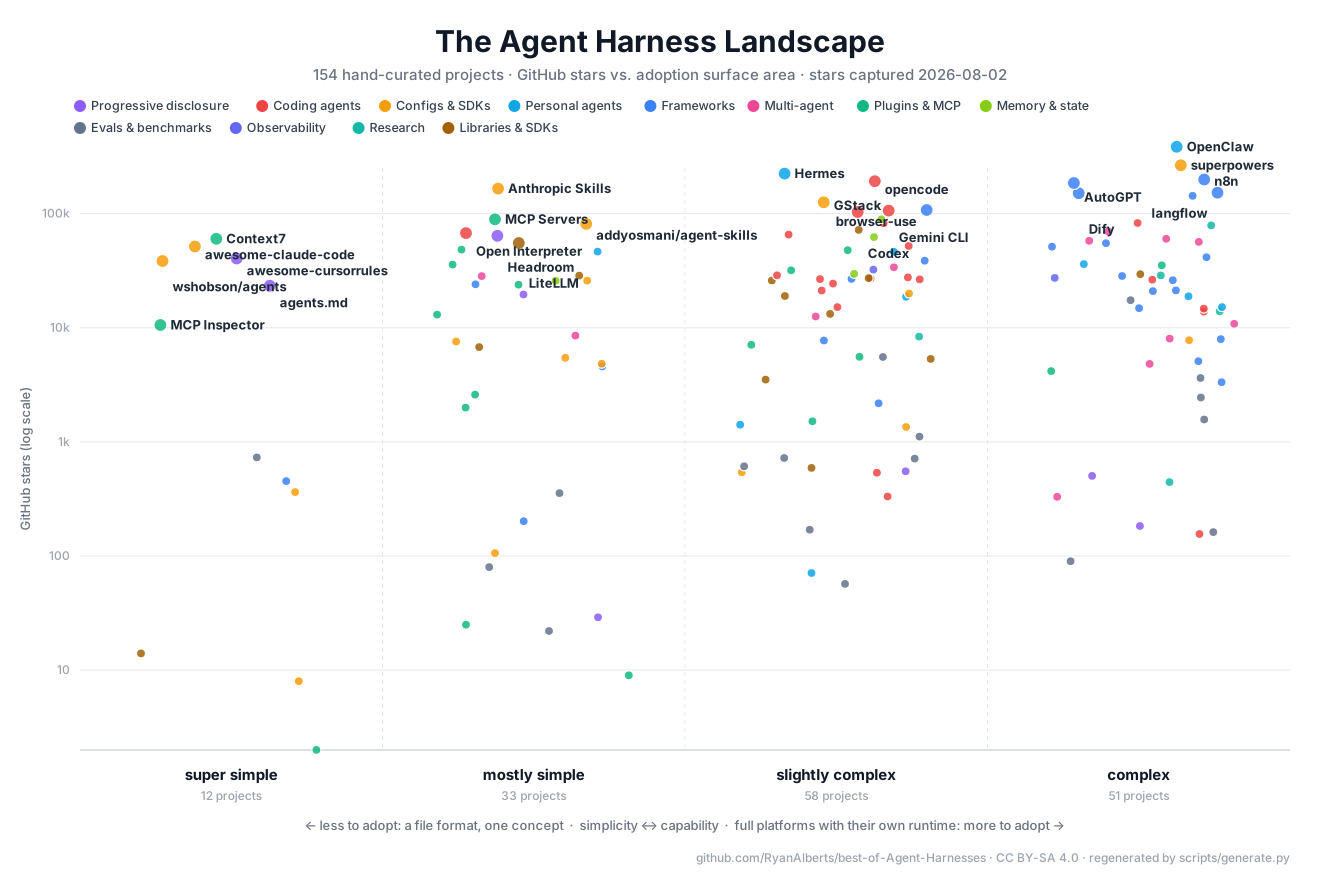
It curates and rescores 154 agent harnesses weekly because raw GitHub stars are a terrible way to choose orchestration infrastructure.
To teach developers how to run Small Language Models and AI agents on local hardware instead of cloud APIs.
A curated directory of over 200 agentic AI projects arguing that workflow beats raw model size.
This repository catalogs technical books on large language models, complete with dual ratings and code repositories, for developers who prefer structured learning over blog posts.
Chinese-language ML/DL notes built around the heresy of learning by doing first, theory later—if ever.
It packages a professor's decade of SIGMOD and NeurIPS experience into structured AI skills, bridging the 'last-mile' gap where generic guides and busy advisors leave grad students stranded.
A tutorial that reverse-engineers Claude Code's core architecture in ~4,300 lines so you don't have to read half a million.
An official, terminal-first syllabus for developers who prefer keyboard-driven AI assistance to IDE hand-holding.
heatdrop uses Google Analytics to see which pages get read — nothing else. Your call. How we handle data.