01
lexifina/global-law
+61% /wk +163 ★/day→steady
Every country's law as a git history where each commit is one law taking effect — so you can blame a statute like a line of code.
Agentero is a local-first research workbench that unifies your papers, notes, and AI context so your own agent can actually follow the literature.
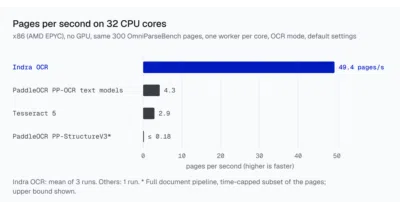
Indra OCR trades heavyweight pipelines for a tiny ONNX recognizer, and somehow still beats Tesseract and PaddleOCR on accuracy.
It gives AI agents complete social media research workflows—outlier detection, comment mining, competitor teardowns—that produce actionable business artifacts instead of raw API responses.
A stdlib-only Python tool that pulls years of chat history out of Claude Code, Cursor, Aider, and seven other AI coding assistants into one normalized JSONL format.
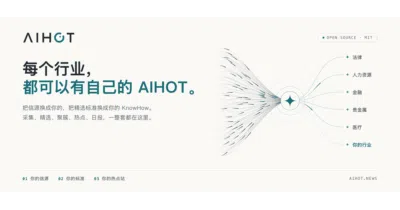
Because one person can't be the expert in every industry, AIHOT open-sources its entire automated newsroom — every prompt and threshold — for anyone to retarget at their own field.
Helix Foundry pulls your scattered company data into one knowledge graph, with an LLM doing the boring schema work for review.
OXR turns PDFs and document images into agent-ready Markdown or JSON, and claims #1 on three parsing benchmarks while being small enough to be fast.
Carrel turns a folder of messy documents into a queryable knowledge base — passages, images, and a knowledge graph — that agents can interrogate via API.
SolarWM exists to make long-horizon video world models reproducible, open-sourcing the full stack from a unified data contract to staged training recipes and checkpoints across three major backbones.
WeChat 4.x can merge-forward whole chats as a ZIP, but Claude and Codex ship no share extension to catch it — WeChatBridge registers twelve and routes the archive into your agent, Obsidian, or the clipboard.
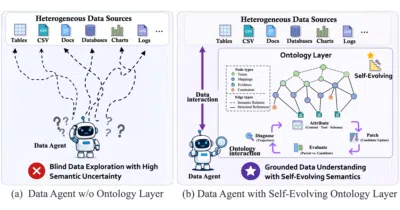
Data agents re-infer your business logic from raw tables on every task; EvoOntology builds a versioned semantic layer over your data and evolves it from execution history, publishing only updates that beat their parent.
GraphGen constructs fine-grained knowledge graphs from source text to generate synthetic QA pairs that target the specific concepts and relationships your model is most likely to get wrong.
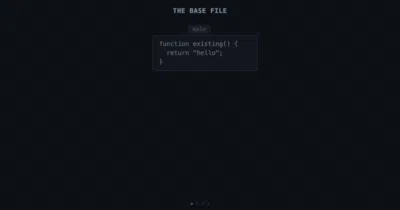
A Rust merge driver that resolves false conflicts by understanding code structure instead of counting lines.
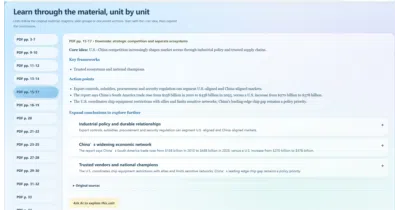
learn-from-materials turns PDFs, books and papers into interactive learning pages where every claim traces back to a source page.
A document-AI toolkit built for the specific miseries of Japanese layout: vertical text, furigana, tables, and handwriting.
designlang reverse-engineers a live website’s design system from the DOM and emits tokens, configs, and component stubs for any platform.
Open-source Claude skills that run SEO and generative-engine optimization on your actual Google data instead of scraped estimates.
Jonex unifies multimodal ingestion, ontology compilation, and source-grounded retrieval into a single governed enterprise platform.
An open-source pipeline that curates, licenses, and retrieves task-specific instructions so agents don't have to wing it.
heatdrop uses Google Analytics to see which pages get read — nothing else. Your call. How we handle data.