ruc-datalab/EvoOntology
A self-editing data dictionary that has to pass review to ship
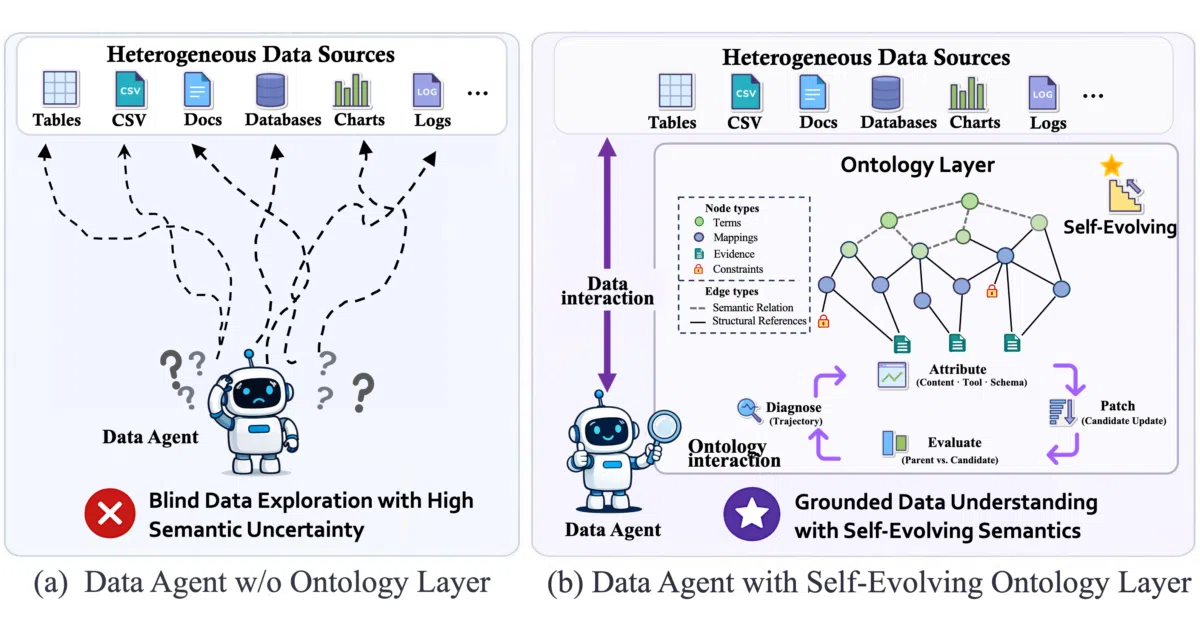
Data agents re-infer your business logic from raw tables on every task; EvoOntology builds a versioned semantic layer over your data and evolves it from execution history, publishing only updates that beat their parent.
Too new to rank. Velocity needs a few days of history.
not enough history yet
star history
What it does
EvoOntology is a plugin for Claude Code and Codex that builds a semantic layer over heterogeneous data — tables, files, databases. Instead of the agent guessing what a metric means or which table holds the entities, it queries an ontology on demand through MCP tools (browse_semantics, resolve_semantics). The ontology records terms, mappings from concepts to actual columns and paths, constraints, and the evidence backing each claim. Between sessions, an evolution agent reads recorded trajectories and proposes localized patches.
The interesting bit
The ontology is treated as trainable agent state — like weights, but inspectable. Every candidate update runs a paired evaluation against its parent (same data, agent, decoding settings, interaction budget) and only ships as ontology_vN+1 if it reproducibly wins. It’s CI for business semantics: rejected candidates are kept as evidence for the next round rather than silently merged.
Key highlights
- Three-layer design: a Content Layer (typed graph of Terms, Mappings, Constraints, Evidence), a Schema Layer fixing the representational rules, and a Tool Layer exposing MCP access plus a compact session manifest.
- Active access: agents pull only the semantics needed for the current step instead of having the whole ontology injected into context.
- Updates are versioned, inspectable, comparable, and reversible — no silent drift.
- Self-reported gains over ReAct without an ontology: +20.0 on DDR-Bench (10-K), +8.8 on BIRD, +1.0 on InsightBench.
- SQLite workloads get built-in read-only task replay, and the repo ships adapters for BIRD, DDR-10K, and InsightBench.
Caveats
- The evolution payoff is uneven: InsightBench moves about one point, so this is not a uniform multiplier.
- All numbers come from the authors’ own paper (a four-backbone subset), not independent replication.
- Outside SQLite, grounding relies on host tools with explicit observation recording — verification is only as good as that pipeline.
Verdict If your agents work over messy, heterogeneous data and keep re-deriving your metric definitions every session, this is a serious attempt at fixing that. If your world is one well-documented database, the payoff is thinner.
Frequently asked
- What is ruc-datalab/EvoOntology?
- Data agents re-infer your business logic from raw tables on every task; EvoOntology builds a versioned semantic layer over your data and evolves it from execution history, publishing only updates that beat their parent.
- Is EvoOntology open source?
- Yes — ruc-datalab/EvoOntology is open source, released under the MIT license.
- What language is EvoOntology written in?
- ruc-datalab/EvoOntology is primarily written in Python.
- How popular is EvoOntology?
- ruc-datalab/EvoOntology has 1.3k stars on GitHub.
- Where can I find EvoOntology?
- ruc-datalab/EvoOntology is on GitHub at https://github.com/ruc-datalab/EvoOntology.