fabio-rovai/open-ontologies
A knowledge graph engine that issues receipts
It materializes ontologies and hands you a Lean-checked certificate for every inference, because asking a reasoner to explain itself usually goes nowhere.
Collecting fresh signals — velocity needs a few days of history.
collecting data…
star history
What it does
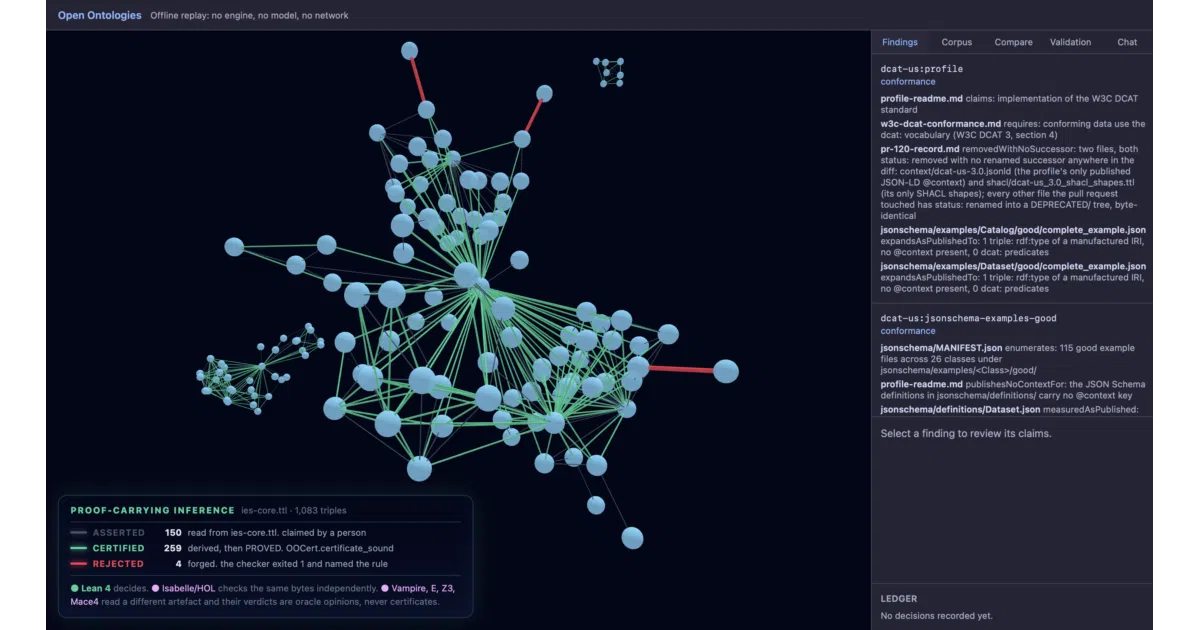
Open Ontologies is a Rust platform for engineering and operating enterprise ontologies and knowledge graphs with Terraform-style lifecycle management—plan changes, assess blast radius, apply, monitor drift, and rollback. It reasons over OWL and RDFS, validates against SHACL, loads data from CSV to DuckDB into RDF, and exports to prover formats like TPTP and SMT-LIB. Every inference produces a derivation certificate—two small TSV files—that anyone can verify later with a separate checker, no network or running instance required.
The interesting bit
The engine and checker are intentionally estranged: an untrusted Rust engine writes certificates, and a proved-sound Lean 4 checker (with an independent Isabelle/HOL kernel) reads them. If the engine bugs out, a conclusion is forged, or you sneak in a custom rule, the checker rejects it and names the offending line and rule. The tool is also unusually honest about its limits—where an answer is measured rather than proved, it says so, and unsatisfiability claims carry no certificate.
Key highlights
- Proof-carrying inference: each derivation ships with a certificate that a core-Lean-4 checker (no Mathlib) accepts or rejects
- Tamper detection: editing a conclusion after the run changes the verdict to refused, exit 1, with the rule and premises exposed
- Honest rule provenance: built-in rules yield
entailed, while your own SWRL, RIF Core, or Horn rules yieldentailed_under_supplied_rules, enforced by tests - Assistant-native: speaks MCP, so Claude or Cursor can drive ontology changes and reasoning in conversation
- Data flexibility: ingests CSV, JSON, XML, YAML, XLSX, Parquet, PostgreSQL, and DuckDB into RDF
Caveats
- Storage is in-memory by default; persistence requires explicitly setting
OPEN_ONTOLOGIES_STORAGE_MODE, or the store evaporates - Certificates prove logical entailment from the listed assertions, but do not bind those assertions to your actual database—closing that gap is an open issue (#158)
- Unsatisfiability answers and some inconsistency results are engine opinions, not proved; the README is explicit that no certificate backs them
Verdict
Reach for it if you operate knowledge graphs under audit, compliance, or cross-organizational distrust and need more than a screenshot of a reasoner’s output. Avoid it if you just want a quick SPARQL endpoint or triplestore without the proof ceremony.
Frequently asked
- What is fabio-rovai/open-ontologies?
- It materializes ontologies and hands you a Lean-checked certificate for every inference, because asking a reasoner to explain itself usually goes nowhere.
- Is open-ontologies open source?
- Yes — fabio-rovai/open-ontologies is open source, released under the MIT license.
- What language is open-ontologies written in?
- fabio-rovai/open-ontologies is primarily written in Rust.
- How popular is open-ontologies?
- fabio-rovai/open-ontologies has 504 stars on GitHub.
- Where can I find open-ontologies?
- fabio-rovai/open-ontologies is on GitHub at https://github.com/fabio-rovai/open-ontologies.