wquguru/harness-books
Two books on the engineering that keeps AI agents from going rogue
Not prompt tricks—control structures: how Claude Code and Codex constrain, recover, and govern model behavior inside real workflows.
Not currently ranked — collecting fresh signals.
star history
What it does
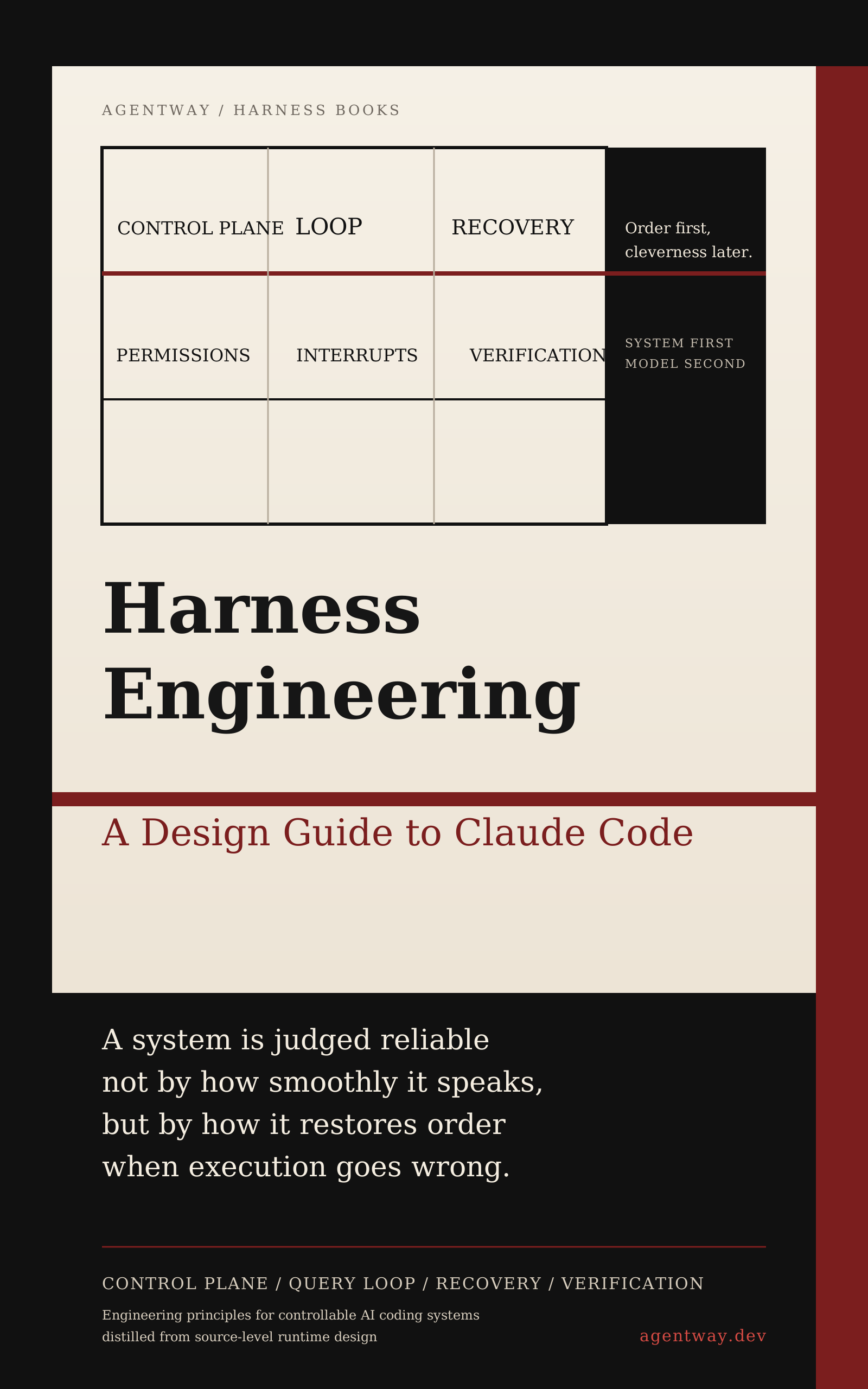
This repo publishes two free books on “harness engineering”—the architecture around code-writing AI agents. Book 1 dissects Claude Code’s runtime: query loops, tool permissions, context governance, failure recovery, multi-agent verification. Book 2 compares Claude Code against Codex, mapping where each system places order (prompt assembly vs. instruction fragments, runtime discipline vs. structured control layers). Both are readable online or as PDFs; the repo also contains build tooling to assemble the Honkit-based sites.
The interesting bit
The core argument is that prompts aren’t chat-window sugar—they’re part of the control plane. The real risk isn’t an occasional wrong answer; it’s a system with no structure for handling consequences. That’s a shift from “make the model smarter” to “make the system accountable.”
Key highlights
- Book 1 traces why agent systems need components like control planes, recovery paths, and team-level rules—not just better prompts
- Book 2 compares Claude Code and Codex as divergent harness designs, not feature checklists
- Includes source maps grounding claims in actual files (Appendix C in Book 1, Appendix A in Book 2)
- Executable checklists for turning principles into constraints (both books)
- Built with locale-aware Honkit; local build scripts provided
Caveats
- The repo is primarily content and build tooling, not a runnable harness you can install
- No quantitative benchmarks or empirical evaluations—claims are architectural and conceptual
- The “Python” language tag is misleading; the build scripts are Python, the books are prose
Verdict
Worth your time if you’re building or adopting coding agents and need a framework for thinking about control, not just output quality. Skip if you want copy-paste prompts or a ready-to-deploy system.
Frequently asked
- What is wquguru/harness-books?
- Not prompt tricks—control structures: how Claude Code and Codex constrain, recover, and govern model behavior inside real workflows.
- Is harness-books open source?
- Yes — wquguru/harness-books is an open-source project tracked on heatdrop.
- What language is harness-books written in?
- wquguru/harness-books is primarily written in Python.
- How popular is harness-books?
- wquguru/harness-books has 3.2k stars on GitHub.
- Where can I find harness-books?
- wquguru/harness-books is on GitHub at https://github.com/wquguru/harness-books.