wpydcr/LLM-Kit
The Swiss Army knife for Chinese LLM tinkerers
A Gradio-based WebUI that bundles model serving, fine-tuning, voice synthesis, live2d avatars, and database agents into one download—mostly for local Chinese models.
Not currently ranked — collecting fresh signals.
star history
What it does
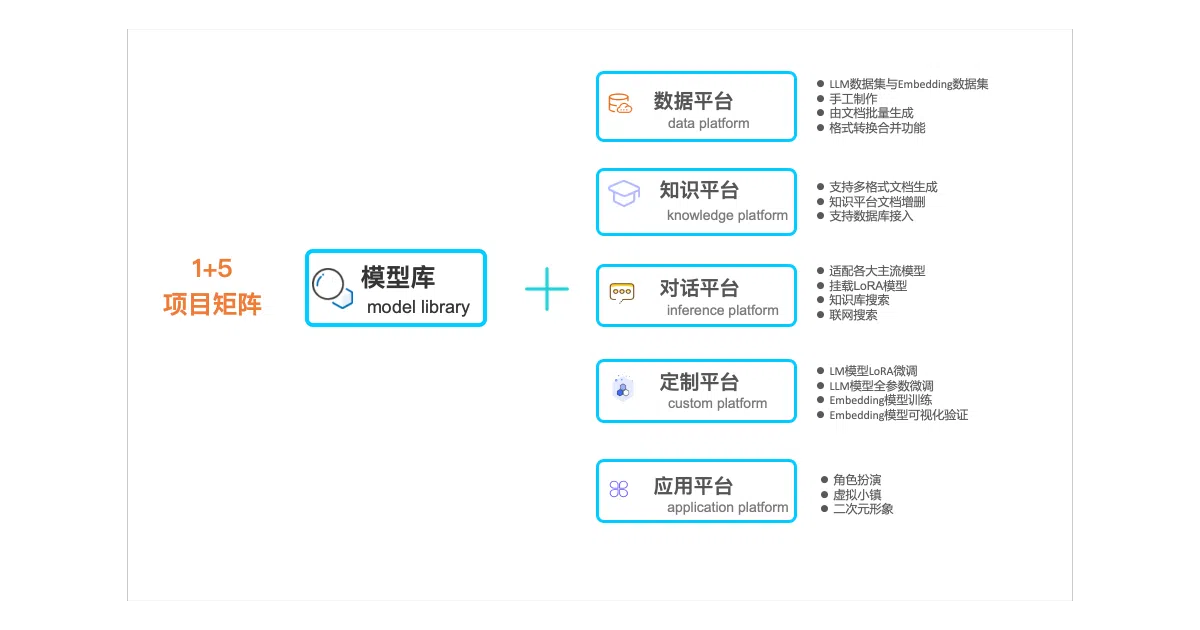
LLM-Kit (“Su Qin”) is a Gradio web interface that wraps the full lifecycle of Chinese-centric LLMs into a single install. It connects to major Chinese and Western APIs (OpenAI, Wenxin, Tongyi Qianwen, Claude, etc.), runs local models like ChatGLM and Baichuan, and adds RAG via FAISS, MySQL database agents, LoRA/full fine-tuning, dataset preparation, Midjourney image generation, plus voice (VITS/SVC) and Live2D avatar mouths. The pitch: zero code, one download, your own customized model and application.
The interesting bit
The scope is almost comically broad—it’s less a toolkit than a whole lab bench wired together. The value is in the wiring: Chinese developers get quantized local inference, API fallbacks, and training pipelines in one place, with Baidu Pan links for pre-packaged Windows/Linux dependencies so you don’t fight conda for three hours.
Key highlights
- Supports 10+ LLM APIs and a dozen local Chinese models (ChatGLM, Baichuan, Qwen, InternLM, etc.) with 4-bit/8-bit quantization
- Fine-tuning via LoRA or full parameters; embedding model training for BERT/SentenceBERT architectures
- RAG with FAISS, MySQL database access via ChatDB-style integration, and agent tooling
- Voice pipeline: online TTS, local TTS, VITS inference, SVC voice conversion; Live2D mouth sync and scene customization
- Dataset format conversion tools for both LLM and embedding training data
- AGPL-3.0 licensed with explicit commercial licensing available (the README spends unusual energy on this)
Caveats
- Windows users hit friction: bitsandbytes quantization and DeepSpeed training are Linux-only; DeepSpeed inference on Windows requires manual compilation
- Several roadmap items are checked off with strikethrough or remain unfinished (P-Tuning is crossed out, multi-modal Qwen-VL pending, AI agent design not implemented, VITS/SVC training missing, API deployment mode not started)
- Documentation and dependency bundles live on Baidu Pan, which is inaccessible without a Chinese phone number—international users are second-class
Verdict
Worth a look if you’re a Chinese-speaking developer who wants to prototype LLM applications locally without stitching together a dozen repos. Skip it if you need stable, production-grade infrastructure or if you’re outside China and can’t access the Baidu ecosystem.
Frequently asked
- What is wpydcr/LLM-Kit?
- A Gradio-based WebUI that bundles model serving, fine-tuning, voice synthesis, live2d avatars, and database agents into one download—mostly for local Chinese models.
- Is LLM-Kit open source?
- Yes — wpydcr/LLM-Kit is open source, released under the AGPL-3.0 license.
- What language is LLM-Kit written in?
- wpydcr/LLM-Kit is primarily written in Python.
- How popular is LLM-Kit?
- wpydcr/LLM-Kit has 554 stars on GitHub.
- Where can I find LLM-Kit?
- wpydcr/LLM-Kit is on GitHub at https://github.com/wpydcr/LLM-Kit.