vastsa/PI-Desktop
Your AI Coder Moves Into Its Own Desktop Workspace
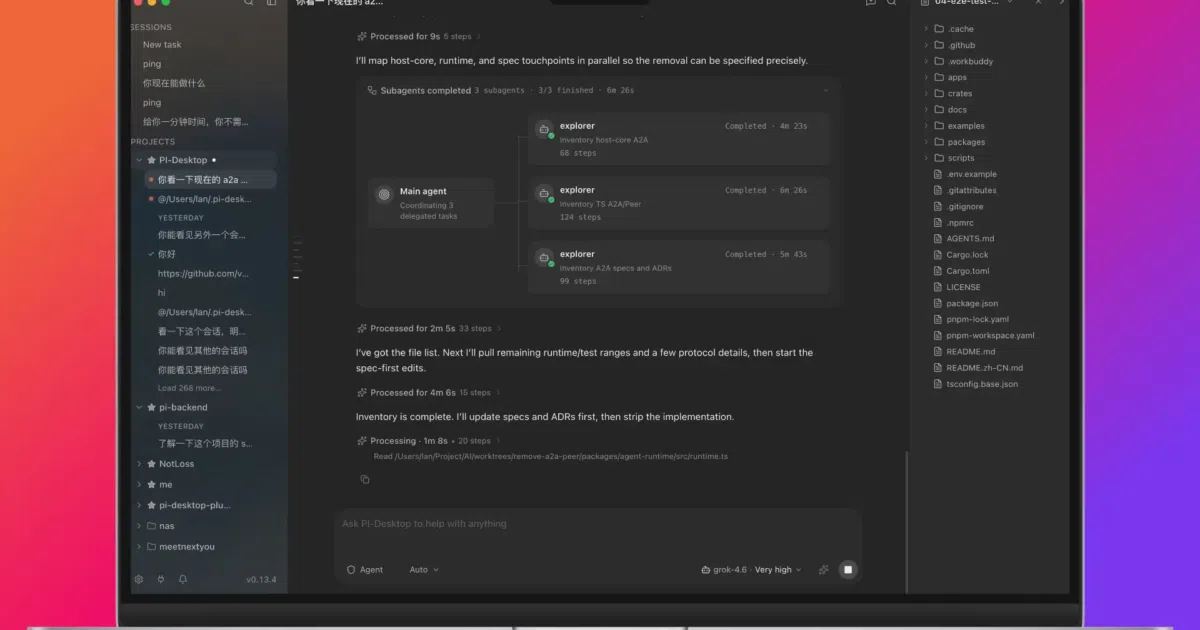
PI-Desktop gives AI coding agents a workspace of their own, separate from any editor or terminal, so you can bring your own model and stay in control.
Feature · 15 Sep 2026
PI-Desktop Was Built by AI Models, for AI Coders
A local-first desktop workspace that separates the UI from the agent loop, treats permission as a first-class concern, and refuses to lock you into a single model or editor.
Read the in-depth article →
Velocity · 7d
+38
★ / day
Trend
↘cooling
star history
What it does
PI-Desktop is a cross-platform desktop application that runs AI coding agents outside your editor or terminal, giving them a standalone environment for long-running sessions across multiple local projects. It connects to whatever model you supply—OpenAI, Anthropic, Ollama, or any OpenAI-compatible endpoint—and lets agents read files, edit code, and run commands through a permission layer backed by a Rust host core. A React UI handles the workspace, while a separate sidecar process manages the agent loop and model streaming.
The interesting bit
The architecture treats the renderer as untrusted—no Node integration—while privileged operations live in a Rust core and the agent loop runs in its own sidecar. That separation is unusual for an Electron app, and it means the agent can only touch your filesystem after the Rust layer approves the action.
Key highlights
- Three autonomy modes: Agent (full loop), Plan (frozen plan awaits approval), and Goal (outcome-first, agent picks the path).
- Subagents can spin up in the background for exploration, multi-file implementation, or adversarial review, then report back.
- Plugins install via
.piplugpackages; the app also supports MCP servers and reusable Skills. - Conversations store locally as JSONL with a SQLite index; API credentials live in the OS keychain; no PI-Desktop telemetry or mandatory relay.
- Imports existing sessions from Claude Code, Codex, OpenCode, and Pi.
Caveats
- The project is explicitly in early preview; APIs, extension interfaces, and desktop behaviors may evolve.
- macOS builds are not yet code-signed or notarized, so Gatekeeper will likely complain.
- Plugin processes are isolated from the renderer but are still user-trusted code rather than a full OS sandbox.
Verdict
Worth a look if you want a vendor-neutral, local-first home for AI agents that doesn’t hijack your IDE. Skip it if you need a mature, battle-tested toolchain today.
Frequently asked
- What is vastsa/PI-Desktop?
- PI-Desktop gives AI coding agents a workspace of their own, separate from any editor or terminal, so you can bring your own model and stay in control.
- Is PI-Desktop open source?
- Yes — vastsa/PI-Desktop is open source, released under the LGPL-3.0 license.
- What language is PI-Desktop written in?
- vastsa/PI-Desktop is primarily written in TypeScript.
- How popular is PI-Desktop?
- vastsa/PI-Desktop has 7.3k stars on GitHub and is currently cooling off.
- Where can I find PI-Desktop?
- vastsa/PI-Desktop is on GitHub at https://github.com/vastsa/PI-Desktop.