topoteretes/cognee
A hippocampus for your LLM agents
Cognee gives AI agents persistent memory by treating documents as a living knowledge graph rather than a vector dump.
Feature · 28 Jun 2026
Why Agent Memory Requires More Than Vector Search
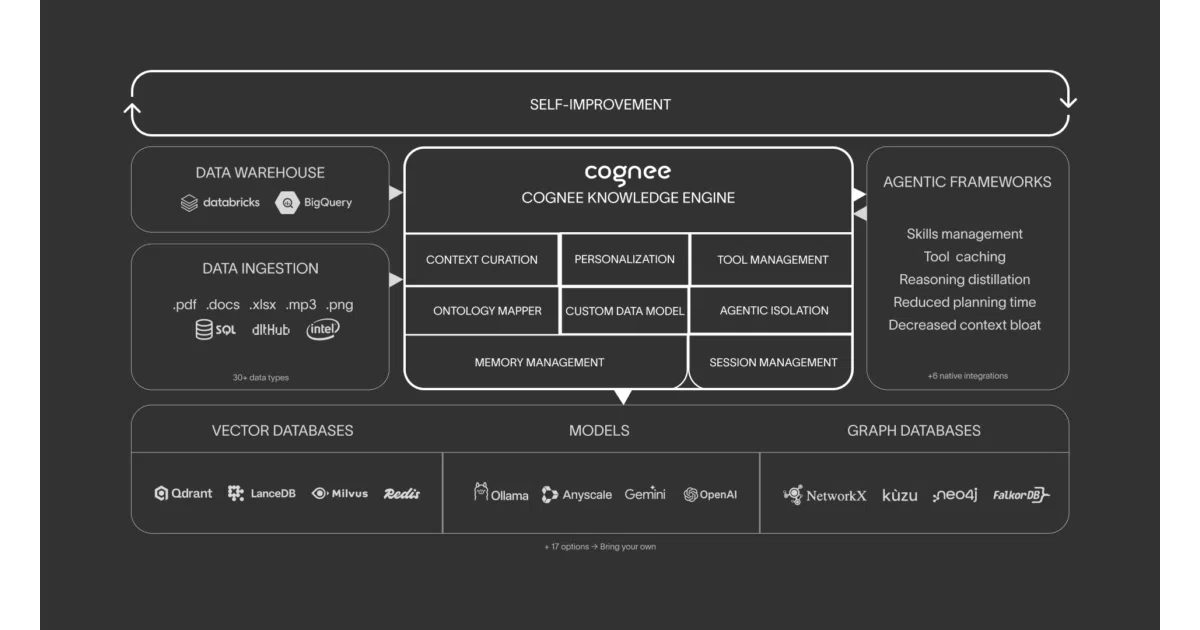
Cognee is an open-source memory control plane that turns documents, interactions, and feedback into a self-improving knowledge graph so agents can recall facts, relationships, and context across sessions.
Read the in-depth article →
Velocity · 7d
+28
★ / day
Trend
↘cooling
star history
What it does
Cognee is an open-source memory layer for AI agents that ingests data in any format and stores it as a queryable knowledge graph. It exposes four operations — remember, recall, forget, and improve — with auto-routing between fast session cache and slower permanent storage. Agents can share memory across sessions, retrieve by semantic similarity, or follow relationship edges through the graph.
The interesting bit The project explicitly marries embeddings with graph structure and “cognitive science approaches,” which is a fancy way of saying it tries to model how memory actually works: quick session recall plus slower consolidation into long-term storage. There’s also a Claude Code plugin that hooks the agent lifecycle — capturing tool calls, injecting context at prompt time, and bridging session data into the graph when the session ends.
Key highlights
- Self-hostable with one-click deploys to Modal, Railway, Fly.io, Render, and Daytona, plus a managed Cognee Cloud option
- Multimodal ingestion, ontology grounding, and tenant isolation built in
- OTEL collector and audit traits for tracing what the agent remembered and why
- Published research paper on optimizing knowledge graphs for LLM reasoning
- Active plugin ecosystem: Claude Code, OpenClaw, and community add-ons
Caveats
- The README is heavy on quickstart and setup instructions but light on architectural depth; exactly how the cognitive-science models translate to code is unclear
- Several feature claims (“continuously learns,” “cross-agent knowledge sharing”) are stated as goals rather than demonstrated mechanisms
- Requires Python 3.10–3.14; no mention of async backend scalability limits
Verdict Worth evaluating if you’re building agents that need to remember state across long horizons and you’re unsatisfied with naive RAG. Skip it if you just need a vector database — this is heavier infrastructure with a steeper conceptual model.
Frequently asked
- What is topoteretes/cognee?
- Cognee gives AI agents persistent memory by treating documents as a living knowledge graph rather than a vector dump.
- Is cognee open source?
- Yes — topoteretes/cognee is open source, released under the Apache-2.0 license.
- What language is cognee written in?
- topoteretes/cognee is primarily written in Python.
- How popular is cognee?
- topoteretes/cognee has 32.8k stars on GitHub and is currently cooling off.
- Where can I find cognee?
- topoteretes/cognee is on GitHub at https://github.com/topoteretes/cognee.