topoteretes/awesome-ai-memory
A curated map of the AI memory land grab
This curated roster sorts dozens of AI memory tools by storage type, license, and function so you can stop guessing.
Not currently ranked — collecting fresh signals.
star history
What it does
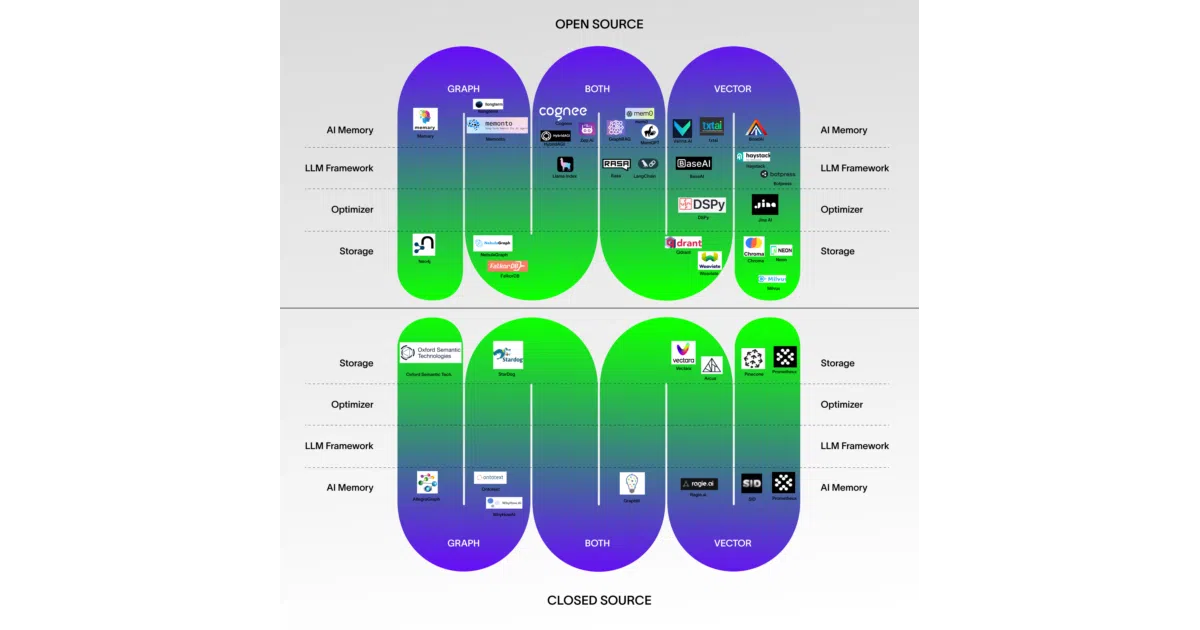
This repository is a curated awesome-list that catalogs over 40 projects in the AI memory space, from open-source vector stores like Chroma and Qdrant to managed memory layers like Mem0 and Zep. It classifies each entry along three axes: open versus closed source, storage paradigm—graph, vector, or both—and functional role, whether pure storage, LLM framework, optimizer, or dedicated memory tool. Think of it as a reference spreadsheet for an ecosystem that currently has more acronyms than architecture.
The interesting bit
The list is maintained by the creators of cognee, one of the projects in the directory, which gives it the slightly self-interested but genuinely informed perspective of a team living in this space daily. The multi-dimensional taxonomy is more granular than a typical flat awesome-list, letting you filter for something as specific as an open-source graph memory tool without reading forty READMEs.
Key highlights
- Covers over 40 projects, split between open-source repositories and closed-source vendors
- Categories include dedicated memory tools (MemGPT, GraphRAG), LLM frameworks (LlamaIndex, LangChain), optimizers (DSPy), and raw storage (Neo4j, Milvus)
- Each entry tagged by storage paradigm: graph, vector, or hybrid
- Includes an ecosystem infographic mapping the landscape visually
- Maintained by the cognee team, who accept pull requests for missing entries
Caveats
- It is a static markdown table, not a comparative analysis: there are no benchmarks, feature matrices, or maturity ratings
- A few entries stretch the definition of “AI memory”; Prometheus, for instance, is primarily a monitoring system, yet appears as a graph memory tool
- Coverage is necessarily incomplete; the authors explicitly note there may be many companies they are not aware of
Verdict
Worth bookmarking if you are evaluating memory infrastructure for an AI agent or RAG pipeline and want a quick lay of the land. Skip it if you need detailed benchmarks or architectural guidance; this is a phone book, not a review.
Frequently asked
- What is topoteretes/awesome-ai-memory?
- This curated roster sorts dozens of AI memory tools by storage type, license, and function so you can stop guessing.
- Is awesome-ai-memory open source?
- Yes — topoteretes/awesome-ai-memory is open source, released under the Apache-2.0 license.
- What language is awesome-ai-memory written in?
- topoteretes/awesome-ai-memory is primarily written in Python.
- How popular is awesome-ai-memory?
- topoteretes/awesome-ai-memory has 888 stars on GitHub.
- Where can I find awesome-ai-memory?
- topoteretes/awesome-ai-memory is on GitHub at https://github.com/topoteretes/awesome-ai-memory.