stochasticai/xTuring
Wrap LoRA, INT4, and DeepSpeed into one fine-tuning API
xTuring lets you fine-tune and run private LLMs on your own hardware by wrapping the messy stack of LoRA, quantization, and DeepSpeed into a single Python API.
Not currently ranked — collecting fresh signals.
star history
What it does
xTuring is a Python library that wraps the end-to-end lifecycle of open-source LLMs—data loading, fine-tuning, evaluation, and inference—into a single BaseModel API. It targets privacy-conscious users who want to run everything locally or inside a VPC, and it supports a wide model zoo including LLaMA, Mistral, Qwen3, GPT-OSS, and even the 0.6B-parameter Qwen3 for CPU experimentation. Under the hood it handles the tedious parts: LoRA adapters, INT8/INT4 quantization via GenericLoraKbitModel, DeepSpeed integration, and Intel-optimized CPU kernels.
The interesting bit
The project treats hardware elasticity as a first-class concern. You can start with a toy model on a laptop using the qwen3_0_6b_lora checkpoint, then promote the same code to a multi-GPU node for a 120B parameter GPT-OSS model by simply changing a string key. The README also includes a striking performance table: on 4×A100s, training LLaMA-7B with LoRA and DeepSpeed drops from 21 hours per epoch to 20 minutes compared to full offloading. That is not a minor optimization; it is the difference between an overnight experiment and a coffee break.
Key highlights
- Supports a broad registry of models—LLaMA/LLaMA 2, Mistral, MiniMax M2, GPT-J, GPT-2, Mamba, and others—addressable through simple string keys like
llama2_lora_int8. - Built-in low-precision training paths: INT8 and INT4 quantization, plus LoRA, including a combined
LoRA + INT4mode viaGenericLoraKbitModel. - Evaluation support is currently limited to perplexity, but it works on any causal LM and any dataset you load.
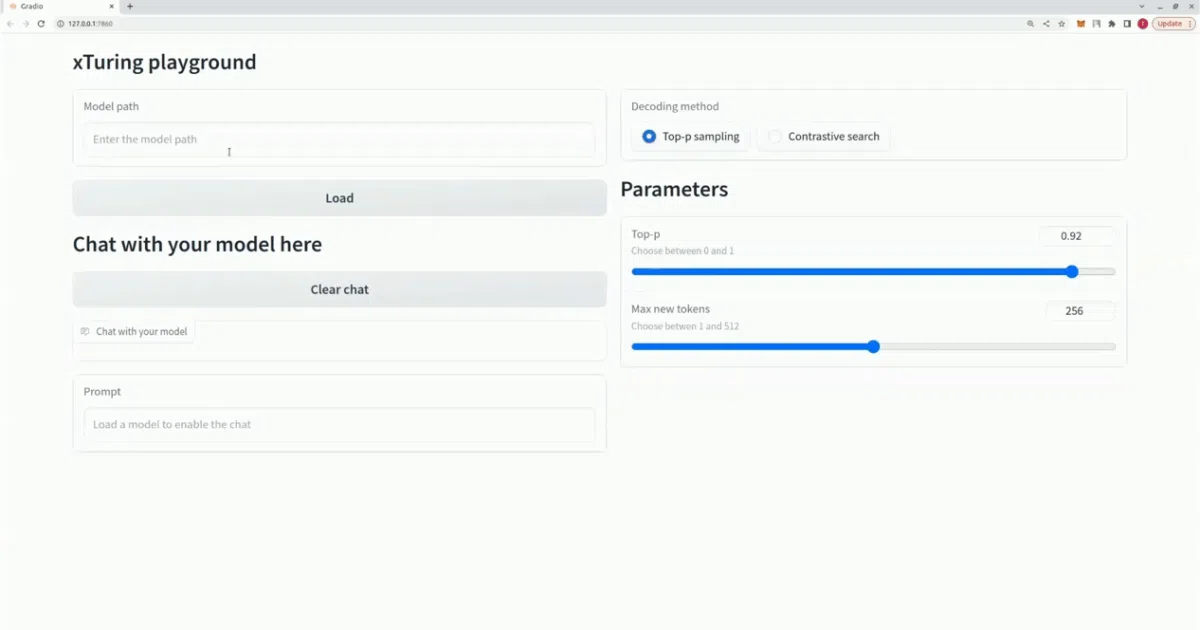
- Ships with both a CLI chat interface and a localhost UI playground for rapid manual testing after fine-tuning.
- Provides pre-fine-tuned Alpaca checkpoints for DistilGPT-2 and LLaMA LoRA that you can load immediately with
BaseModel.load.
Caveats
- Evaluation metrics are thin: only perplexity is supported so far, so you will need external tooling for task-specific benchmarks.
- The INT4 path uses a separate
GenericLoraKbitModelclass rather than the standardBaseModel.createregistry, which fractures the otherwise uniform API slightly. - Several roadmap items—INT3/INT2/INT1 quantization and Stable Diffusion support—remain unchecked, so the feature set is still evolving.
Verdict
Good for teams that want to experiment with private fine-tuning without hand-rolling HuggingFace, PEFT, and DeepSpeed integrations. Skip it if you need advanced evaluation suites, non-causal architectures, or quantization levels beyond INT4.
Frequently asked
- What is stochasticai/xTuring?
- xTuring lets you fine-tune and run private LLMs on your own hardware by wrapping the messy stack of LoRA, quantization, and DeepSpeed into a single Python API.
- Is xTuring open source?
- Yes — stochasticai/xTuring is open source, released under the Apache-2.0 license.
- What language is xTuring written in?
- stochasticai/xTuring is primarily written in Python.
- How popular is xTuring?
- stochasticai/xTuring has 2.7k stars on GitHub.
- Where can I find xTuring?
- stochasticai/xTuring is on GitHub at https://github.com/stochasticai/xTuring.