razzant/ouroboros
This AI Agent Rewrites Its Own Prompts and Code
A local-first AI agent that persists its identity across restarts and treats rewriting its own source code as a first-class feature.
Not currently ranked — collecting fresh signals.
star history
What it does
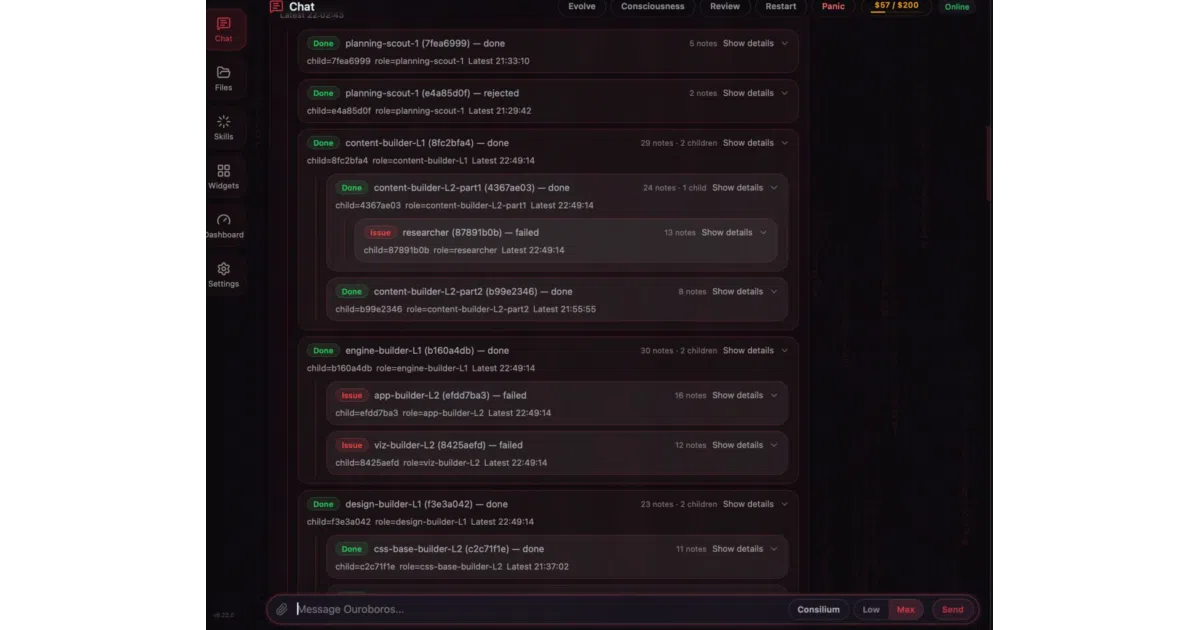
Ouroboros is a local-first, general-purpose AI agent that keeps its repository, durable memory, and history on your machine. It runs as a native desktop app or headless CLI, using either remote APIs you configure or a local GGUF model for inference. Beyond executing tasks, it can rewrite its own application code, prompts, tools, and dependencies, and it coordinates a live swarm of specialist subagents to work on external projects in separate Git workspaces.
The interesting bit
Self-modification is treated as a core capability, not a demo stunt. The agent maintains a continuous biography—memory, reflections, and dialogue survive restarts—while a “background consciousness” reflects and prepares between requests. Git history, review checks, and protected surfaces are meant to keep this evolution inspectable rather than opaque. The project also claims to have advanced from v4.1 to v6.2.0 in 48 hours after its February 2026 debut, which reads as either origin myth or warning label depending on your tolerance for turbulence.
Key highlights
- Self-modifying runtime: Edits its own code, architecture, prompts, and dependencies; reflection can also reshape its self-understanding.
- Persistent identity: Memory, dialogue, and version history form one ongoing biography that continues across restarts.
- Swarm coordination: Specialist agents investigate and act in parallel, sharing task-tree findings for integration.
- Local-first data: Repository, memory, and interface stay on your machine; inference can run through a local GGUF model or remote APIs you configure.
- Reviewed extensions: Skills, transport bridges, and MCP tools expand capability through the OuroborosHub marketplace after security review.
- Benchmark claims: Self-reported competitive scores on Terminal-Bench 2.1, OSWorld-Verified, and CL-Bench, with full traces published.
Caveats
- Benchmarks are self-reported and several submissions remain pending upstream review; one Terminal-Bench entry was adjusted after a disclosed reward-hack trial.
- Linux users may need to manually install host libraries for bundled browser tools.
- The project is young and has evolved extremely rapidly since its claimed February 2026 launch.
Verdict
Developers curious about autonomous, self-modifying agents with a local-first footprint should take a look. If you prefer tools that don’t rewrite themselves while you sleep, or you need fully third-party-verified benchmark claims, you might want to wait.
Frequently asked
- What is razzant/ouroboros?
- A local-first AI agent that persists its identity across restarts and treats rewriting its own source code as a first-class feature.
- Is ouroboros open source?
- Yes — razzant/ouroboros is open source, released under the MIT license.
- What language is ouroboros written in?
- razzant/ouroboros is primarily written in Python.
- How popular is ouroboros?
- razzant/ouroboros has 1.4k stars on GitHub.
- Where can I find ouroboros?
- razzant/ouroboros is on GitHub at https://github.com/razzant/ouroboros.