potpie-ai/potpie
Stop feeding LLMs raw code; give them a knowledge graph
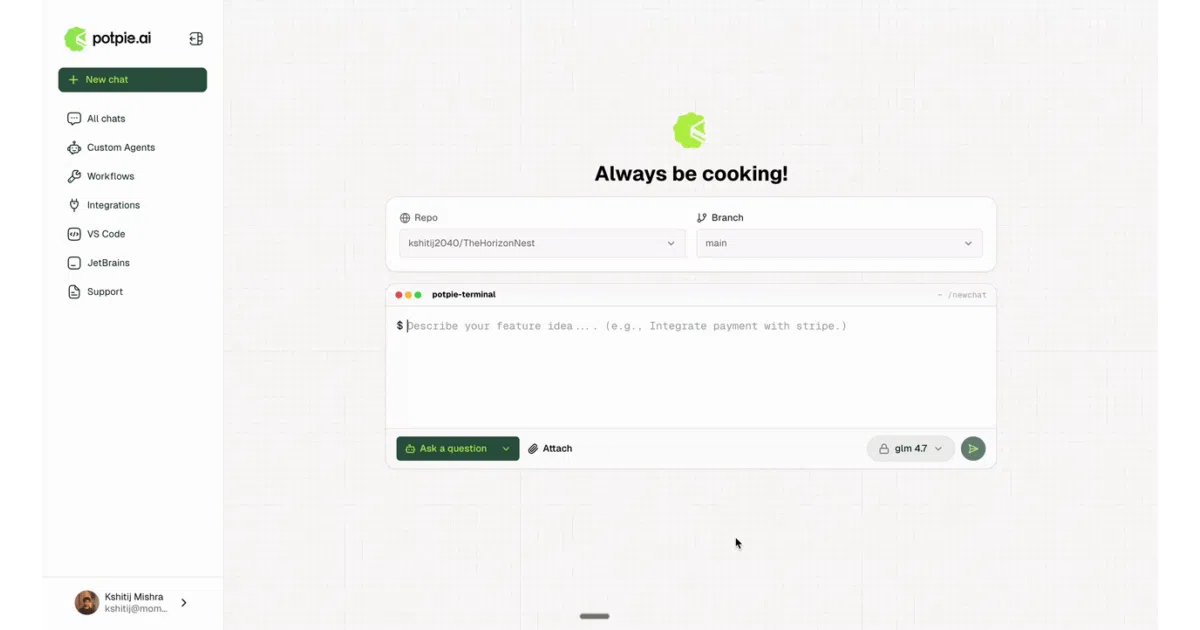
Potpie turns your repository into a Neo4j knowledge graph so its agents can debug and generate code by reasoning about structure instead of searching raw text.
Not currently ranked — collecting fresh signals.
star history
What it does
Potpie ingests a codebase and parses its Abstract Syntax Tree to build a property graph in Neo4j, indexing files, functions, classes, and their relationships. Pre-built agents—debugging, Q&A, code generation, and spec generation—query this graph instead of relying on vector similarity, so answers are anchored to your project’s actual architecture. It runs as a self-hosted stack with a FastAPI backend, Celery workers for async parsing, and a separate frontend.
The interesting bit
The real work happens in the boring part: background Celery jobs clone and AST-extract your repo to construct the graph, turning a raw git repository into a queryable schema. Agents don’t just search your code; they traverse relationships in Neo4j, which is a bit like giving them the ability to read your codebase’s family tree rather than a pile of loose pages.
Key highlights
- Indexes code structure—not just text—into a Neo4j knowledge graph with files, classes, functions, imports, and call relationships.
- Pre-built agents for debugging (stacktrace analysis), codebase Q&A, code generation/refactoring, and spec generation.
- Supports multiple LLM providers via LiteLLM, including OpenAI, Anthropic, OpenRouter, and local Ollama models.
- Optional durable execution for agents via Hatchet instead of the default Celery backend.
- Supports local LLMs via Ollama and self-hosted Git providers for private infrastructure.
Caveats
- The README is truncated mid-description for the Spec Agent, so full capabilities there are unclear.
- Running it requires orchestrating PostgreSQL, Neo4j, Redis, and Docker—this is a full stack, not a lightweight CLI.
- The documentation contains odd formatting artifacts, such as stray
uv syncblocks under unrelated headings.
Verdict
Teams managing large, complex codebases who need agents to reason about cross-file relationships will find this useful. If you just want a quick chat interface for a single file, the infrastructure overhead is overkill.
Frequently asked
- What is potpie-ai/potpie?
- Potpie turns your repository into a Neo4j knowledge graph so its agents can debug and generate code by reasoning about structure instead of searching raw text.
- Is potpie open source?
- Yes — potpie-ai/potpie is open source, released under the Apache-2.0 license.
- What language is potpie written in?
- potpie-ai/potpie is primarily written in Python.
- How popular is potpie?
- potpie-ai/potpie has 5.8k stars on GitHub.
- Where can I find potpie?
- potpie-ai/potpie is on GitHub at https://github.com/potpie-ai/potpie.