open-edge-platform/geti
Intel’s shortcut from 20 images to a deployed vision model
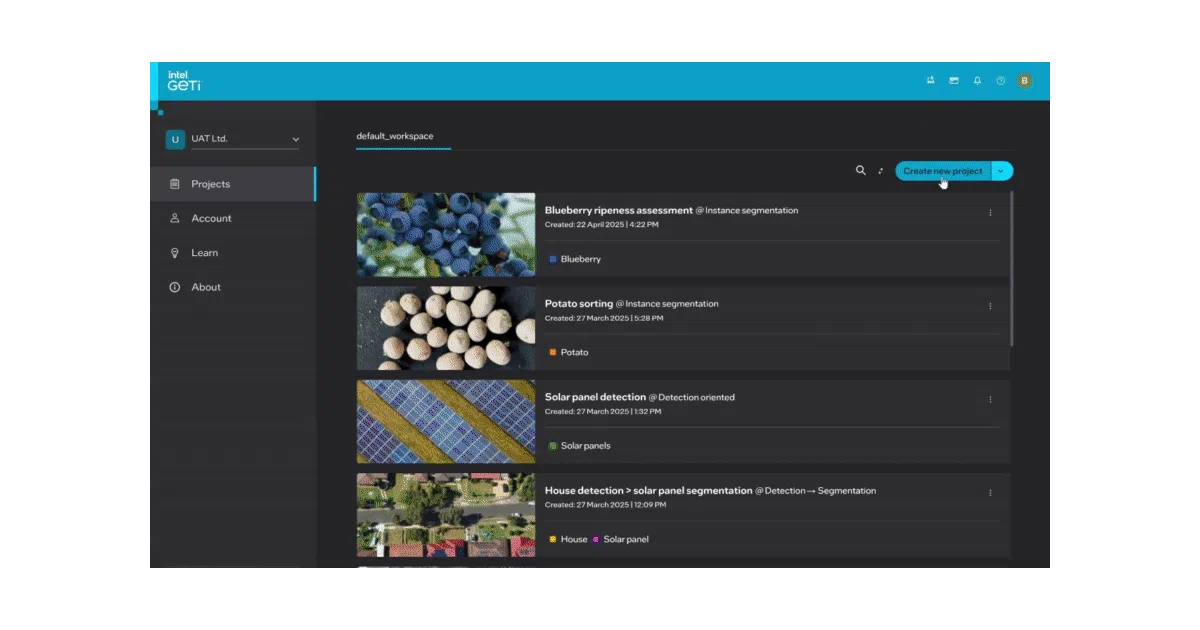
Geti tries to compress the full computer vision lifecycle into a web UI that demands as few as ten images and a Kubernetes cluster.
Not currently ranked — collecting fresh signals.
star history
What it does
Geti is an end-to-end computer vision platform that runs as a Kubernetes-native distributed system. Users annotate images in a browser, train models on architectures like YOLOX or EfficientNet, and export OpenVINO-optimized binaries for Intel CPUs, GPUs, and VPUs. The loop—dataset preparation, active learning, evaluation, and edge deployment—is orchestrated through microservices behind a web front end.
The interesting bit
The project bets on extreme data efficiency: it claims useful models from 10–20 images via active learning and Visual Prompting powered by Meta’s Segment Anything Model. That is a genuine technical bet, though the price of admission is standing up a full K8s stack rather than running a single Python script.
Key highlights
- Active learning selects the most informative samples automatically, theoretically shrinking the labeling burden to a handful of images.
- Smart annotation and Visual Prompting borrow SAM and other models to generate bounding boxes and masks with minimal human clicks.
- Supports chaining multiple tasks—say, detection followed by classification—so teams can build modular pipelines instead of monolithic models.
- Exports production models in OpenVINO format for Intel’s XPU portfolio, or in PyTorch if you prefer to leave the ecosystem.
- Anomaly detection is included out of the box via Padim, STFPM, and UFlow architectures.
Caveats
- The software is distributed under Intel’s “Limited Edge Software Distribution License,” which is not a standard open-source license; check the terms before redistributing.
- Despite being pitched to “anyone,” the system requires Kubernetes orchestration even for local-machine deployment, so it is not a lightweight script.
- Training and optimization are tightly coupled to Intel silicon: fine-tuning targets Intel Arc GPU B-series, and inference is explicitly optimized for the Intel XPU portfolio.
Verdict
Worth a look if you are already embedded in Intel’s hardware ecosystem and need to bootstrap vision models without massive datasets. Skip it if you want a hackable, lightweight Python framework or if your stack runs on non-Intel accelerators.
Frequently asked
- What is open-edge-platform/geti?
- Geti tries to compress the full computer vision lifecycle into a web UI that demands as few as ten images and a Kubernetes cluster.
- Is geti open source?
- Yes — open-edge-platform/geti is an open-source project tracked on heatdrop.
- What language is geti written in?
- open-edge-platform/geti is primarily written in TypeScript.
- How popular is geti?
- open-edge-platform/geti has 1.3k stars on GitHub.
- Where can I find geti?
- open-edge-platform/geti is on GitHub at https://github.com/open-edge-platform/geti.