nicedreamzapp/claude-code-local
Claude Code without the cloud bill or the NDA panic
It tricks Claude Code into talking to local MLX and DeepSeek models instead of Anthropic’s servers, so your code never leaves the Mac.
Not currently ranked — collecting fresh signals.
star history
What it does
This repo turns an Apple Silicon Mac into an on-device inference stack that exposes local models through an Anthropic-compatible API. That lets Anthropic’s own claude-code CLI run against quantized local brains—Qwen, Gemma, Llama, and DeepSeek V4 Flash—instead of cloud servers. The project positions itself as the “brain” of a four-part ambient-computing stack, with sibling repos handling voice and remote browser access.
The interesting bit
The author builds and hosts custom “abliterated” MLX quantizations, then wraps them in launchers and a local server so Claude Code needs zero reconfiguration to go offline. For the 1-million-context DeepSeek V4 Flash, it swaps Apple’s MLX for Antirez’s bare-metal ds4 engine—pure C and Metal kernels—and persists the KV cache to disk so the massive system prompt prefills exactly once. It is essentially a compatibility layer pretending to be a datacenter, which is a lot of engineering to avoid a network request.
Key highlights
- Qwen 3.5 122B, Gemma 4 31B, Llama 3.3 70B, and DeepSeek V4 Flash (1M context) served via MLX or Antirez’s
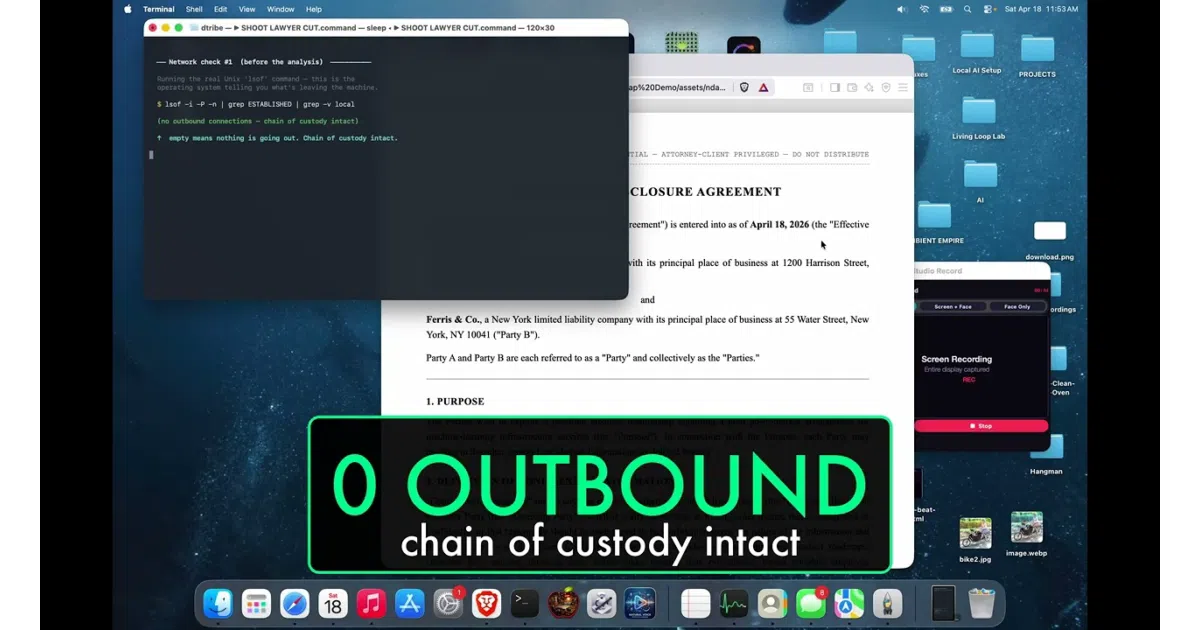
ds4engine. - Fully offline and airgap-ready; the README demos NDA review with Wi-Fi physically disabled and
lsofrunning live. - Custom “abliterated” MLX quantizations hosted on HuggingFace, not generic mirrors.
- RAM floor is 32 GB for Gemma, 96 GB for Qwen, and 128 GB for DeepSeek.
- Voice and browser-remote access are handled by separate repos in the four-part “ambient” stack.
Caveats
- The hardware bar is high: the README lists minimum RAM at 32 GB for the smallest model and 128 GB for DeepSeek V4 Flash.
- The documentation is interleaved with marketing for a pre-configured Mac mini (“AirGap Box”) and a $19 agent pack, which blurs the line between open-source project and product storefront.
- Voice and browser features rely on companion repositories that are mentioned but not detailed here.
Verdict
If you handle sensitive code or documents on a maxed-out Apple Silicon Mac and want Claude Code without egress, this is a direct path. If you are RAM-constrained, running Intel, or simply prefer other front-ends, it is not for you.
Frequently asked
- What is nicedreamzapp/claude-code-local?
- It tricks Claude Code into talking to local MLX and DeepSeek models instead of Anthropic’s servers, so your code never leaves the Mac.
- Is claude-code-local open source?
- Yes — nicedreamzapp/claude-code-local is open source, released under the MIT license.
- What language is claude-code-local written in?
- nicedreamzapp/claude-code-local is primarily written in Python.
- How popular is claude-code-local?
- nicedreamzapp/claude-code-local has 3.4k stars on GitHub.
- Where can I find claude-code-local?
- nicedreamzapp/claude-code-local is on GitHub at https://github.com/nicedreamzapp/claude-code-local.