neuml/txtai
One embeddings database for search, graphs, and LLM agents
It exists because vector search, knowledge graphs, and LLM pipelines are usually three separate infrastructure headaches.
Not currently ranked — collecting fresh signals.
star history
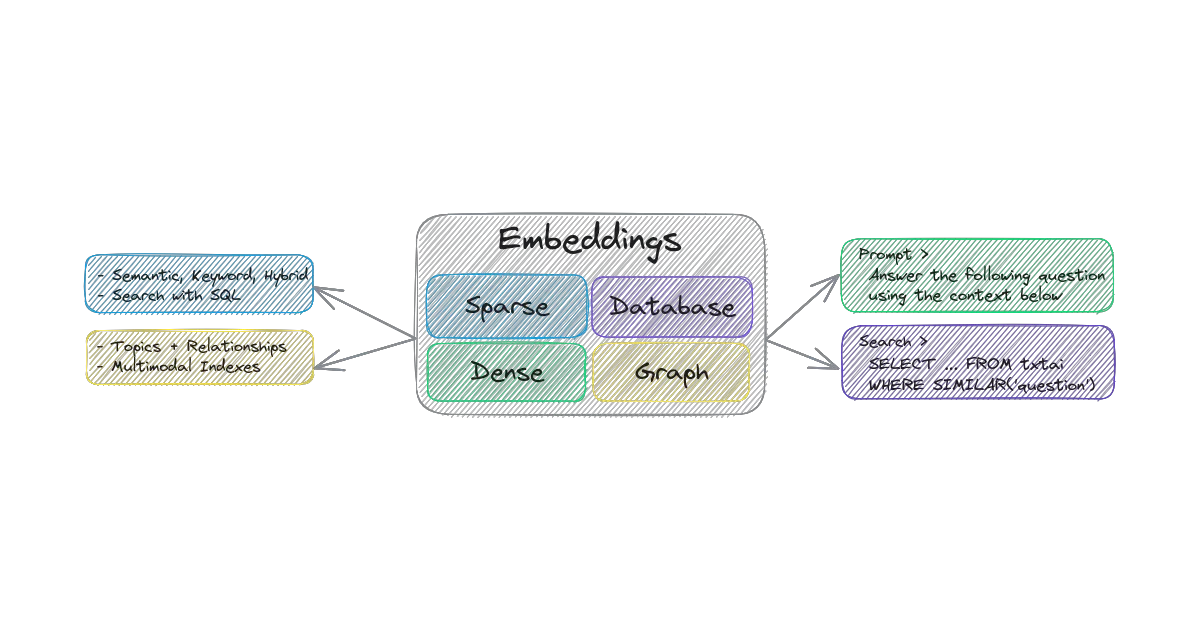
What it does txtai is a Python framework built around an embeddings database that unifies vector indexes, graph networks, and relational storage. It indexes text, documents, audio, images, and video, then exposes them to semantic search, SQL queries, and LLM workflows. On top of that foundation it runs pipelines for transcription, summarization, translation, and autonomous agents that can chain those capabilities together.
The interesting bit Instead of treating vector search as a standalone product, txtai uses it as the knowledge layer for everything else—RAG, agent tool-calling, and graph analysis all read from the same store. The agents are built on Hugging Face’s smolagents and can call LiteLLM, llama.cpp, or local Transformers models, which means you aren’t locked into a single LLM provider to get autonomy.
Key highlights
- Multimodal indexing: embeds and searches across text, images, audio, and video in the same pipeline
- SQL + vector hybrid: queries mix relational SQL filters with semantic similarity
- Agent toolkit: autonomous agents connect embeddings, pipelines, and other agents via smolagents, with support for
agents.mdandskill.mdprompting - Polyglot bindings: Web and MCP APIs with official clients for JavaScript, Java, Rust, and Go
- Local-first: runs offline with Hugging Face models or llama.cpp, scaling out to containers only when you choose
Caveats
- The project is maintained by NeuML, which also sells consulting services and a hosted cloud platform (txtai.cloud), so commercial incentives may shape the open-source roadmap.
- The scope is broad—vector search, SQL, graphs, multimodal indexing, LLM pipelines, and agents—so developers looking for a single-purpose library may find themselves navigating over 70 example notebooks to locate the right abstraction.
Verdict Good for teams that want an integrated knowledge base for RAG or agentic workflows without stitching together a separate vector store, graph DB, and orchestrator. Less compelling if you prefer to hand-pick and wire your own components.
Frequently asked
- What is neuml/txtai?
- It exists because vector search, knowledge graphs, and LLM pipelines are usually three separate infrastructure headaches.
- Is txtai open source?
- Yes — neuml/txtai is open source, released under the Apache-2.0 license.
- What language is txtai written in?
- neuml/txtai is primarily written in Python.
- How popular is txtai?
- neuml/txtai has 13k stars on GitHub.
- Where can I find txtai?
- neuml/txtai is on GitHub at https://github.com/neuml/txtai.