jeecgboot/JeecgBoot
Java Low-Code That Clones Dify and Still Makes You Git Merge
JeecgBoot exists so Java teams can describe an ERP in plain language, generate the Spring Boot and Vue code, and then manually merge it to keep things flexible.
Velocity · 7d
+4.9
★ / day
Trend
↘cooling
star history
What it does
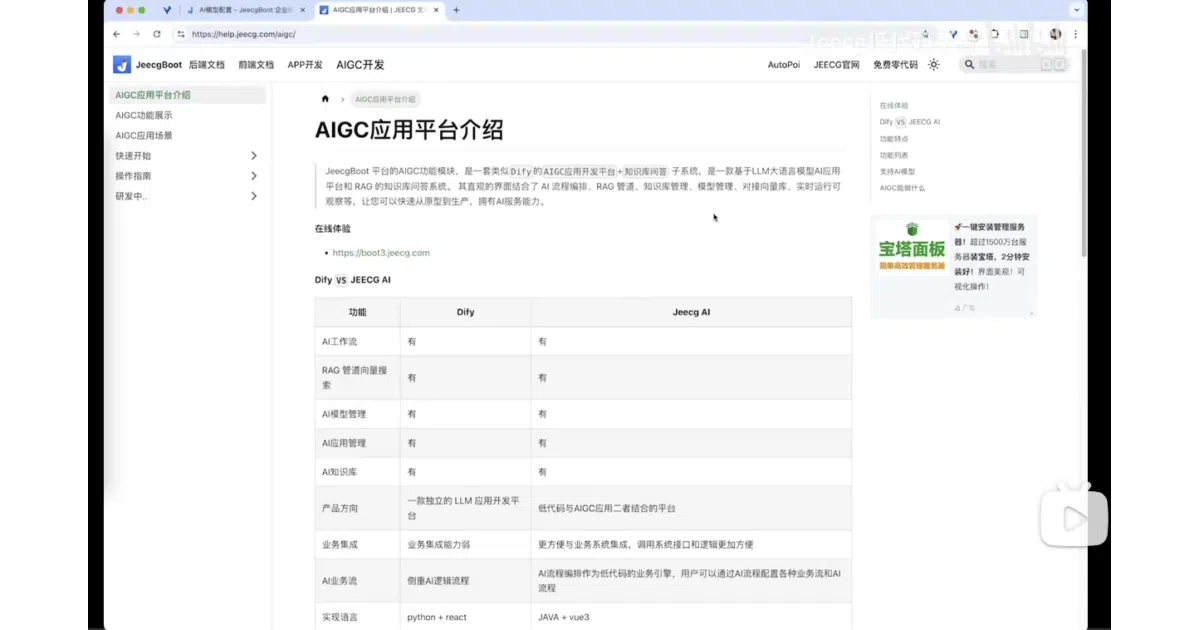
JeecgBoot is a dual-mode AI low-code platform aimed at Java enterprise development. It offers a “zero-code” path for rapid business-system scaffolding and a “low-code” path that turns natural-language prompts into front-end Vue code, back-end Spring Boot code, SQL schemas, and menu permissions. The same package also hosts an internal AI application platform—explicitly described by its maintainers as Dify-like—that bundles chatbots, RAG knowledge bases, flow orchestration, and MCP plugins for models including DeepSeek, ChatGPT, and Ollama.
The interesting bit
The project’s signature workflow is “AI generate → online configure → code generate → manual merge,” which is a candid admission that full automation remains out of reach. That loop is sold as a defense against the rigidity of typical low-code tools, letting developers hand-merge the boilerplate the platform claims to remove while retaining control over the remainder.
Key highlights
- Ships with a built-in AI app builder comparable to Dify, complete with RAG pipelines, vector database support, and model management, keeping AIGC experiments inside the same Java repository.
- Targets Chinese enterprise “domestic innovation” (信创) requirements with certified compatibility for Kylin OS, Dameng and Kingbase databases, and TongWeb middleware.
- Includes native report (JimuReport) and dashboard/Big-Screen (JimuBI) designers, reducing the need to graft external BI tools onto the stack.
- Publishes four separate backend branches—Shiro, Spring Authorization Server, Sa-Token, and a legacy Spring Boot 2 edition—so teams can pick their auth poison.
- Supports switching between Spring Cloud Alibaba microservices and monolithic deployment, with starter modules for distributed locks, transactions, and job scheduling.
Caveats
- The “80% repetitive work eliminated” claim is self-reported marketing arithmetic, not an independent measurement.
- Complex business logic still requires manual coding and merging; the README presents this as flexibility, but it is effectively unpaid integration work.
- The platform is a vertically integrated product of Beijing Guoju Software, bundling the low-code engine, AI modules, mobile framework, and report designers under one vendor umbrella.
Verdict
Government-adjacent and large Chinese enterprises building internal MIS, ERP, or OA systems will find a domestic-innovation-compliant, batteries-included stack. Small teams and developers who prefer composable, vendor-neutral tools should keep shopping.
Frequently asked
- What is jeecgboot/JeecgBoot?
- JeecgBoot exists so Java teams can describe an ERP in plain language, generate the Spring Boot and Vue code, and then manually merge it to keep things flexible.
- Is JeecgBoot open source?
- Yes — jeecgboot/JeecgBoot is open source, released under the Apache-2.0 license.
- What language is JeecgBoot written in?
- jeecgboot/JeecgBoot is primarily written in Java.
- How popular is JeecgBoot?
- jeecgboot/JeecgBoot has 48.3k stars on GitHub and is currently cooling off.
- Where can I find JeecgBoot?
- jeecgboot/JeecgBoot is on GitHub at https://github.com/jeecgboot/JeecgBoot.