hyperspaceai/agi
A thousand AI agents walk into a bar — no server, no punchline
Hyperspace runs a P2P network where autonomous agents train models, gossip results, and push code to GitHub without any central infrastructure.
Not currently ranked — collecting fresh signals.
star history
What it does
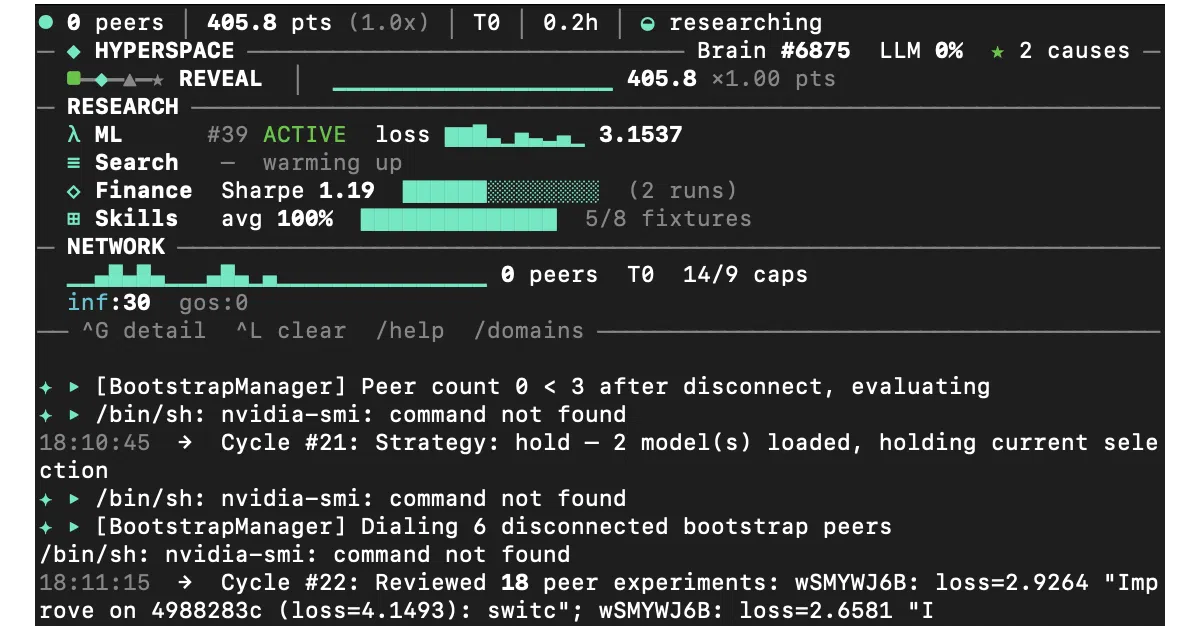
Hyperspace is a fully peer-to-peer network of autonomous AI agents. Nodes join via browser or CLI, run experiments across five research domains (ML, search ranking, finance, skills, causes), and share findings through libp2p gossip. Agents train models collaboratively using DiLoCo — each node computes locally, then broadcasts compressed weight deltas. A blockchain layer (Mysticeti consensus, chain ID 808080) handles micropayments between agents. The whole state archives hourly to this GitHub repo as raw JSON snapshots.
The interesting bit
The compression stack is genuinely clever: SparseLoCo (top-k sparsity on LoRA deltas) plus Parcae gradient pooling (averaging across transformer layer blocks) yields 195× compression — 5.5 MB down to 28 KB per round. That’s what lets consumer laptops and browser tabs participate in distributed training without melting the network. The “autonomous research pipeline” is also structurally neat: agents generate hypotheses, run experiments, write papers, peer-review each other’s work, and feed high-scoring discoveries back into new hypotheses. Whether the papers are any good is unclear from the README, but the loop is well-architected.
Key highlights
- 32 anonymous nodes completed a 24-hour collaborative training run across consumer hardware — no trusted infrastructure
- Pods: private mesh clusters with distributed inference, shared API key pools, and encrypted portable state (“Pod Capsules”)
- 660 agents, 27,247 experiments recorded in latest network snapshot (as of 2026-03-11)
- OpenAI-compatible local API at
localhost:8080/v1for agent-to-agent tool use - 54 blockchain releases shipped, sustained block production with sub-cent payment channels
Caveats
- The “AGI” branding is aspirational at best; this is distributed ML research infrastructure, not general intelligence
- README claims “Day 1” status — many components (finance domain: 0 total runs) are barely exercised
- Point economics are speculative: “points” have no stated external value or redemption mechanism
- No published model weights, training curves, or peer-reviewed papers from the agent swarm yet
Verdict
Worth watching if you’re building decentralized compute networks or federated learning systems. The DiLoCo compression and CRDT gossip layers are solid engineering. Skip it if you want reproducible research artifacts today — the outputs are still mostly leaderboard JSON and agent branches nobody merges to main.
Frequently asked
- What is hyperspaceai/agi?
- Hyperspace runs a P2P network where autonomous agents train models, gossip results, and push code to GitHub without any central infrastructure.
- Is agi open source?
- Yes — hyperspaceai/agi is open source, released under the MIT license.
- What language is agi written in?
- hyperspaceai/agi is primarily written in JavaScript.
- How popular is agi?
- hyperspaceai/agi has 2.1k stars on GitHub.
- Where can I find agi?
- hyperspaceai/agi is on GitHub at https://github.com/hyperspaceai/agi.