georgia-tech-db/evadb
SQL queries that call GPT-4 and YOLO like regular functions
EvaDB lets developers run AI models inside SQL against structured and unstructured data without building pipelines.
Not currently ranked — collecting fresh signals.
star history
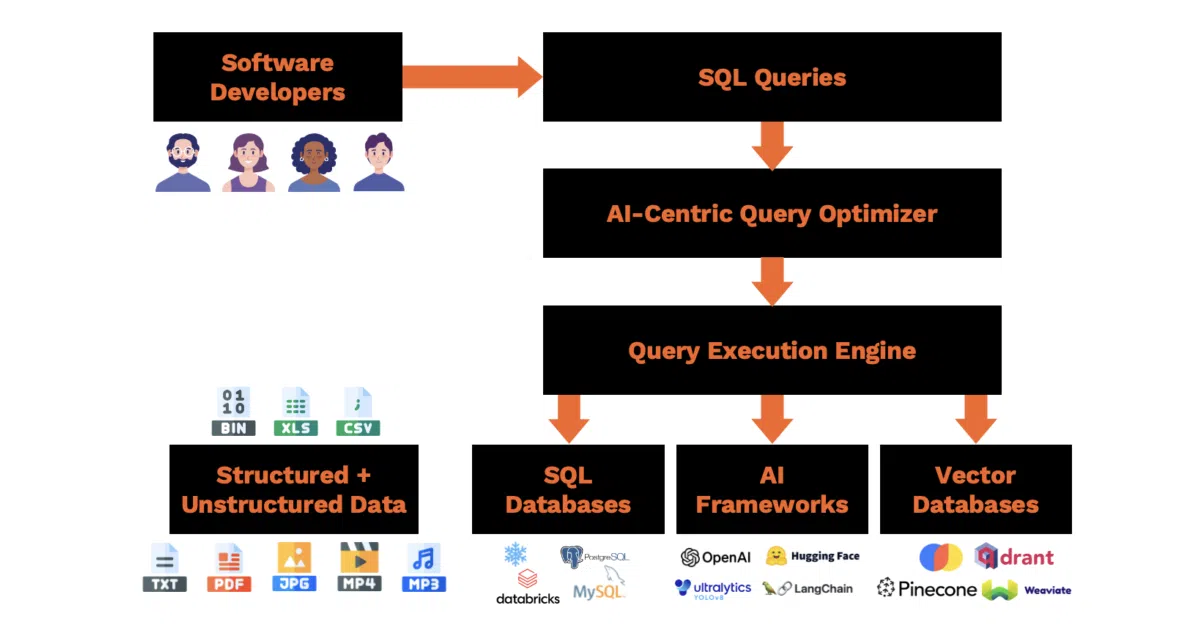
What it does EvaDB is a query engine that wraps AI models in SQL functions. You connect it to existing databases (PostgreSQL, SQLite, Snowflake, S3) and write standard-looking queries that invoke Hugging Face classifiers, OpenAI LLMs, YOLO object detectors, or custom PyTorch models. It handles the inference, result caching, and batching behind the scenes.
The interesting bit The project treats expensive AI calls as first-class query operators with database-style optimizations: function result caching, LLM batching to cut token costs, predicate push-down, and parallel execution across CPUs/GPUs. The README shows a query that extracts speech from video, stores it in a table, then runs ChatGPT over the transcript — all in SQL.
Key highlights
- Supports structured sources (PostgreSQL, MySQL, ClickHouse, Snowflake) and unstructured storage (local filesystem, S3)
- Pre-integrated models from Hugging Face, OpenAI, Ultralytics YOLO, plus AutoML frameworks (Ludwig, sklearn, XGBoost, statsforecast)
- Vector search via
CREATE INDEX ... USING FAISSon embedding columns - Custom model registration through
CREATE FUNCTION - Google Colab notebooks for sentiment analysis, video QA, traffic analysis, and image similarity search
Caveats
- The README is heavy on feature lists and light on performance benchmarks or latency numbers; “faster AI queries” is claimed but not quantified
- Some supported frameworks listed (e.g., “Xboost” for classification) appear to have minor naming inconsistencies
- The target of “99% of AI problems” is vague and not substantiated
Verdict Worth a look if you’re a SQL-comfortable developer who needs to sprinkle AI into existing data pipelines without orchestrating separate services. ML engineers who already manage custom training and inference stacks will likely find it constraining.
Frequently asked
- What is georgia-tech-db/evadb?
- EvaDB lets developers run AI models inside SQL against structured and unstructured data without building pipelines.
- Is evadb open source?
- Yes — georgia-tech-db/evadb is open source, released under the Apache-2.0 license.
- What language is evadb written in?
- georgia-tech-db/evadb is primarily written in Python.
- How popular is evadb?
- georgia-tech-db/evadb has 2.7k stars on GitHub.
- Where can I find evadb?
- georgia-tech-db/evadb is on GitHub at https://github.com/georgia-tech-db/evadb.