facebookresearch/lingua
Meta’s LLM research sandbox strips PyTorch to the bone
Meta built a minimal PyTorch training stack so researchers can swap architectures, losses, and data loaders without fighting framework boilerplate.
Not currently ranked — collecting fresh signals.
star history
What it does
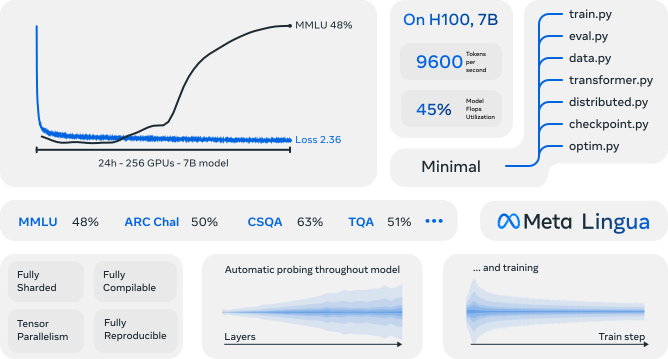
Meta Lingua is a slim, research-oriented library for training and running inference on large language models. It is essentially a collection of plain PyTorch modules—model definitions, distributed training wrappers, data loaders, and profilers—organized into a reusable lingua core and a set of apps that wire them together. The codebase is explicitly designed to be edited: the authors encourage you to fork the logic, swap in new architectures like Mamba or minGRU, and iterate without navigating layers of abstraction. It handles the full lifecycle from preprocessing to evaluation, with built-in SLURM integration for cluster jobs.
The interesting bit
The most unusual choice is the authors’ insistence that “nothing is sacred.” Instead of a rigid framework, you get a distributed.py wrapper that can mix and match FSDP, model parallelism, torch.compile, and float8 on a vanilla nn.Module, plus a checkpoint format that lets you resume training on a different GPU topology. It is a research notebook that accidentally became a cluster job manager.
Key highlights
- Ships with reference implementations of Transformer, Mamba, Hawk, minGRU, and minLSTM, plus multi-token prediction apps.
distributed.pyapplies FSDP, model parallelism, activation checkpointing, andtorch.compileto plain PyTorch modules with minimal ceremony.- Checkpoints use PyTorch’s
.distcpformat, allowing models to be reloaded across different GPU counts and sharding strategies. - Includes automatic MFU/HFU profiling and memory tracing via xformers, dumping traces directly to the experiment directory.
- Published benchmark tables show 1B and 7B models matching the DCLM baseline on downstream tasks.
Caveats
- The project is explicitly marked as under development, so APIs and apps may shift.
- Bundled configs are templates that require manual path and resource tuning before they work.
- The tooling assumes a SLURM cluster; while local and single-GPU runs are possible, the ergonomics are clearly built for multi-node scheduling.
Verdict
Grab this if you are a researcher who needs to mutate model architectures or training loops without wading through megabytes of indirection. If you are looking for a polished, batteries-included production framework, look elsewhere—this is a lab bench, not a factory.
Frequently asked
- What is facebookresearch/lingua?
- Meta built a minimal PyTorch training stack so researchers can swap architectures, losses, and data loaders without fighting framework boilerplate.
- Is lingua open source?
- Yes — facebookresearch/lingua is open source, released under the BSD-3-Clause license.
- What language is lingua written in?
- facebookresearch/lingua is primarily written in Python.
- How popular is lingua?
- facebookresearch/lingua has 4.8k stars on GitHub.
- Where can I find lingua?
- facebookresearch/lingua is on GitHub at https://github.com/facebookresearch/lingua.