eosphoros-ai/DB-GPT
Autonomous SQL and Python for the paranoid data team
It exists so you can ask a database questions in English and let an agent write the SQL, run the Python, and generate the report without touching production unsupervised.
Not currently ranked — collecting fresh signals.
star history
What it does
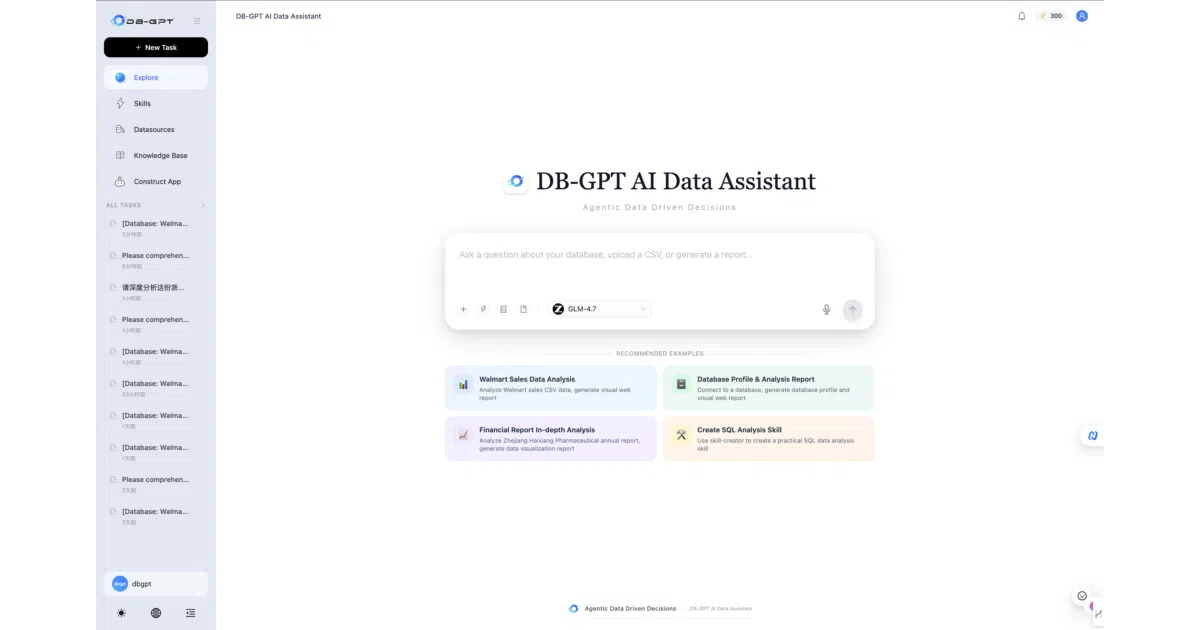
DB-GPT is an open-source agentic AI data assistant that connects to databases, CSV and Excel files, warehouses, and knowledge bases. You ask questions in plain English, and it autonomously writes SQL, runs Python-based analysis, and produces charts, dashboards, and HTML reports. It also serves as a platform for building AI-native data agents and workflows with RAG and multi-model support.
The interesting bit
The project treats data analysis as an agentic workflow: it plans tasks, breaks them into steps, calls tools, and executes code inside sandboxed environments to keep things from going sideways on live data. Reusable “skills” let teams package domain knowledge and analysis methods into repeatable workflows.
Key highlights
- Supports a wide range of LLM providers including DeepSeek, OpenAI, Moonshot (Kimi), MiniMax, and local models via vLLM or llama.cpp
- Multi-source access across relational databases, spreadsheets, documents, and knowledge bases in mixed workflows
- Sandboxed execution for code and tools to isolate analysis from production environments
- Reusable skills system for packaging domain-specific SQL analysis and workflows
- Includes Text2SQL fine-tuning support for models like LLaMA, Qwen, Baichuan, and BLOOM via DB-GPT-Hub
Caveats
- The README is heavy on quickstart installers and light on architectural depth; expect to dig into external docs for non-trivial customization
- The supported-models table in the README is truncated, so full compatibility details require checking the documentation or release notes
Verdict
Data teams and product builders who want an AI assistant that can actually query structured data without hand-holding should look here; if you just need a chatbot wrapper, this is overkill.
Frequently asked
- What is eosphoros-ai/DB-GPT?
- It exists so you can ask a database questions in English and let an agent write the SQL, run the Python, and generate the report without touching production unsupervised.
- Is DB-GPT open source?
- Yes — eosphoros-ai/DB-GPT is open source, released under the MIT license.
- What language is DB-GPT written in?
- eosphoros-ai/DB-GPT is primarily written in Python.
- How popular is DB-GPT?
- eosphoros-ai/DB-GPT has 20.2k stars on GitHub.
- Where can I find DB-GPT?
- eosphoros-ai/DB-GPT is on GitHub at https://github.com/eosphoros-ai/DB-GPT.