decodingai-magazine/second-brain-ai-assistant-course
Six Modules, a Dollar, and a Production RAG Bot
An open-source curriculum that takes you from crawling messy notes to deploying a fine-tuned, agentic RAG assistant using real LLMOps tooling for about a dollar.
Not currently ranked — collecting fresh signals.
star history
What it does
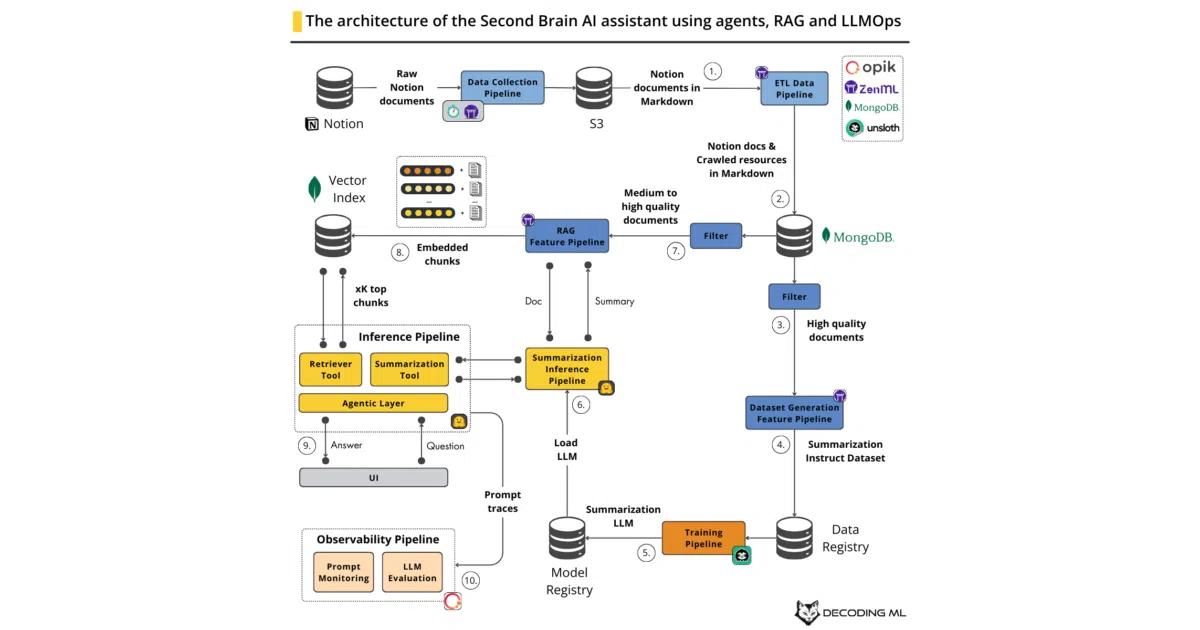
This open-source course teaches you to build a personal AI assistant that reads your own knowledge base—notes, links, and documents—and answers questions via an agentic RAG pipeline. Over six modules, you construct offline ETL and training pipelines that crawl content, score quality with LLMs and heuristics, distill a fine-tuning dataset, and specialize a Llama 3.1 8B model, then wire it all into an online inference and monitoring stack. The curriculum emphasizes software engineering and LLMOps best practices—using ZenML for orchestration, Opik for evaluation, and modern Python tooling—rather than one-off notebook demos.
The interesting bit
The course treats your scattered notes and bookmarks as messy real-world source data, not just a quick demo payload. Rather than stopping at a naive vector search, it walks you through the unglamorous but critical work of content normalization, LLM-based quality scoring, and distillation to build a training dataset. That focus on plumbing—plus fine-tuning and serving Llama 3.1 via Hugging Face endpoints—makes it a full-stack engineering exercise rather than a toy tutorial.
Key highlights
- Six end-to-end modules covering architecture, data ETL, dataset distillation, fine-tuning, advanced RAG, and LLMOps monitoring.
- Uses industry tools throughout: ZenML for pipeline orchestration, Opik for evaluation, Unsloth and Comet for fine-tuning, MongoDB for storage, and
smolagentsfor the agent layer. - Provides a ready-made snapshot of ~100 Notion pages and 500+ AI/ML links in a public S3 bucket, so you can run everything without a Notion account.
- Targets patterns like contextual and parent retrieval, serverless deployment to Hugging Face, and the FTI architecture pattern.
- Estimated compute cost is roughly $1–$5 if you run the code; the curriculum itself is free and self-paced.
Caveats
- It expects intermediate Python and at least beginner-level familiarity with LLMs and RAG.
- A GPU is optional, but you’ll still need to juggle cloud alternatives or pay a few dollars in API and endpoint fees to run the full stack.
- It is a guided course and reference implementation, not a drop-in library you can import into an existing project.
Verdict
Worth your time if you are an ML engineer, data engineer, or curious developer trying to close the gap between a notebook prototype and a deployable GenAI system. Skip it if you are after a plug-and-play assistant or a managed SaaS; this is a build-it-yourself curriculum.
Frequently asked
- What is decodingai-magazine/second-brain-ai-assistant-course?
- An open-source curriculum that takes you from crawling messy notes to deploying a fine-tuned, agentic RAG assistant using real LLMOps tooling for about a dollar.
- Is second-brain-ai-assistant-course open source?
- Yes — decodingai-magazine/second-brain-ai-assistant-course is open source, released under the MIT license.
- What language is second-brain-ai-assistant-course written in?
- decodingai-magazine/second-brain-ai-assistant-course is primarily written in Jupyter Notebook.
- How popular is second-brain-ai-assistant-course?
- decodingai-magazine/second-brain-ai-assistant-course has 3.1k stars on GitHub.
- Where can I find second-brain-ai-assistant-course?
- decodingai-magazine/second-brain-ai-assistant-course is on GitHub at https://github.com/decodingai-magazine/second-brain-ai-assistant-course.