data-infra/cube-studio
A kitchen-sink AI platform for the full model lifecycle
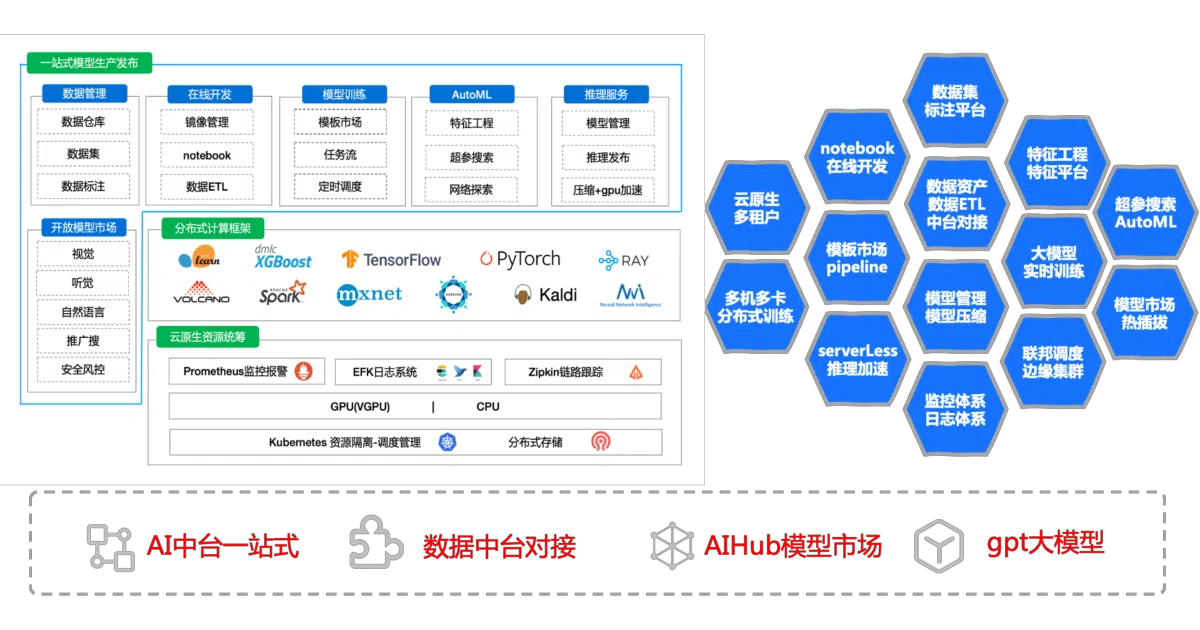
Cube Studio is an open-source, Kubernetes-native attempt to unify data annotation, drag-and-drop training pipelines, LLM fine-tuning, and GPU rental billing inside a single web UI.
Not currently ranked — collecting fresh signals.
star history
What it does
Cube Studio is a web-based control plane for managing the full AI workflow on Kubernetes. It covers data annotation (manual and automated via vision and language models), interactive development in JupyterLab or VS Code, drag-and-drop pipeline orchestration for training, hyperparameter search, distributed training, and model serving—including LLM inference via vLLM, Ollama, or MindIE. It also layers on multi-tenant SSO, RBAC, resource quotas, and a metering/billing system for compute rentals.
The interesting bit
The project’s most unusual trait is its aggressive hardware inclusivity: it explicitly schedules and supports domestic Chinese accelerators like Huawei Ascend, Hygon DCU, Cambricon, Moore Threads, MetaX, and Biren alongside standard NVIDIA cards, plus ARM architectures and RDMA networking. It also treats “compute marketplace” features—rental instances, daily billing, and resource quotas—as first-class citizens rather than afterthoughts.
Key highlights
- Drag-and-drop pipeline builder for training workflows with support for distributed jobs, RDMA, and hyperparameter search.
- Built-in data annotation with automated pre-labeling using vision and language models, plus LabelStudio integration.
- LLM lifecycle support including DeepSeek SFT fine-tuning, reward modeling, RL training, and multi-machine inference via vLLM/Ollama/MindIE.
- GPU virtualization (VGPU), fractional sharing, and bin-packing strategies for cluster scheduling.
- Metering, billing, and a compute rental marketplace with on-demand and monthly billing models.
Caveats
- The README is almost entirely a feature matrix with no architectural overview, code structure, or contribution guidelines beyond a wiki link and a WeChat QR code.
- It is unclear how tightly integrated the dozens of listed components are; the project reads like a consortium of subsystems rather than a single cohesive codebase.
- The repository appears to have migrated from
tencent/cube-studio, and the current README warns that the old repository is no longer synced, but the relationship between the two is not explained.
Verdict
Worth evaluating if you run a private data center in China and need one web UI to bridge annotation teams, model engineers, and finance departments. Skip it if you are looking for a lightweight, composable MLOps stack where you pick your own tools.
Frequently asked
- What is data-infra/cube-studio?
- Cube Studio is an open-source, Kubernetes-native attempt to unify data annotation, drag-and-drop training pipelines, LLM fine-tuning, and GPU rental billing inside a single web UI.
- Is cube-studio open source?
- Yes — data-infra/cube-studio is an open-source project tracked on heatdrop.
- What language is cube-studio written in?
- data-infra/cube-studio is primarily written in Python.
- How popular is cube-studio?
- data-infra/cube-studio has 2.6k stars on GitHub.
- Where can I find cube-studio?
- data-infra/cube-studio is on GitHub at https://github.com/data-infra/cube-studio.