codefuse-ai/codefuse-chatbot
Ant Group's DevOps agent: RAG, sandboxes, and multi-agent orchestration
An open-source chatbot that tries to own the entire software lifecycle by gluing together code analysis, document retrieval, and sandboxed execution under a multi-agent scheduler.
Not currently ranked — collecting fresh signals.
star history
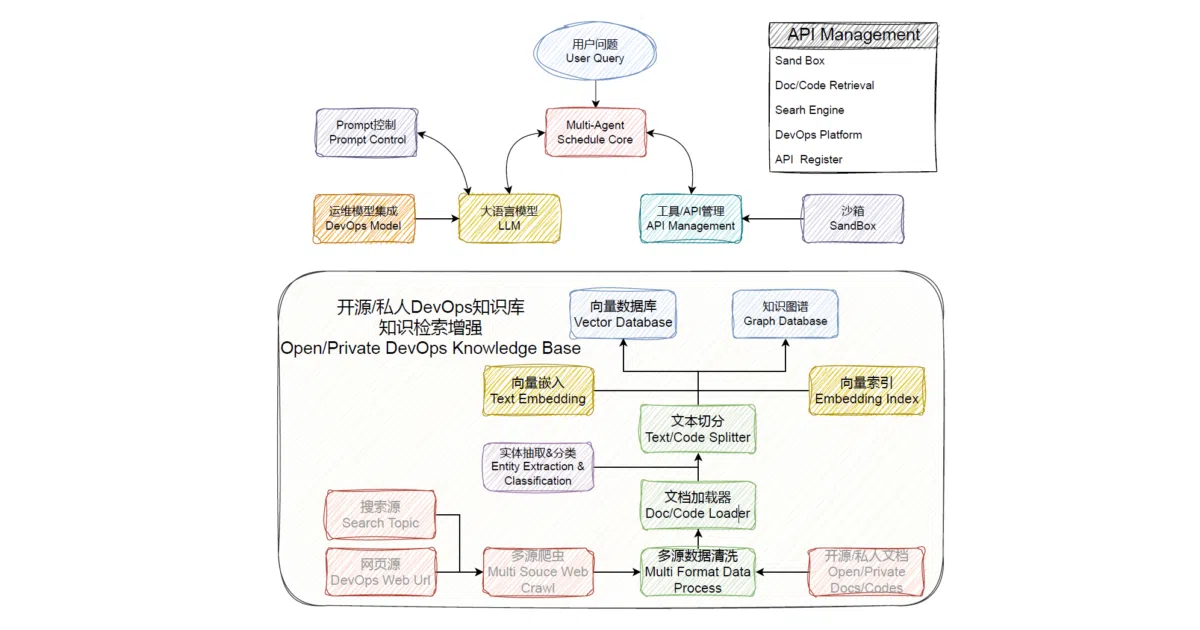
What it does CodeFuse-ChatBot is an AI assistant aimed at the full software development lifecycle—design, coding, testing, deployment, and ops. It wraps RAG over code repos and documents, tool learning, and a sandboxed execution environment inside a multi-agent framework. The goal: turn fragmented DevOps tool-juggling into a conversational workflow.
The interesting bit The project treats “private knowledge augmentation” as the central premise. It builds a knowledge graph on top of your docs, indexes your entire codebase for repo-level understanding, and dispatches tasks through a configurable multi-agent core (codefuse-muAgent). The sandbox is the safety rail—code compiles and runs in isolation before any real damage occurs.
Key highlights
- Multi-agent scheduling core with “one-click” mode configuration via
codefuse-muAgent(installable viapip install codefuse-muagent) - Repo-level code analysis and file-level code generation, not just snippet retrieval
- Vector + graph database hybrid for document and knowledge-base queries
- Sandboxed execution environment for safe code compilation and action testing
- Supports both open-source LLM/embedding models (offline private deploy) and OpenAI API
- Built on top of
langchain-chatchatandcodebox-api; explicitly acknowledges its foundations
Caveats
- Documentation and primary README are in Chinese; English README exists but the project is clearly China-first
- GPU requirements are non-trivial: CodeLlama-34B-int4 needs ~20GB VRAM
- Apple Silicon users need to manually install
qpdfvia Homebrew before setup - Only two models are explicitly listed in the model-access table; “coming soon” on HF Hub for the CodeLlama variant
Verdict Worth a look if you’re running a self-hosted DevOps shop and want to experiment with agentic workflows over your own code and docs. Skip it if you need polished English documentation, lightweight CPU-only deployment, or a mature plugin ecosystem—this is still very much a build-it-yourself proposition.
Frequently asked
- What is codefuse-ai/codefuse-chatbot?
- An open-source chatbot that tries to own the entire software lifecycle by gluing together code analysis, document retrieval, and sandboxed execution under a multi-agent scheduler.
- Is codefuse-chatbot open source?
- Yes — codefuse-ai/codefuse-chatbot is an open-source project tracked on heatdrop.
- What language is codefuse-chatbot written in?
- codefuse-ai/codefuse-chatbot is primarily written in Python.
- How popular is codefuse-chatbot?
- codefuse-ai/codefuse-chatbot has 1.3k stars on GitHub.
- Where can I find codefuse-chatbot?
- codefuse-ai/codefuse-chatbot is on GitHub at https://github.com/codefuse-ai/codefuse-chatbot.