alexzhang13/rlm
Recursive inference for LLMs that write their own subroutines
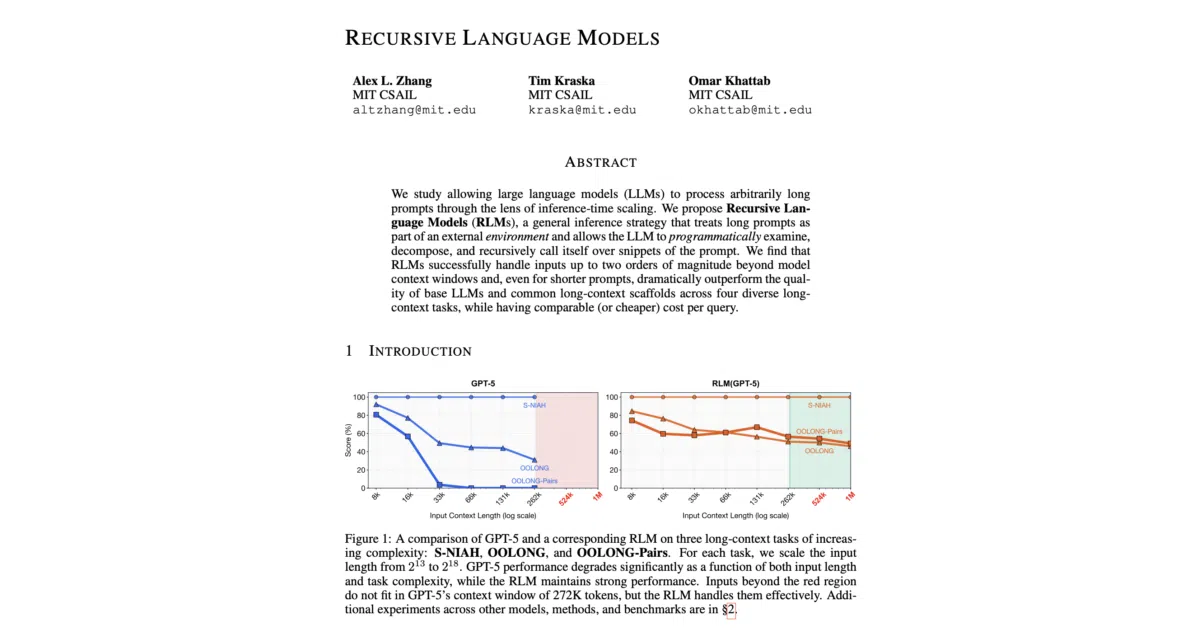
RLM exists to let language models handle near-infinite contexts by giving them a REPL where they can recursively call themselves as functions, replacing rigid JSON tool-calling with programmable decomposition.
Not currently ranked — collecting fresh signals.
star history
What it does
RLM wraps standard LLM APIs in a programmable harness. Instead of a flat prompt, the model receives a REPL—local Python, IPython, Docker, or cloud sandboxes like Modal and E2B—where the input context is a code variable and the model can spawn further completions by calling functions. The repository also bundles a reinforcement-learning training environment built on verifiers and prime-rl to teach models how to wield this recursion.
The interesting bit
The authors want LLMs to abandon JSON tool-calling and treat sub-agents as ordinary functions inside a real code environment. By handing decomposition and recursive execution to the model itself, the system effectively turns the LLM into its own scheduler rather than a passive text generator.
Key highlights
- Supports a wide range of sandboxes: local
exec, IPython, Docker, Modal, Prime Intellect, Daytona, and E2B. - Plugs into major API providers and router platforms (OpenAI, Anthropic, OpenRouter, Portkey).
- Includes a training environment for RLMs with a worked long-context QA example (
oolong). - Already adopted by downstream projects like DSPy and Ax.
Caveats
- The default local REPL runs via
execin the host process and shares its virtual environment; the README explicitly warns this is “not for production.” - Prime Intellect Sandboxes are currently in beta and suffer from slow runtimes.
- The training harness deliberately avoids cloud sandboxes for simplicity, so you’ll need to wire in isolation yourself if you want safe distributed training.
Verdict
Worth a look if you’re building agentic systems and tired of shuffling JSON schemas between model calls. Skip it if you just need a standard chat completion wrapper with no appetite for sandboxing or recursive control flow.
Frequently asked
- What is alexzhang13/rlm?
- RLM exists to let language models handle near-infinite contexts by giving them a REPL where they can recursively call themselves as functions, replacing rigid JSON tool-calling with programmable decomposition.
- Is rlm open source?
- Yes — alexzhang13/rlm is open source, released under the MIT license.
- What language is rlm written in?
- alexzhang13/rlm is primarily written in Python.
- How popular is rlm?
- alexzhang13/rlm has 5.6k stars on GitHub.
- Where can I find rlm?
- alexzhang13/rlm is on GitHub at https://github.com/alexzhang13/rlm.