aiwaves-cn/agents
Backpropagation, But the Gradients Are Made of Words
It provides a systematic framework for training language agents by treating prompts as weights and back-propagating textual "gradients" through the agent pipeline.
Not currently ranked — collecting fresh signals.
star history
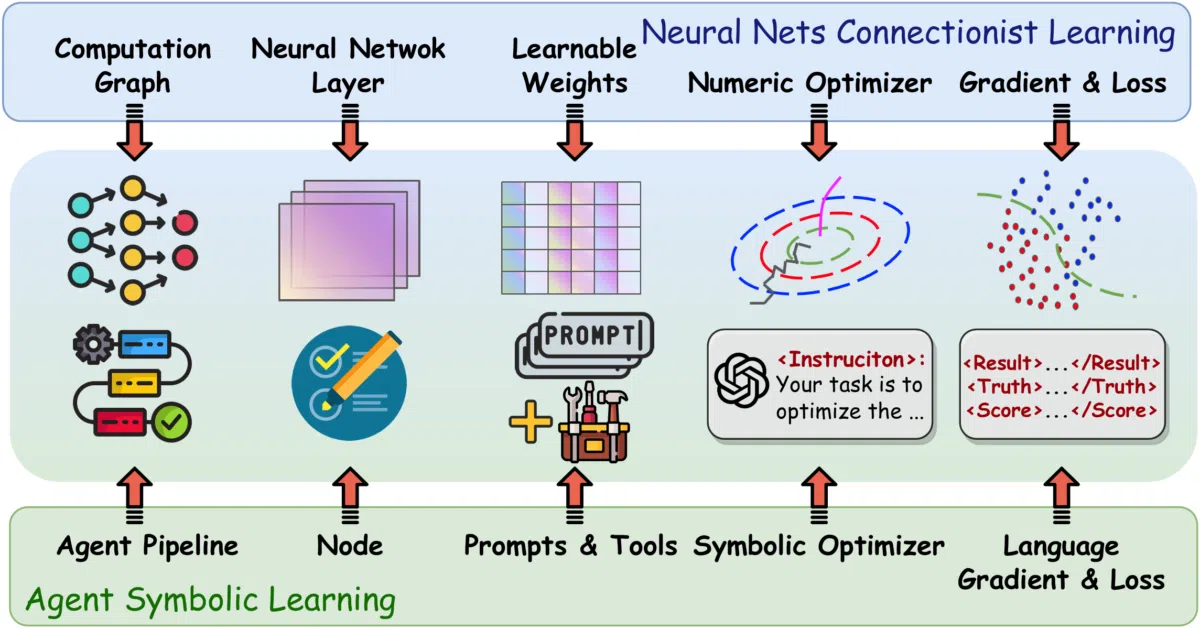
What it does Agents 2.0 structures autonomous language agents as a computational graph. Each node in the pipeline corresponds to a step in the agent’s reasoning, while the prompts and tools inside it serve as tunable “weights”. After execution, the framework evaluates the outcome with a prompt-based loss function, propagates textual feedback backward through the graph, and updates the symbolic components—including node connections—to improve subsequent runs.
The interesting bit The framework borrows the mechanics of neural-network training—forward passes, backward propagation, and gradient-based updates—but implements them entirely through natural language. Instead of numeric tensors, it uses “language loss” and “language gradients” (structured textual reflections) to refine prompts and tools rather than the base model itself.
Key highlights
- Treats agent pipelines as computational graphs and prompts/tools as layer weights, directly analogizing neural-net training.
- Implements a full symbolic learning loop: forward execution, prompt-based loss evaluation, textual back-propagation, and gradient-guided weight updates.
- Supports multi-agent optimization by mapping nodes to individual agents or allowing collaborative actions within a single node.
- Major v2.0 release adds learning and evaluation capabilities to the original autonomous agent framework.
- Backed by an arXiv paper, documentation site, and Apache 2.0 license.
Verdict Worth a look if you are experimenting with agentic reasoning and want to optimize prompt strategies and agent structure through an automated feedback loop. Probably overkill if you just need a simple chain-of-thought wrapper around an API call.
Frequently asked
- What is aiwaves-cn/agents?
- It provides a systematic framework for training language agents by treating prompts as weights and back-propagating textual "gradients" through the agent pipeline.
- Is agents open source?
- Yes — aiwaves-cn/agents is open source, released under the Apache-2.0 license.
- What language is agents written in?
- aiwaves-cn/agents is primarily written in Python.
- How popular is agents?
- aiwaves-cn/agents has 6k stars on GitHub.
- Where can I find agents?
- aiwaves-cn/agents is on GitHub at https://github.com/aiwaves-cn/agents.