WongKinYiu/yolov7
YOLOv7: the paper that became a repo before the naming war
The official PyTorch implementation of the YOLOv7 paper, complete with six model sizes, export pipelines, and enough branch variants to need a map.
Not currently ranked — collecting fresh signals.
star history
What it does
This is the reference PyTorch implementation of YOLOv7, a family of real-time object detectors. It covers training from scratch on MS COCO, fine-tuning on custom datasets, inference on images and video, and export to ONNX, TensorRT, and CoreML. The repo also hosts experimental branches for pose estimation, instance segmentation, and anchor-free heads.
The interesting bit
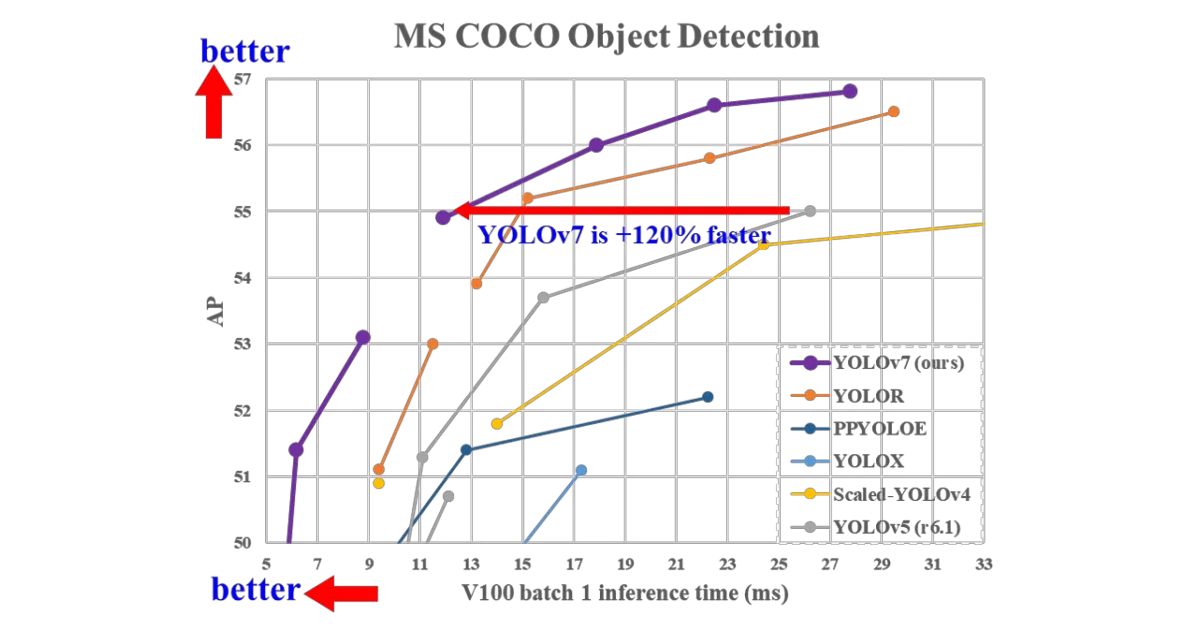
The “trainable bag-of-freebies” pitch: architectural tweaks and training strategies that boost accuracy without inflating inference cost. The README backs this with hard numbers—51.4% AP at 161 fps for the base model, scaling up to 56.8% AP at 36 fps for the E6E variant. That’s a useful spread for picking your latency budget.
Key highlights
- Six model variants (YOLOv7 through YOLOv7-E6E) with published COCO benchmarks and pre-trained weights
- Docker setup recommended; tested on Python 3.7.13 and PyTorch 1.12.0+cu113
- Export notebooks for CoreML, ONNX with NMS, and TensorRT (two approaches, one via external
tensorrt-python) - Transfer learning via
*_training.ptweights; custom dataset finetuning with separate hyperparameter files - Side branches: pose estimation (
pose), instance segmentation (mask,u7/seg), and anchor-free detection (u6)
Caveats
- The README truncates mid-table for the anchor-free section, so some details are literally cut off
- TensorRT export relies on an external repo (
Linaom1214/tensorrt-python), not a self-contained path - Cache invalidation warning: if you’ve used other YOLO versions, you must manually delete
.cachefiles and re-download labels
Verdict
Worth a look if you need a battle-tested real-time detector with clear scaling options and deployment exports. Skip if you’re already happy with YOLOv8 or newer forks—the YOLO naming situation is messy enough that this repo’s historical value may exceed its future maintenance.
Frequently asked
- What is WongKinYiu/yolov7?
- The official PyTorch implementation of the YOLOv7 paper, complete with six model sizes, export pipelines, and enough branch variants to need a map.
- Is yolov7 open source?
- Yes — WongKinYiu/yolov7 is open source, released under the GPL-3.0 license.
- What language is yolov7 written in?
- WongKinYiu/yolov7 is primarily written in Jupyter Notebook.
- How popular is yolov7?
- WongKinYiu/yolov7 has 14.2k stars on GitHub.
- Where can I find yolov7?
- WongKinYiu/yolov7 is on GitHub at https://github.com/WongKinYiu/yolov7.