VILA-Lab/Dive-into-Claude-Code
Claude Code Is 98.4% Plumbing, and That’s the Point
This repository dissects Claude Code’s architecture to show that building a production AI agent is mostly about deterministic infrastructure, not model reasoning.
Not currently ranked — collecting fresh signals.
star history
What it does
VILA-Lab’s repo is a full source-level teardown of Claude Code v2.1.88—roughly 1,900 TypeScript files and half a million lines—mapped to an actionable design guide for anyone building AI agents. It traces every implementation choice back to five human values and thirteen design principles, then layers on community research and cross-system comparisons with OpenClaw and Hermes-Agent. The result is less a product review and more an engineering field manual for production agent systems.
The interesting bit
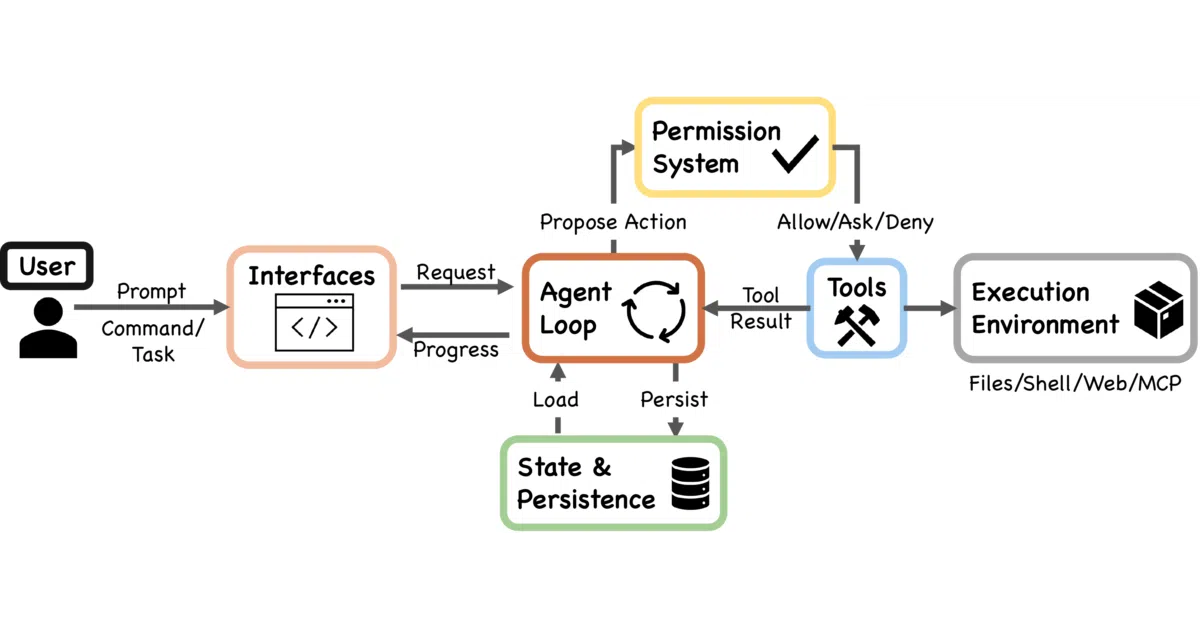
The central surprise is quantitative: only 1.6% of the codebase is “AI” logic, while 98.4% is deterministic infrastructure—permission gates, context compaction, tool routing, and recovery. The agent loop itself is a plain ReAct while-loop; the real complexity is the cross-cutting harness that keeps the model from misbehaving or melting down. That ratio flips the popular narrative that agents are mostly prompt engineering with a thin wrapper.
Key highlights
- 1.6% AI, 98.4% infrastructure: The model reasons, but the harness enforces through seven safety layers, a nine-step turn pipeline, and five-stage context compaction before every call.
- Deny-first permission model: Seven graduated modes from
plantobypassPermissions, with a broad deny always overriding a narrow allow; trust is never restored on resume. - Shared failure modes: Defense-in-depth has cracks—commands exceeding 50 subcommands bypass security analysis entirely to avoid event-loop starvation.
- Pre-trust attack window: Two patched CVEs stem from hooks and MCP servers executing during initialization before the trust dialog appears.
- Extensible at four cost tiers: Hooks, Skills, Plugins, and MCP servers inject at three points (
assemble,model,execute) with graduated context costs, supported by 27 hook events and up to 54 base tools.
Caveats
- Defense-in-depth degrades under pressure: The safety layers share performance constraints, so 50-plus subcommands can skip security analysis to keep the REPL responsive.
- Extensions get a head start: Hooks and MCP servers run before the user sees a trust dialog, creating a structurally privileged window that has already yielded CVEs.
Verdict
Agent builders and security researchers should read this instead of guessing how production harnesses work; if you are looking for a quick CLI tutorial or prompt tricks, this academic dissection will feel like overkill.
Frequently asked
- What is VILA-Lab/Dive-into-Claude-Code?
- This repository dissects Claude Code’s architecture to show that building a production AI agent is mostly about deterministic infrastructure, not model reasoning.
- Is Dive-into-Claude-Code open source?
- Yes — VILA-Lab/Dive-into-Claude-Code is an open-source project tracked on heatdrop.
- How popular is Dive-into-Claude-Code?
- VILA-Lab/Dive-into-Claude-Code has 2.2k stars on GitHub.
- Where can I find Dive-into-Claude-Code?
- VILA-Lab/Dive-into-Claude-Code is on GitHub at https://github.com/VILA-Lab/Dive-into-Claude-Code.