TokenRhythm/NeoHorse
Recursive Self-Improvement, Minus the Recursion
NeoHorse-1 prototypes a feedback loop where a routing harness evaluates agent trajectories and feeds capability-level signals back into the training mixture, aiming for recursive self-improvement.
Collecting fresh signals — velocity needs a few days of history.
collecting data…
star history
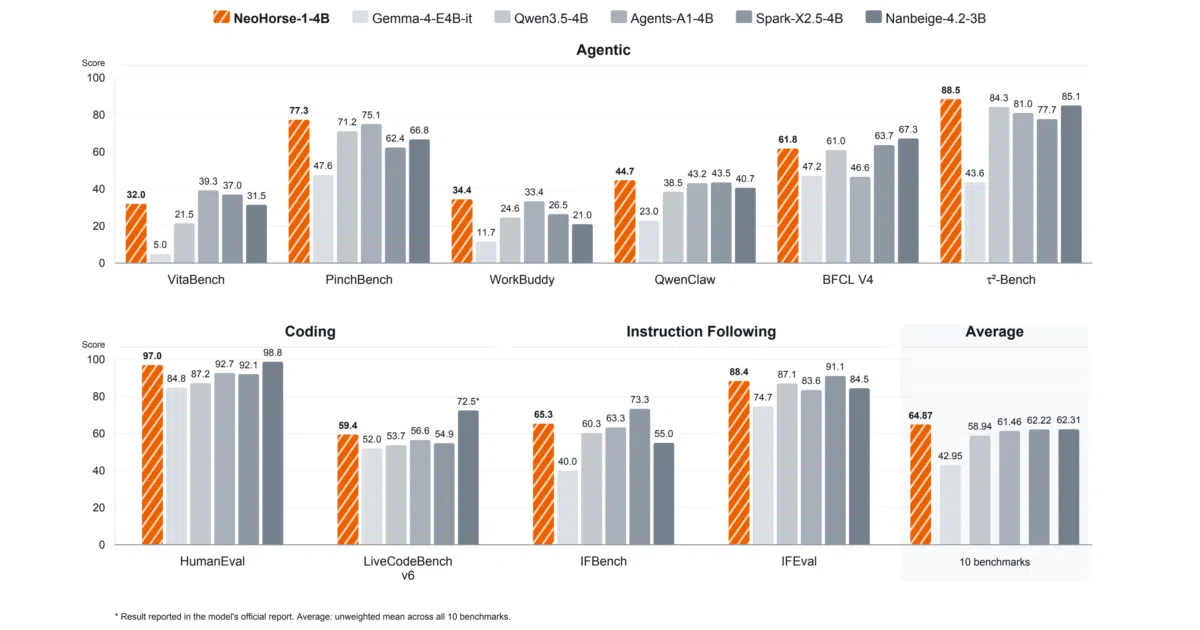
What it does NeoHorse-1 is a pair of post-trained causal language models—4B and 9B parameters, built on Qwen3.5—that target text-based agent tasks, tool use, coding, and instruction following. A routing harness assigns work across a model pool, records tool interactions and outcomes, estimates capability demand, and feeds that signal into the next training mixture. The current release closes one lap of an evaluation–selection–update loop; chaining multiple laps is the stated next step toward recursive self-improvement.
The interesting bit Most post-training treats data curation as a static preprocessing step. NeoHorse treats execution trajectories as a living training signal through routing-guided curriculum SFT and on-policy distillation, preserving harness context rather than discarding it. The project is essentially an attempt to turn an evaluation harness into a curriculum generator.
Key highlights
- Two Apache 2.0 checkpoints (4B and 9B) with native 262k context, extensible up to roughly 1M tokens
- Routing-guided curriculum SFT and on-policy distillation that keep harness context in the training signal
- Heavy data hygiene: exact/near-duplicate removal, evaluation decontamination, six-dimensional semantic scoring, and subscene-level Scene/Goal/Outcome labels
- GGUF, 8/5/4-bit quantized, and MLX variants for Apple silicon alongside standard BF16 weights
- Text-in/text-out interface for self-hosted inference; model cards carry per-size evaluation tables
Caveats
- Recursive self-improvement is described as a future goal, not an achieved outcome; the current harness completes one evaluation-selection-update cycle
- The README is upfront that extending the loop across successive iterations is the next step, so expect a research prototype rather than a finished product
Verdict Worth a look if you are building agent training infrastructure and want an open-weight experiment in closed-loop post-training. Skip it if you need a drop-in replacement for your current model stack.
Frequently asked
- What is TokenRhythm/NeoHorse?
- NeoHorse-1 prototypes a feedback loop where a routing harness evaluates agent trajectories and feeds capability-level signals back into the training mixture, aiming for recursive self-improvement.
- Is NeoHorse open source?
- Yes — TokenRhythm/NeoHorse is open source, released under the Apache-2.0 license.
- How popular is NeoHorse?
- TokenRhythm/NeoHorse has 524 stars on GitHub.
- Where can I find NeoHorse?
- TokenRhythm/NeoHorse is on GitHub at https://github.com/TokenRhythm/NeoHorse.