The-Pocket/PocketFlow-Tutorial-Codebase-Knowledge
AI writes the docs you wish existed for every repo
An agent that crawls GitHub repos and generates beginner-friendly tutorials explaining how the code actually works.
Not currently ranked — collecting fresh signals.
star history
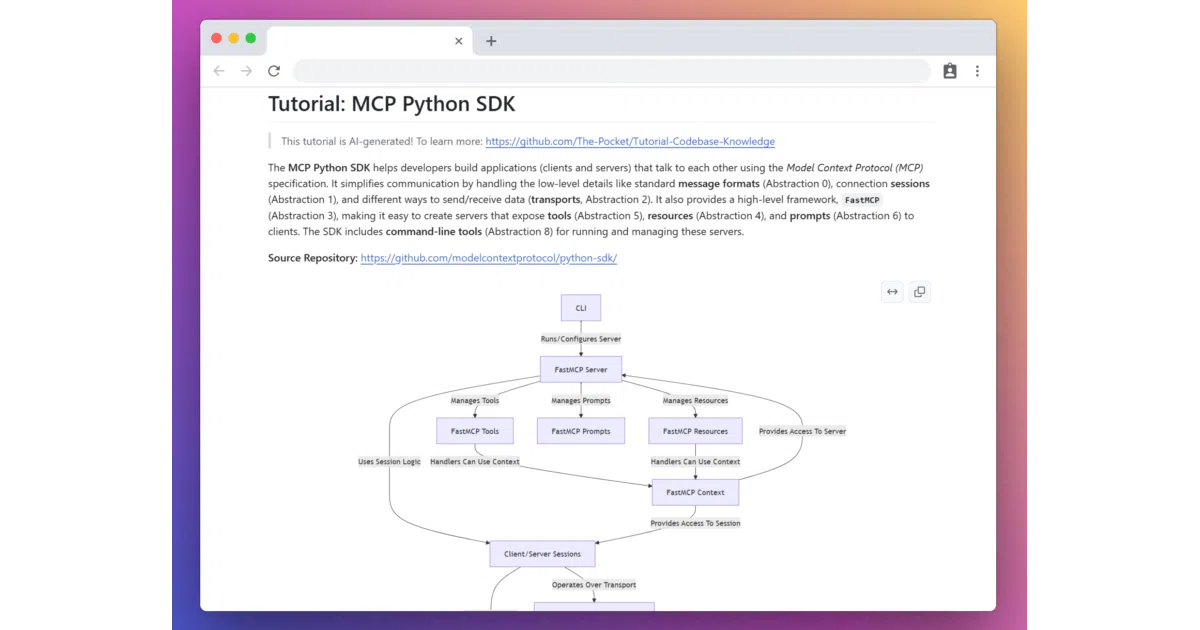
What it does Feed it a GitHub URL or local directory, and it crawls the codebase, identifies core abstractions, and spits out a structured tutorial with visualizations. Think of it as an intern who actually reads the source before writing documentation. It supports filtering by file patterns, size limits, and output languages including Chinese.
The interesting bit The project is built on Pocket Flow, a 100-line LLM framework, and the author used “agentic coding” — designing the flow while letting AI agents write the implementation. The generated tutorials for well-known projects (FastAPI, Celery, DSPy, even LevelDB) are hosted live and were entirely AI-authored.
Key highlights
- Crawls remote repos or local directories; filters with include/exclude globs and max file size
- Supports multiple LLM providers (Gemini, xAI, Ollama) via environment variables
- LLM response caching enabled by default; disable with
--no-cache - Docker support with mounted volumes for input codebases and output tutorials
- Generated tutorials for 20+ popular repos are already published and linked
Caveats
- Requires a capable LLM with “thinking capabilities” (Claude 3.7 with thinking, O1, or Gemini Pro 2.5); weaker models likely produce weaker tutorials
- Default setup assumes Gemini; other providers need manual URL/model/key configuration
- No explicit evaluation of tutorial accuracy is mentioned — the examples look good, but your mileage may vary
Verdict Worth trying if you’re onboarding to an unfamiliar codebase or maintaining internal docs. Skip it if you need guaranteed correctness without human review, or if you’re hoping for deep architectural critique rather than beginner-friendly explanation.
Frequently asked
- What is The-Pocket/PocketFlow-Tutorial-Codebase-Knowledge?
- An agent that crawls GitHub repos and generates beginner-friendly tutorials explaining how the code actually works.
- Is PocketFlow-Tutorial-Codebase-Knowledge open source?
- Yes — The-Pocket/PocketFlow-Tutorial-Codebase-Knowledge is open source, released under the MIT license.
- What language is PocketFlow-Tutorial-Codebase-Knowledge written in?
- The-Pocket/PocketFlow-Tutorial-Codebase-Knowledge is primarily written in Python.
- How popular is PocketFlow-Tutorial-Codebase-Knowledge?
- The-Pocket/PocketFlow-Tutorial-Codebase-Knowledge has 12.7k stars on GitHub.
- Where can I find PocketFlow-Tutorial-Codebase-Knowledge?
- The-Pocket/PocketFlow-Tutorial-Codebase-Knowledge is on GitHub at https://github.com/The-Pocket/PocketFlow-Tutorial-Codebase-Knowledge.