RUC-NLPIR/FlashRAG
RAG experiments without the duct tape
FlashRAG exists so researchers stop rebuilding retrieval pipelines from scratch just to compare against the same 23 baselines.
Not currently ranked — collecting fresh signals.
star history
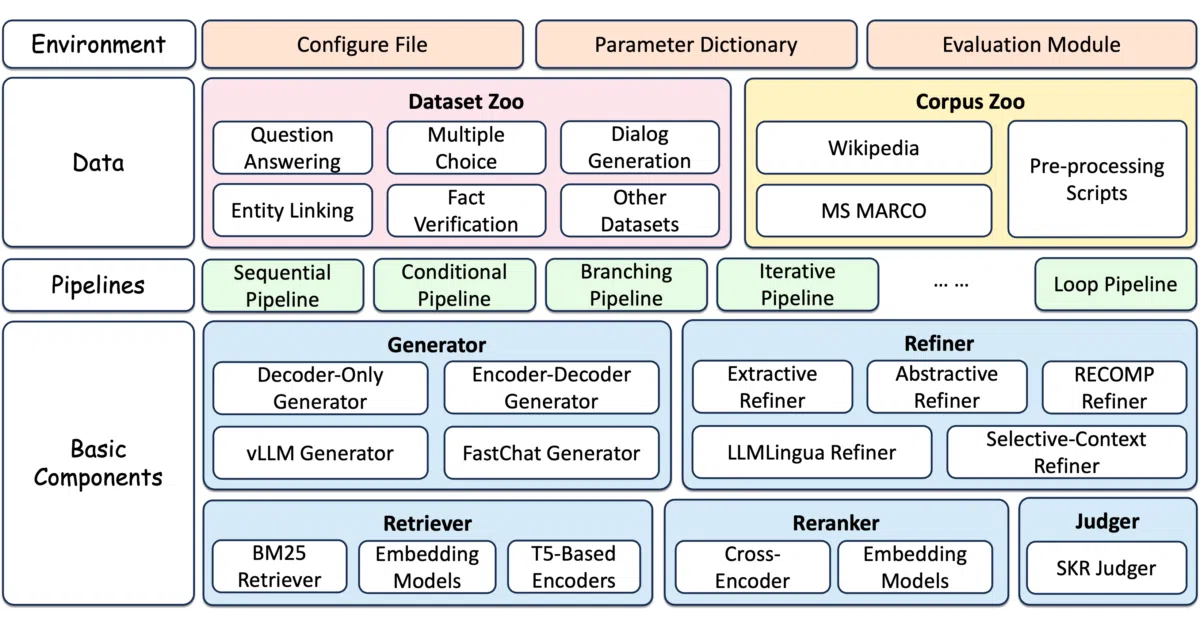
What it does FlashRAG bundles 36 pre-processed RAG benchmark datasets and 23 implemented algorithms—including recent reasoning-based methods like R1-Searcher and Search-R1—into a modular Python framework. It gives you retrievers, rerankers, generators, and compressors that can be wired into custom pipelines or run as one-click baselines. A built-in UI lets you configure experiments and kick off evaluations without writing glue scripts.
The interesting bit
The toolkit treats reproducibility as infrastructure, not a weekend hack: it integrates vLLM and Faiss for speed, supports multimodal retrieval with CLIP-based retrievers and MLLMs like Qwen and InternVL, and even includes a web-search retriever that pulls live results via Serper. There are also separate forks built on Paddle and MindSpore for Chinese hardware platforms.
Key highlights
- 36 pre-processed benchmark datasets and 23 implemented RAG algorithms with reported results
- 7 reasoning-based methods that combine chain-of-thought-style reasoning with retrieval, hitting F1 scores near 60 on HotpotQA
- Modular components: retrievers, rerankers, generators, compressors, plus a web-search retriever
- Multimodal support for vision-language models and CLIP-based retrieval
- Visual UI for running baselines and evaluations without touching code
Caveats
- The roadmap explicitly notes the codebase is still under active development and that “code adaptability and readability” remain unfinished items
Pyserinisupport is deprecated in favor ofBM25sdue to installation friction- Some features, like API-based retriever support via
vLLMserver, are still on the todo list
Verdict FlashRAG is for RAG researchers who need a common baseline to beat or a modular sandbox to test new components. If you are building a production RAG product and need polished SDK ergonomics, this is a research toolkit—not a framework.
Frequently asked
- What is RUC-NLPIR/FlashRAG?
- FlashRAG exists so researchers stop rebuilding retrieval pipelines from scratch just to compare against the same 23 baselines.
- Is FlashRAG open source?
- Yes — RUC-NLPIR/FlashRAG is open source, released under the MIT license.
- What language is FlashRAG written in?
- RUC-NLPIR/FlashRAG is primarily written in Python.
- How popular is FlashRAG?
- RUC-NLPIR/FlashRAG has 3.6k stars on GitHub.
- Where can I find FlashRAG?
- RUC-NLPIR/FlashRAG is on GitHub at https://github.com/RUC-NLPIR/FlashRAG.