R6410418/Jackrong-llm-finetuning-guide
A Browser-First Field Manual for Fine-Tuning LLMs
An educational knowledge base that lowers the barrier to LLM fine-tuning, distillation, and local deployment using nothing more than a browser and free cloud GPUs.
Not currently ranked — collecting fresh signals.
star history
What it does
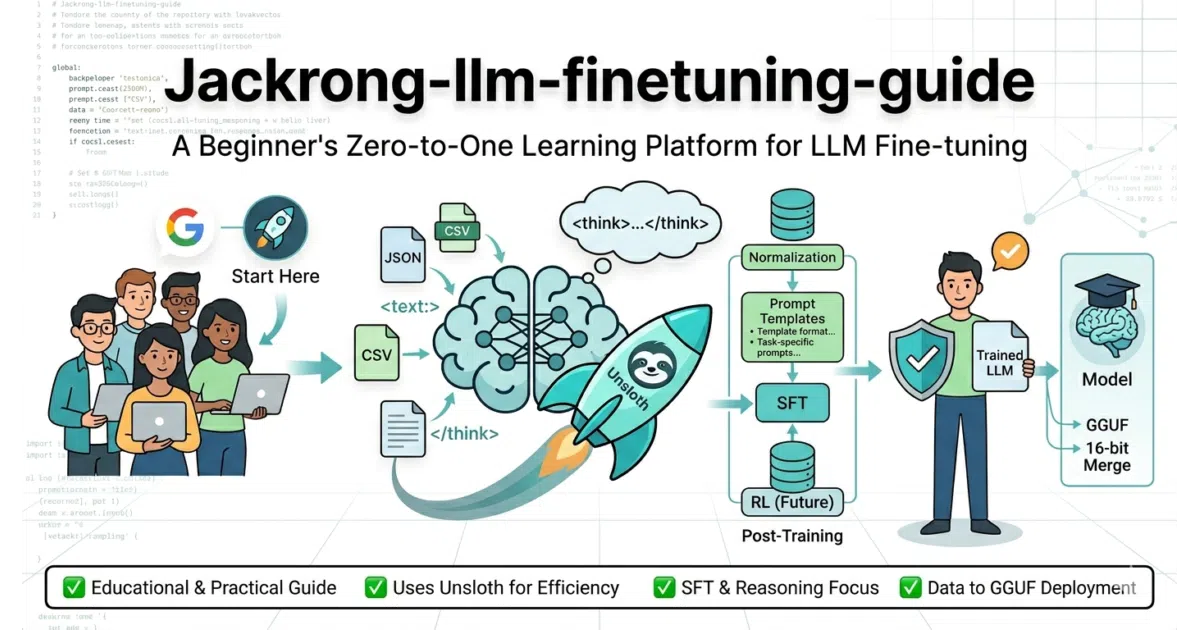
This repository is a curated educational portal for beginners and developers who want to train, adapt, and deploy large language models without expensive hardware. It bundles browser-ready Jupyter notebooks for Google Colab and Kaggle with Python scripts, data-processing recipes, and long-form PDF guides. The project covers the full lifecycle: dataset distillation, supervised fine-tuning with LoRA/QLoRA, reinforcement learning via GRPO and GSPO, and export to quantized GGUF formats for local inference.
The interesting bit
The standout is the qwen-mtp-gguf subproject, which turns Qwen’s Multi-Token Prediction speculative decoding into a staged, agent-ready release pipeline. It performs preflight checks on disk and RAM, extracts only the necessary MTP tensors, and automates conversion, smoke-testing, and quantized upload—designed so that coding agents can run the entire workflow unsupervised. That’s unusually rigorous for an educational repo.
Key highlights
- Browser-first training:
SFTandRLrecipes run in Colab and Kaggle without local GPU setup. - End-to-end scope: includes 24 curated high-fidelity datasets, distillation workflows, and
GGUFquantization. - Agent-ready MTP pipeline: automates Qwen speculative-decoding
GGUFconversion with preflight safety checks and resume-friendly uploads. - Multilingual documentation and long-form PDF guides for learners starting from zero.
- Open-source commitment: full training code for released Hugging Face models is preserved and reproducible.
Caveats
- Support for some popular model families (Qwen 3, Llama 3.1/3.3) is listed as scheduled but not yet released.
- The repository is a collection of guides and recipes rather than a unified framework or library, so expect to stitch pieces together.
Verdict
Worth bookmarking if you are a beginner or hobbyist who wants to move from “prompt engineering” to actually training models in the cloud for free. Pass if you are looking for a managed MLOps platform or a single pip-installable training framework.
Frequently asked
- What is R6410418/Jackrong-llm-finetuning-guide?
- An educational knowledge base that lowers the barrier to LLM fine-tuning, distillation, and local deployment using nothing more than a browser and free cloud GPUs.
- Is Jackrong-llm-finetuning-guide open source?
- Yes — R6410418/Jackrong-llm-finetuning-guide is open source, released under the Apache-2.0 license.
- What language is Jackrong-llm-finetuning-guide written in?
- R6410418/Jackrong-llm-finetuning-guide is primarily written in Jupyter Notebook.
- How popular is Jackrong-llm-finetuning-guide?
- R6410418/Jackrong-llm-finetuning-guide has 1.7k stars on GitHub.
- Where can I find Jackrong-llm-finetuning-guide?
- R6410418/Jackrong-llm-finetuning-guide is on GitHub at https://github.com/R6410418/Jackrong-llm-finetuning-guide.