PacktPublishing/LLM-Engineers-Handbook
An end-to-end LLM playbook with the infrastructure attached
Most LLM tutorials end with a trained model; this one continues through RAG, monitoring, and AWS deployment so you can see how the plumbing actually fits together.
Not currently ranked — collecting fresh signals.
star history
What it does
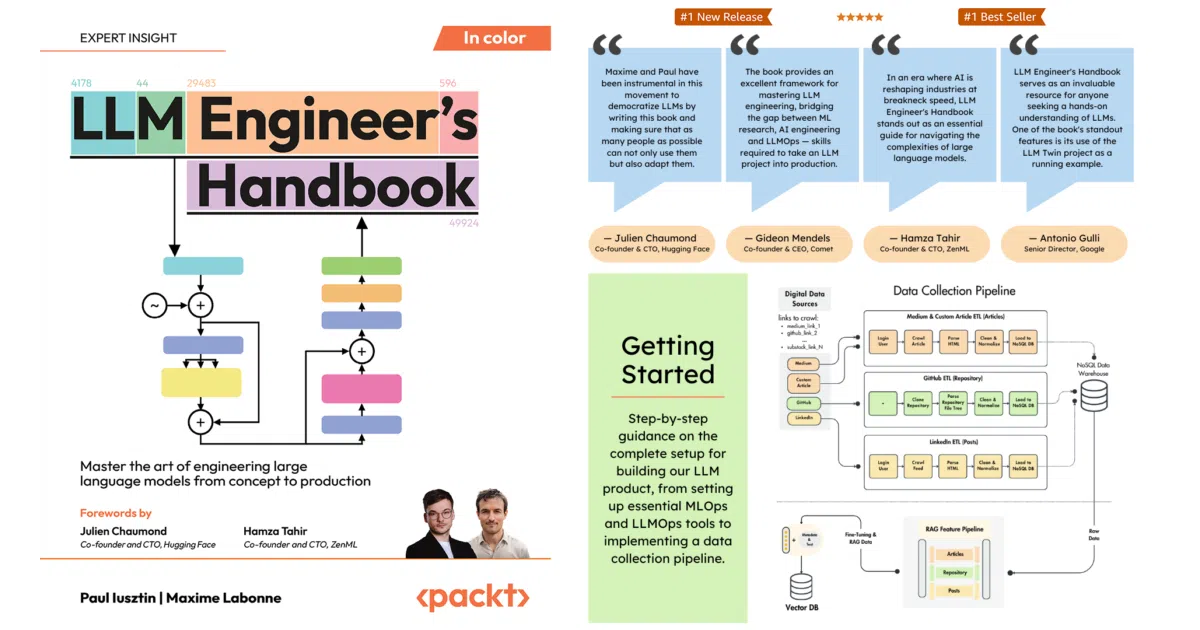
This is the official codebase for the LLM Engineer’s Handbook, a Python project that implements an end-to-end LLM system. It covers data collection and generation, model training, a RAG retrieval module, and deployment to AWS, all organized under a Domain-Driven Design layout. ZenML pipelines stitch the ML lifecycle together, while separate infrastructure layers handle external services like Qdrant, MongoDB, and FastAPI.
The interesting bit
The repo treats the boring parts as first-class citizens. Rather than leaving deployment as an exercise for the reader, it includes the wiring for experiment tracking with Comet ML, prompt monitoring with Opik, and a CI/CD pipeline via GitHub Actions. The README explicitly warns that the code is actively maintained and may contain updates not yet reflected in the printed book.
Key highlights
- Implements a full LLM training pipeline and a simple RAG system under a DDD-style package structure (
domain/,application/,infrastructure/,model/) - Uses ZenML to orchestrate reusable pipeline steps for data processing and model training
- Includes a trained reference model,
TwinLlama-3.1-8B-DPO, available on Hugging Face - Ships with utility scripts for inference (
ml_service.py), RAG retrieval (rag.py), and data warehouse export (data_warehouse.py) - Targets production AWS deployment with monitoring and evaluation frameworks built in
Caveats
- The dependency surface is wide: the README lists mandatory credentials for OpenAI, Hugging Face, Comet ML/Opik, AWS, MongoDB, and Qdrant, so a full local or cloud run requires significant external setup
- The README explicitly warns that the repository is actively maintained and may contain updates not reflected in the book, so readers should expect drift from the printed text
Verdict
Grab this if you are a developer who learns by dismantling working systems and wants to see how LLM training, RAG, and cloud deployment fit together under one roof. Skip it if you are looking for a lightweight, framework-agnostic tutorial; the ZenML and AWS coupling here is deliberate and substantial.
Frequently asked
- What is PacktPublishing/LLM-Engineers-Handbook?
- Most LLM tutorials end with a trained model; this one continues through RAG, monitoring, and AWS deployment so you can see how the plumbing actually fits together.
- Is LLM-Engineers-Handbook open source?
- Yes — PacktPublishing/LLM-Engineers-Handbook is open source, released under the MIT license.
- What language is LLM-Engineers-Handbook written in?
- PacktPublishing/LLM-Engineers-Handbook is primarily written in Python.
- How popular is LLM-Engineers-Handbook?
- PacktPublishing/LLM-Engineers-Handbook has 5.4k stars on GitHub.
- Where can I find LLM-Engineers-Handbook?
- PacktPublishing/LLM-Engineers-Handbook is on GitHub at https://github.com/PacktPublishing/LLM-Engineers-Handbook.