NandhaKishorM/laya
A decision engine that refuses to generate text
Laya exists to give multilingual documents a fast, deterministic decision layer without the latency and parsing drama of autoregressive models.
Collecting fresh signals — velocity needs a few days of history.
collecting data…
star history
What it does
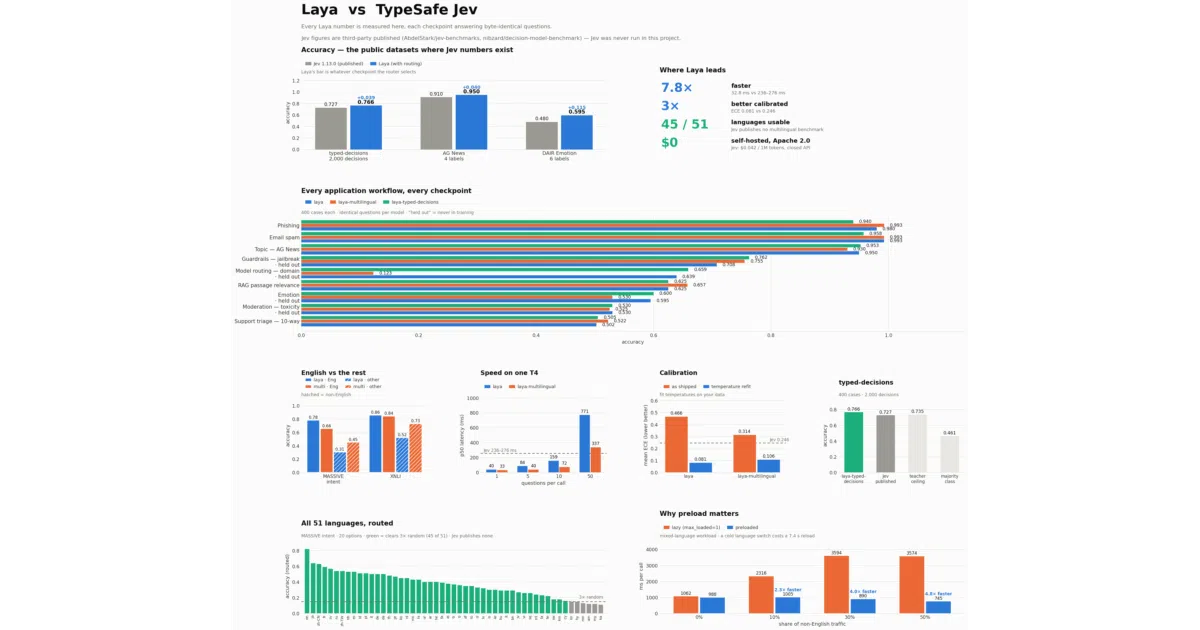
Laya is a non-autoregressive decision engine that answers typed questions—choice, score, and noul (yes/no)—over any text state such as emails, tickets, or JSON documents. It runs in a single encoder forward pass, clocked at roughly 33 ms per question on a T4 and 7.2 ms when batched. Because it never generates text, there is nothing to parse and no risk of hallucination. A built-in Router selects among three checkpoints—an English ModernBERT-large model, a 2×-faster mmBERT-base multilingual model for 100+ languages, and a dedicated typed-decisions variant—to match each request.
The interesting bit
The project treats fast “System 1” judgments as a routing and scoring problem, not a generation task. Its Router can batch heterogeneous requests that mix languages, question types, and target checkpoints into shared forward passes without changing the results, which is an unusual trick for a classifier stack.
Key highlights
- Single-pass typed decisions:
choice,score, andnoul. - Automatic per-request routing across three specialized checkpoints.
- ~33 ms per question on a T4; ~7.2 ms batched; cold-start loading down to ~2 s on CPU.
- The package defers PyTorch loading until inference runs, keeping lightweight processes slim.
- Optional fast paths via TileLang,
torch.compile, and ONNX Runtime, plus prediction hooks for audit, trace, cache, or redaction. - Ships with a self-hosted HTTP server, MCP server, LangChain/LangGraph integration, and a TypeScript client.
Caveats
- Checkpoints live on Hugging Face Hub and must be downloaded on first use; fully offline operation requires preloading.
- The
noulquestion type enforces stricttrue/falsecriteria keys, and malformed questions are rejected outright rather than silently fixed. - The 0.3.10–0.3.11 changelogs document fixes for MPS crashes, Windows Python 3.14 loading failures, calibration overfitting, and router misrouting of European text—most appear resolved, but the breadth of edge cases suggests a wide platform surface area.
Verdict
Use Laya when you need deterministic, low-latency classification or guardrails over multilingual documents without the prompt-engineering overhead of autoregressive models. Skip it if your task requires reasoning, creativity, or open-ended text generation—this engine decides, it does not compose.
Frequently asked
- What is NandhaKishorM/laya?
- Laya exists to give multilingual documents a fast, deterministic decision layer without the latency and parsing drama of autoregressive models.
- Is laya open source?
- Yes — NandhaKishorM/laya is open source, released under the Apache-2.0 license.
- What language is laya written in?
- NandhaKishorM/laya is primarily written in Python.
- How popular is laya?
- NandhaKishorM/laya has 20.6k stars on GitHub.
- Where can I find laya?
- NandhaKishorM/laya is on GitHub at https://github.com/NandhaKishorM/laya.