NandhaKishorM/laya · 26 Sep 2026 · Feature
System 1 at 33 Milliseconds: The Non-Autoregressive Bet Against Generative AI

Samantha Lowe
Staff Writer
Laya is a multilingual decision engine that trades text generation for typed, calibrated judgments in a single forward pass, targeting the latency and hallucination costs of routing work through large language models.
NandhaKishorM/laya
★24.7k stars
star history
The Hype Moment: When Classification Became Too Expensive
For the past three years, the default answer to any text-understanding problem has been to prompt a large language model. Need to route a support ticket? Ask GPT-4. Want to detect a jailbreak? Ask GPT-4. This works, but it is structurally wasteful: you are invoking a general-purpose text generator to perform a classification task, paying for token-by-token generation, accepting parse errors, and hoping the output is not a hallucinated label. Mainstream zero-shot classification pipelines, whether served through SageMaker JumpStart or integrated into GIS platforms, typically follow the same pattern: load a massive pretrained encoder, present text alongside candidate labels, and let the model generate scores [3][11]. The repository behind Laya arrives at a moment when engineering teams are realizing that “good enough” reasoning is often overkill, and that speed, cost, and determinism matter more than eloquence.
Non-autoregressive models are not new. They have spent years as a niche concern inside neural machine translation, where researchers traded translation quality for inference speed by generating entire sequences in parallel rather than token by token [2][10]. Academic surveys track their slow march through summarization, speech recognition, and grammatical error correction [2][4]. What Laya attempts is to drag this architecture out of the research lab and into production infrastructure: a fixed-set decision engine that renders judgments—choice, score, or yes/no probability—in the time it takes an LLM to emit its first token.
One Forward Pass, Nothing to Parse
The core technical premise is aggressively simple. Laya does not generate text. It encodes a state—an email body, a JSON document, a user prompt—and runs a single forward pass through a transformer encoder. A decision head then emits probabilities over predefined options. Because there is no autoregressive decoding loop, there is no sampling temperature, no repetition penalty, and no risk of the model inventing a label that does not exist in your schema.
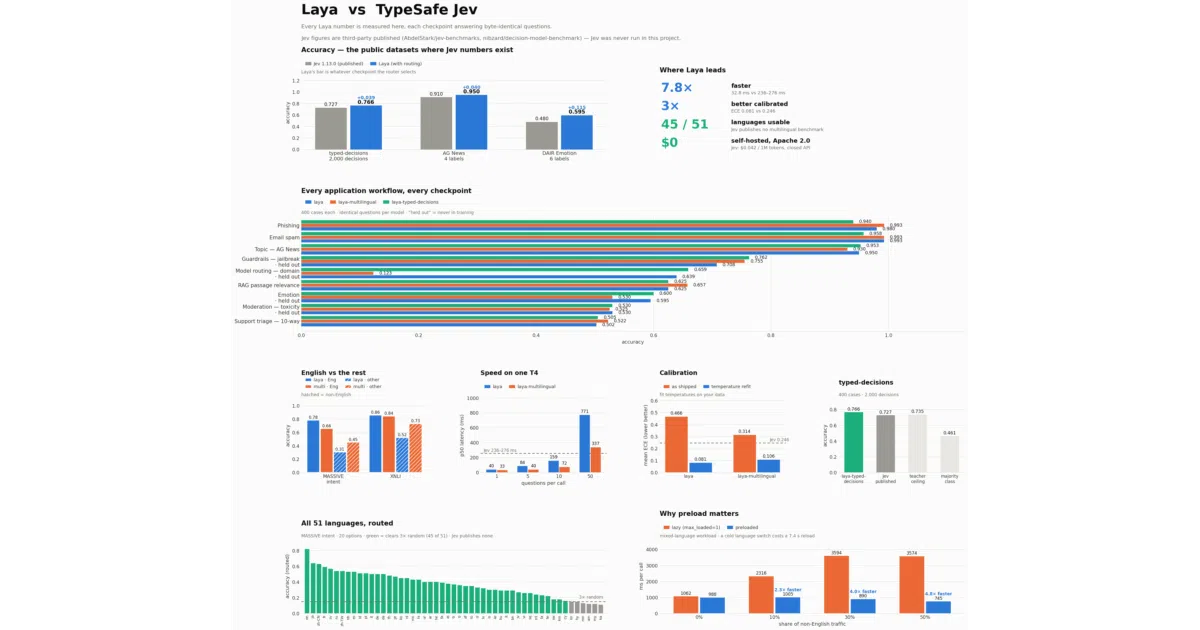
The project ships three checkpoints: an English model built on ModernBERT-large (421M parameters, 512-token context), a multilingual mmBERT-base variant (322M parameters, 1024-token context covering 100+ languages), and a specialized typed-decisions checkpoint also on ModernBERT-large. The English checkpoint answers one question in 39.5 ms on a T4 GPU; the multilingual variant manages 32.8 ms. Batched, the cost drops to 7.2 ms per question. These are not benchmark tricks; they are measured end-to-end latencies for a full prediction call.
This matters because the absence of generation is a feature, not a limitation. The output is structured by construction: a choice returns a top label with per-option probabilities and a confidence score; a score returns an expected value on an ordinal rubric; a noul returns a calibrated probability of a binary condition being true. There is no regex to post-process, no JSON mode to beg for, and no “sorry, as an AI language model” to filter out.
The Router as a Safety Mechanism
The most quietly important piece of the stack is not the model but the router. Laya’s built-in Router detects the script and language of incoming text in sub-millisecond pure Python, then dispatches to the appropriate checkpoint. This is not merely an optimization; it is a guardrail against a specific and dangerous failure mode.
The English checkpoint, when confronted with non-Latin scripts such as Khmer, achieves zero percent accuracy while expressing 95.2 percent confidence. Because the model is both wrong and certain, no downstream confidence threshold can save you. The multilingual checkpoint handles 45 of 51 tested languages at better than 3× random accuracy, but it is weaker on English. The router sits in front of both, forcing a routing decision before any forward pass occurs. On a shared benchmark of 17,416 questions, this routing preserves the English checkpoint’s 0.783 accuracy on English intent classification while automatically falling back to the multilingual model’s 0.451 accuracy on the same task for other languages—without the user manually specifying a language code.
The router keeps two checkpoints resident by default, so alternating between English and, say, Hindi does not trigger a model reload. For memory-constrained hosts, the eviction policy is configurable, though the documentation notes that forcing a single resident model can impose a 7-to-10-second reload penalty on every language switch.
Calibrated Confidence in an Overconfident Field
Laya’s training regimen is another departure from standard practice. The models are trained with reinforcement learning against strictly proper scoring rules—RLCD—rather than standard cross-entropy or human preference ranking. Proper scoring rules penalize miscalibrated probabilities directly; a model that is overconfident pays a cost in its reward signal. The result is that the confidence scores are statistically meaningful out of the box, or at least they are intended to be.
In practice, both base checkpoints ship over-confident. The documentation is admirably blunt about this: raw expected calibration error (ECE) starts at 0.466 for the English model and 0.314 for the multilingual one. Refitting one temperature per question type on held-out data brings these down to 0.081 and 0.106, respectively. Once calibrated, the engine supports automated confidence gating: if a routing decision scores above 0.85, automate it; below that, escalate to a human. This is a workflow primitive that LLMs struggle to offer reliably, because their logit distributions are not trained to be calibrated class probabilities.
The Open-Weights Gambit vs. TypeSafe Jev
Laya does not exist in a vacuum. It is positioned, sometimes explicitly, against TypeSafe Jev, a closed hosted API for similar typed-decision tasks. The comparisons are favorable where Laya wants them to be: roughly 6–7× faster on a single question (33 ms vs. 236–276 ms p50), Apache 2.0 weights versus a proprietary endpoint, and zero per-token hosting cost versus $0.042 per million tokens. On third-party benchmarks, the fine-tuned typed-decisions checkpoint edges out Jev’s published 0.727 accuracy with a 0.766 score, while simultaneously beating the teacher model’s self-agreement ceiling.
Yet the documentation is unusual in admitting exactly where the closed competitor wins. Jev handles high-cardinality label spaces—seventy-plus options—more gracefully because Laya’s decision head shares a fixed token budget between option descriptions and state context. At default settings, 77 options receive only three to four tokens each, causing accuracy to collapse. Jev also achieves higher soft-accuracy on distribution matching, and its raw calibration is better before temperature scaling. Laya’s response is architectural: users can raise the head budget at runtime, or use an embedding-based shortlist to pre-filter options. It is a pragmatic concession rather than a marketing dodge.
Honest Limits as a Feature
Perhaps the most striking section of the project’s documentation is titled “Honest limits.” It states plainly that the base checkpoints score near chance on typed-decisions without domain-specific fine-tuning—0.362 and 0.342 against a 0.318 random baseline. It warns that noul questions can follow their boolean labels rather than the state text on the English checkpoint, that the multilingual model carries a position bias on score questions, and that the action.act_probability signal is currently useless. This level of candor is rare in open-source AI releases, where repositories typically promise zero-shot superpowers and bury failure modes in issue trackers.
The implication is that Laya is not a magic classifier that replaces training data. It is a fast, structured base model meant to be fine-tuned. The provided Kaggle notebook runs the full loop—dataset construction, RLCD training, temperature fitting—in four to five hours on free 2×T4 GPUs. A worked example specializing the model for browser-agent element selection shows top-1 accuracy jumping from 0.10 zero-shot to 0.66 after domain adaptation, with real-task success rising to 62 percent at 17–23 ms per step.
Infrastructure, Not Oracles
Laya’s surrounding tooling suggests the authors understand that a model is only as good as its integration path. The repository exposes a Jev-compatible HTTP server, an MCP server for Claude Desktop and Cursor, LangChain and LangGraph nodes, a TypeScript package, and NixOS modules with hardened systemd units. There are prediction hooks for audit logging and PII redaction, heterogeneous batch routing that groups requests by checkpoint and question schema, and even a TileLang fast path that fuses kernels for GPU inference. These are the fittings of production infrastructure, not a research demo.
The broader significance is architectural. As the AI industry reckons with the cost of inference at scale, there is growing room for narrow, fast, non-generative models that handle the “System 1” work—routing, triage, guardrails, moderation—while reserving large language models for the “System 2” tasks that actually require reasoning and synthesis. Laya makes a specific bet: that most production decisions are typed, bounded, and multilingual, and that they should be solved by encoders making single forward passes rather than decoders writing essays. Whether that bet pays off depends on whether teams are willing to curate fine-tuning data and respect the documented limits. The engine is fast, but it does not pretend to be wise.
Sources
- Home - Laya Restaurant - Hollywood, CA
- A Survey on Non-Autoregressive Generation for Neural ...
- Zero-shot text classification with Amazon SageMaker ...
- Overview-of-Non-autoregressive-Applications
- Zero-Shot Text Classification
- LAYA
- Non-Autoregressive Models Hideout | by Peech
- Zero-shot text classification with knowledge resources ...
- L Λ Y Λ (@layaface) • Instagram photos and videos
- Non-Autoregressive Neural Machine Translation: A Call for ...
- Introduction to the model—ArcGIS AI models | Documentation