MaoXiaoYuZ/Long-Novel-GPT
A novel factory: AI writes books in assembly-line chunks
A Gradio app that breaks novel-writing into a conveyor belt of LLM calls—outline, chapter, prose—then parallelizes the whole thing.
Not currently ranked — collecting fresh signals.
star history
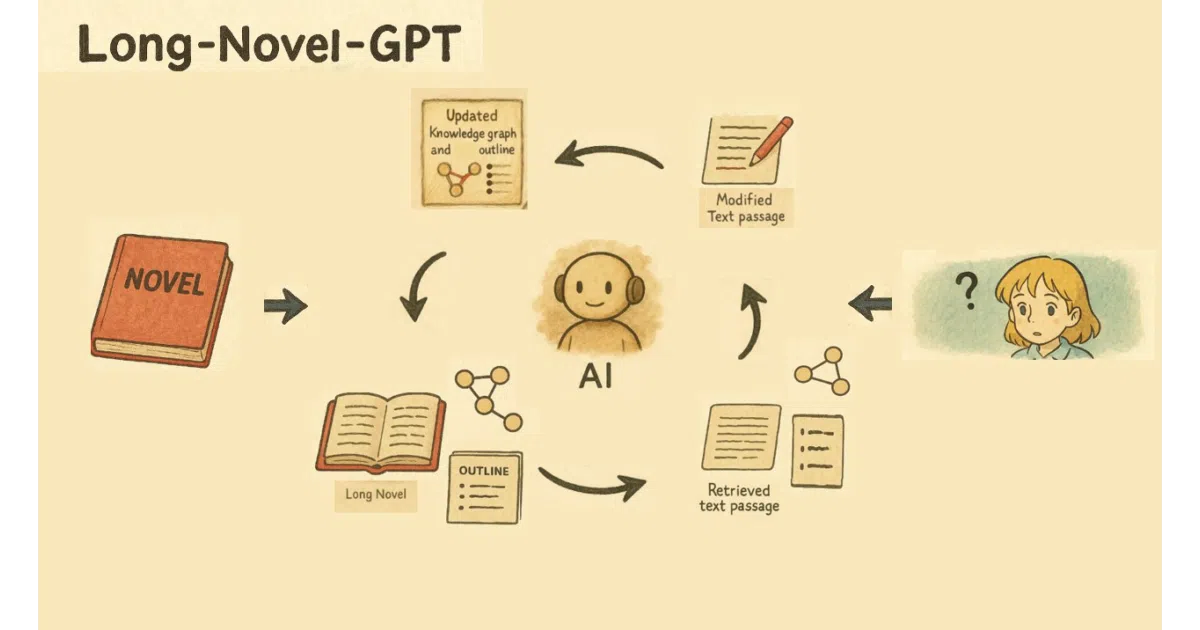
What it does Long-Novel-GPT is a Gradio-based agent that treats novel-writing like a top-down expansion tree. You start with an idea; it generates an outline, then chapters, then full prose. A RAG layer retrieves existing plot summaries and text fragments so the system can rewrite specific sections without losing continuity. It also ingests existing novels, extracts character relationships and plot arcs, and lets you edit from there.
The interesting bit The project openly embraces a factory-floor approach to creativity: it spawns up to 50 parallel threads to generate chapters simultaneously, then expands 200-word stubs into 2,000-word passages in two more passes. The README even does the math for you (50 × 2k = 100k words). It tracks API costs in real time, which is either prudent or quietly terrifying depending on your model provider.
Key highlights
- Top-down pipeline: outline → chapter stubs → full prose, with RAG retrieval at each step
- Parallel generation with configurable thread count; local deployment required for high concurrency
- Imports existing novels for continuation or rewriting
- Community prompt library includes style mimics (e.g., “天蚕土豆风格”)
- Docker one-liner deploy; supports local OpenAI-compatible endpoints
- Real-time cost display and automatic context window management
Caveats
- The “million-word novel” claim in the README actually describes a 100k-word output; the math is presented explicitly but the headline oversells
- “Contract-signing threshold” quality is the project’s own assessment; no external validation is cited
- One-click full-book generation is listed as a future goal, not current capability
Verdict Worth a look if you’re experimenting with AI-assisted fiction workflows or need a structured way to manage long-context generation. Skip it if you want polished prose out of the box—the tool is explicitly designed for supervised, iterative production.
Frequently asked
- What is MaoXiaoYuZ/Long-Novel-GPT?
- A Gradio app that breaks novel-writing into a conveyor belt of LLM calls—outline, chapter, prose—then parallelizes the whole thing.
- Is Long-Novel-GPT open source?
- Yes — MaoXiaoYuZ/Long-Novel-GPT is an open-source project tracked on heatdrop.
- What language is Long-Novel-GPT written in?
- MaoXiaoYuZ/Long-Novel-GPT is primarily written in Python.
- How popular is Long-Novel-GPT?
- MaoXiaoYuZ/Long-Novel-GPT has 1.2k stars on GitHub.
- Where can I find Long-Novel-GPT?
- MaoXiaoYuZ/Long-Novel-GPT is on GitHub at https://github.com/MaoXiaoYuZ/Long-Novel-GPT.