MakazhanAlpamys/Soup
Layer streaming: the 8B-model diet for 4 GB GPUs
Soup exists because fine-tuning LLMs shouldn't require a cloud budget, SSH, or a PhD in distributed systems.
Feature · 19 Aug 2026
Soup Makes Fine-Tuning a Bandwidth Problem, Not a Memory Crisis
A CLI tool built on a 4 GB laptop proves that frozen LLM weights can stream from host RAM one layer at a time, turning consumer hardware into viable training rigs—if you can live with the transfer bottleneck.
Read the in-depth article →
Velocity · 7d
+68
★ / day
Trend
↘cooling
star history
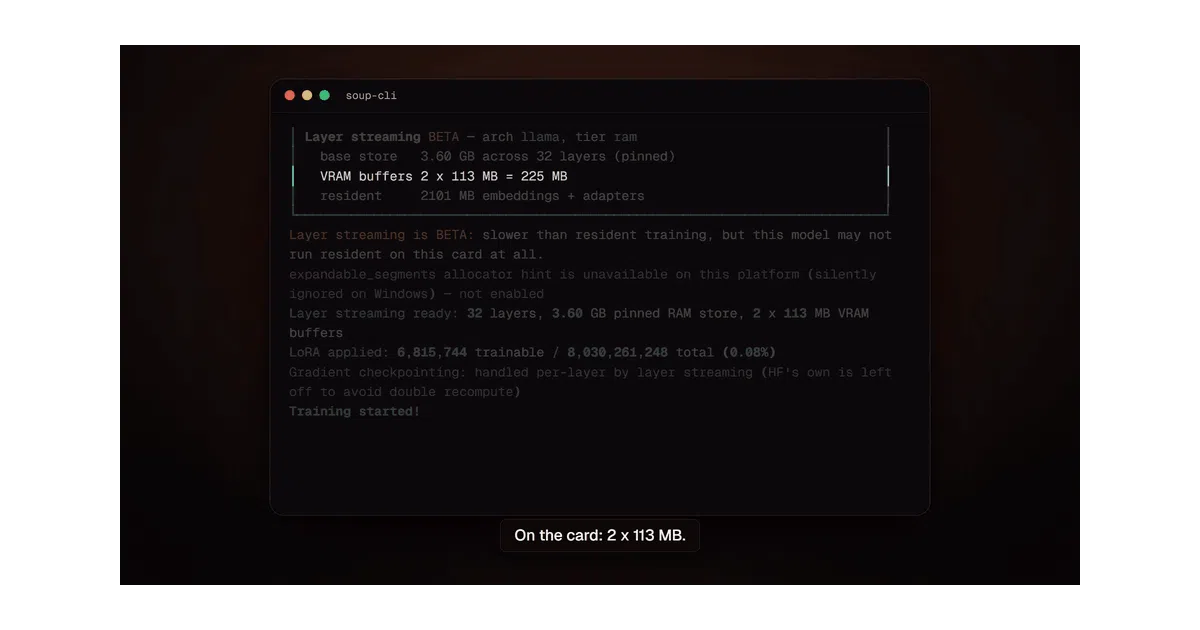
What it does Soup is a Python CLI that abstracts the usual PyTorch/Transformers/PEFT boilerplate into a single YAML file. It handles quantization, batch sizing, and GPU detection automatically, then trains LoRA adapters locally. The layer-streaming mode (beta) keeps the frozen base model in system RAM or on disk, feeding the GPU one decoder layer at a time so an 8B parameter model can train on a 4 GB consumer card.
The interesting bit
The author developed and measured everything on a 4 GB RTX 3050 laptop—then validated the same 3.32 GB peak memory and throughput on an H100, confirming the bottleneck is host-to-device transfer, not the GPU itself. That same validation run caught a silent gradient bug in bitsandbytes on 32B+ models that produced healthy-looking loss curves while computing wrong gradients.
Key highlights
- One YAML config drives SFT, DPO, ORPO, SimPO, KTO, and full fine-tuning (
lora.r: 0). - Layer streaming supports preference losses by reusing the same streamed base as a reference model, avoiding a second full copy in memory.
soup shipbundles offline regression suites (MCQ, arithmetic, tool-calling, JSON validity, safety) and can post SHIP / DON’T SHIP verdicts to PRs.soup reward synthgenerates deterministic Python reward functions from reference data, with a mandatory calibration report that rejects weak verifiers.- v0.73.0 fixed several broken distributed backends (DeepSpeed, SGLang, FSDP2) that had never actually executed a training run.
Caveats
- Layer streaming is explicitly beta, and the headline 119.6 tok/s figure was measured before a v0.73.0 correctness repair that cost ~4.8% throughput on larger models; it has not been re-benchmarked on the 4 GB card since.
- Python 3.13+ is blocked because PyTorch wheels can crash in native extensions before Soup even starts.
- Adapters trained with v0.72.0’s layer streaming were saved under broken
.inner.keys and are effectively inert; they need to be retrained or re-saved.
Verdict
Ideal for developers who want to fine-tune open models on local consumer hardware without wrestling with accelerate configs. If you are already running multi-node H100 clusters with hand-tuned DeepSpeed stages, this is probably too much abstraction.
Frequently asked
- What is MakazhanAlpamys/Soup?
- Soup exists because fine-tuning LLMs shouldn't require a cloud budget, SSH, or a PhD in distributed systems.
- Is Soup open source?
- Yes — MakazhanAlpamys/Soup is open source, released under the Apache-2.0 license.
- What language is Soup written in?
- MakazhanAlpamys/Soup is primarily written in Python.
- How popular is Soup?
- MakazhanAlpamys/Soup has 8.3k stars on GitHub and is currently cooling off.
- Where can I find Soup?
- MakazhanAlpamys/Soup is on GitHub at https://github.com/MakazhanAlpamys/Soup.