MakazhanAlpamys/Soup · 19 Aug 2026 · Feature
Soup Makes Fine-Tuning a Bandwidth Problem, Not a Memory Crisis

Patrick Donovan
Staff Writer
A CLI tool built on a 4 GB laptop proves that frozen LLM weights can stream from host RAM one layer at a time, turning consumer hardware into viable training rigs—if you can live with the transfer bottleneck.
MakazhanAlpamys/Soup
★8.3k stars Velocity · 7d +68 ★/day ↘cooling
star history
The 4-GB Laboratory
Makazhan Alpamys built Soup on a Windows laptop with an RTX 3050 and 4 GB of VRAM. In a field where fine-tuning a 7B parameter model is typically considered the territory of 24 GB consumer cards or cloud A100 clusters, this is either a stunt or a structural insight. The README insists it is the latter. Soup’s headline claim is that it can fine-tune an 8B model—specifically Llama-3.1-8B-Instruct with NF4 quantization—at 119.6 tok/s with a peak memory footprint of 3.32 GB, leaving actual headroom on a 4 GB card.
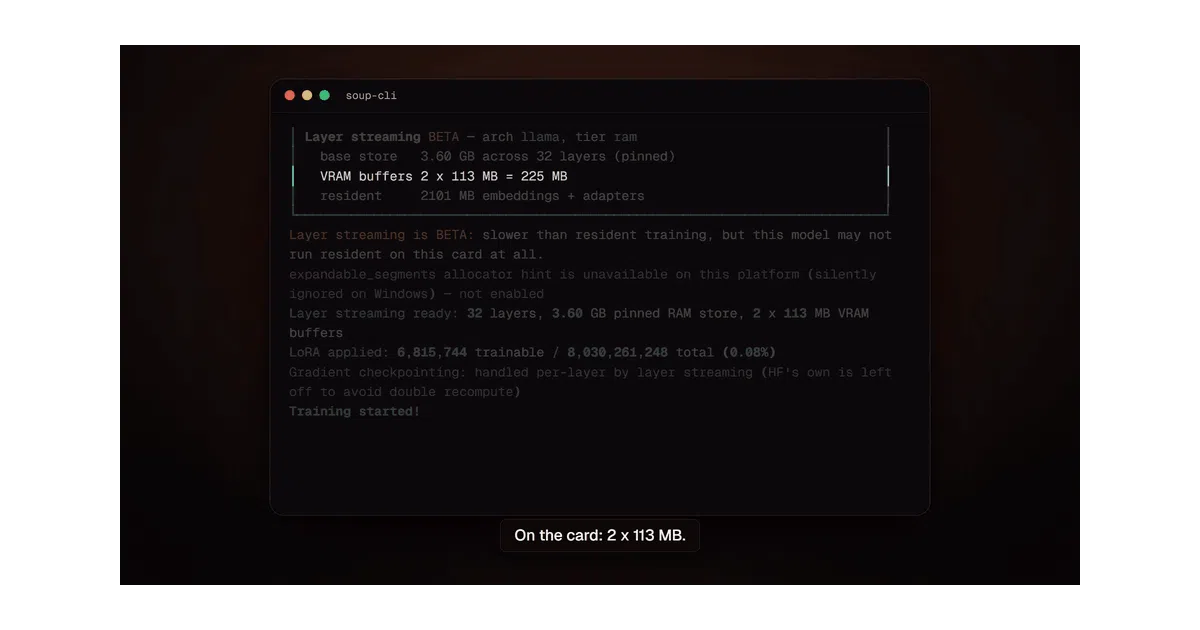
The trick is layer streaming, still marked BETA. Instead of keeping the entire frozen base model resident in VRAM, Soup pins the weights in host RAM (or on NVMe disk if RAM is scarce) and streams individual decoder layers to the GPU on demand. Only the active layer, the adapter gradients, and two small buffers live in video memory at any moment. The result is a training run that is bit-exact against a conventional resident execution, verified across five training subsets with a mean quality difference of +0.006 against a 0.013 within-arm spread. For practitioners who have watched training jobs die with NaN gradients and 0% GPU utilization on modest laptops, the proposition is immediately legible.
When the H100 Barely Beats the Laptop
The project’s credibility hinge is a three-day session on borrowed 8×H100 hardware in August 2026. Rather than using the cluster to scale to larger models, Alpamys used it to validate that the laptop numbers were not a hardware quirk. The H100 reproduced the same Llama-3.1-8B NF4 streamed run at a median 113.00 tok/s inside the same 3.32 GB peak.
This is the counter-intuitive core: the H100 is only marginally slower than the laptop because layer streaming is bound by host-to-device transfer bandwidth, not by GPU compute. The accelerator spends much of its time waiting on PCIe. In effect, Soup turns fine-tuning from a memory problem into a bandwidth problem. For anyone who has spent cycles estimating whether an RTX 2050 is adequate for even a 1.1B TinyLlama job, the reframe is welcome if slightly perverse.
That H100 session also served as a real correctness audit. On NF4 models above roughly 165 MiB per layer—meaning 32B parameters and up—bitsandbytes was keeping a weight reference invisible to gradient checkpointing. The forward pass remained exact, loss curves looked healthy, but the gradients were silently wrong. The fix, gated against controls on real 32B and 72B models, recovered exact gradient tensors (256/256 and 320/320 respectively) at a cost of roughly 4.8% and 3.7% throughput. Soup publishes the full measurement record, including rejected hypotheses and false positives, as a matter of policy. The preprint, versioned on Zenodo, doubled in length to carry these findings.
Not Just Glue, But Plumbing With Teeth
It would be easy to dismiss Soup as a thin CLI over HuggingFace, PEFT, and bitsandbytes. The YAML config and one-command interface certainly sit atop that stack, with optional backends for Unsloth, DeepSpeed, FSDP, and vLLM. But the layer streaming is a genuine mechanical displacement: it removes the need to rent a multi-GPU box for modest fine-tuning jobs. The README’s stated mission—“Never SSH into a broken GPU box again”—is aimed at the operational tax that consumes 30–50% of experienced teams’ time.
The project also enforces an unusual operational rigor. soup ship functions as a regression gate, running extraction-based scorers over offline suites for multiple-choice reasoning, arithmetic, tool-calling, JSON validity, and safety. A tune that wins on your custom task but breaks tool-calling gets a DON’T SHIP verdict, exit code 2, with evidence bound to the exact config that produced it. This is the kind of infrastructure glue that is rarely glamorous but frequently determines whether a fine-tuned model actually deploys or silently degrades in production.
Then there is soup reward synth, which points at a JSONL of reference outputs and infers a deterministic verifier, emitting a readable Python reward function only if it can actually distinguish good answers from bad ones across numeric, JSON schema, regex, and tool-call families. A mandatory calibration report acts as a moat against reward hacking. These are not features you find in a typical training wrapper; they are post-training infrastructure that acknowledges most real-world deployment failures are eval failures, not loss-curve failures.
The Honest Cost
Soup’s marketing is almost as interesting as its engineering. The README admits that v0.73.0 fixed four backends that had never actually run in production: accelerate multi-GPU parsing died because it handed the Python binary to every rank as source; DeepSpeed could not train a LoRA model on any stage; SGLang returned 500 on every generation; and use_fsdp2_compile wrote adapters that reloaded as all zeros. The vLLM backend, until recently, used a hand-rolled "User:/Assistant:" string instead of the model’s actual chat template, causing run-on loops that burned 200 tokens before the fix. These are not the confessions of a project trying to appear seamless; they are the receipts of a project that measures everything on a 4 GB laptop and knows exactly what breaks when it touches real hardware.
There are real limitations. Layer streaming currently excludes GRPO and PPO. DPO works, but because it needs a reference model, it reads the layer stack 1.52× per step—free in memory, expensive in time. The method is still BETA. Python 3.13+ is explicitly unsupported because untested PyTorch wheels crash in native extensions before Soup can even start. And while the pitch is “one command,” the reality is one YAML file, which is still configuration, merely less hellish than writing Python scripts.
Position in the Field
Other tools in this space take different tacks. LLMTools, the Cornell research library, pushes quantization to 2-bit precision via ModuLoRA and QUIP# to squeeze models into consumer VRAM. Soup stays at 4-bit NF4 but attacks the memory wall by eviction rather than compression. Industry guidance from Meta AI notes that parameter-efficient methods like LoRA and QLoRA sharply reduce memory requirements compared with full fine-tuning, which aligns with Soup’s approach, though Meta’s framing treats such methods as standard practice rather than a reason to abandon cloud instances. DigitalOcean’s hardware guidance confirms that a 13B model requires over 200 GB VRAM for full fine-tuning, necessitating multi-GPU A100 or H100 setups, while QLoRA can fit the same model on a 24 GB RTX 4090. Soup’s layer streaming effectively lowers that floor further, to the 4 GB laptop tier, by treating the GPU as a streaming processor rather than a resident owner of weights.
Meanwhile, the broader ecosystem is racing toward distillation and adapter-swapping as the 2026 paradigm, with claims of 10× cheaper inference by distilling large teachers into smaller students. Soup sits slightly orthogonal to this trend: it is not trying to make the model smaller, but to make the training hardware cheaper. It is a bet that the future of fine-tuning is not just efficient quantization or model merging, but re-architecting the training loop to respect the memory hierarchy of consumer hardware.
Outlook: Hardware-Gated Honesty
Soup’s sustainability model is unusual. The maintainer requests donations to buy GPU time for multi-GPU and Apple Silicon validation, but equally values contributors who run help wanted issues on hardware they already own. Features ship behind honest “requires ” gates rather than unverified claims. The preprint describing exact layer streaming is published on Zenodo with versioned DOIs, and the measurement notebooks include the failures and discarded numbers.
If layer streaming matures out of BETA, the implication is structural. Fine-tuning could become viable on any machine with sufficient RAM and a modest GPU, shifting the bottleneck from “how many A100s can I afford” to “how fast is my PCIe bus and how patient am I.” For a field that has spent years assuming training requires data-center residency, that is a genuinely different soup.
Sources
- 35+ Best Soup Recipes
- [D] Estimating hardware for finetuning LLM
- Anyone fine-tuning LLMs at work? What's your usecase? - Reddit
- 90 Best Soup Recipes
- Fine-tune a minimal LLM model with RTX 2050 GPU - Beginners
- 50x Faster Fine-Tuning in 10 Lines of YAML with Ludwig and Ray
- Soups List | Soupsandsups
- LLMTools: Run & Finetune LLMs on Consumer GPUs
- Fine-Tuning LLMs for Business: Complete Use Cases Guide
- 11 Cheap & EASY Soup Recipes Perfect for Winter | Simple ...
- GPU Options for Finetuning Large Models
- To fine-tune or not to fine-tune - Meta AI